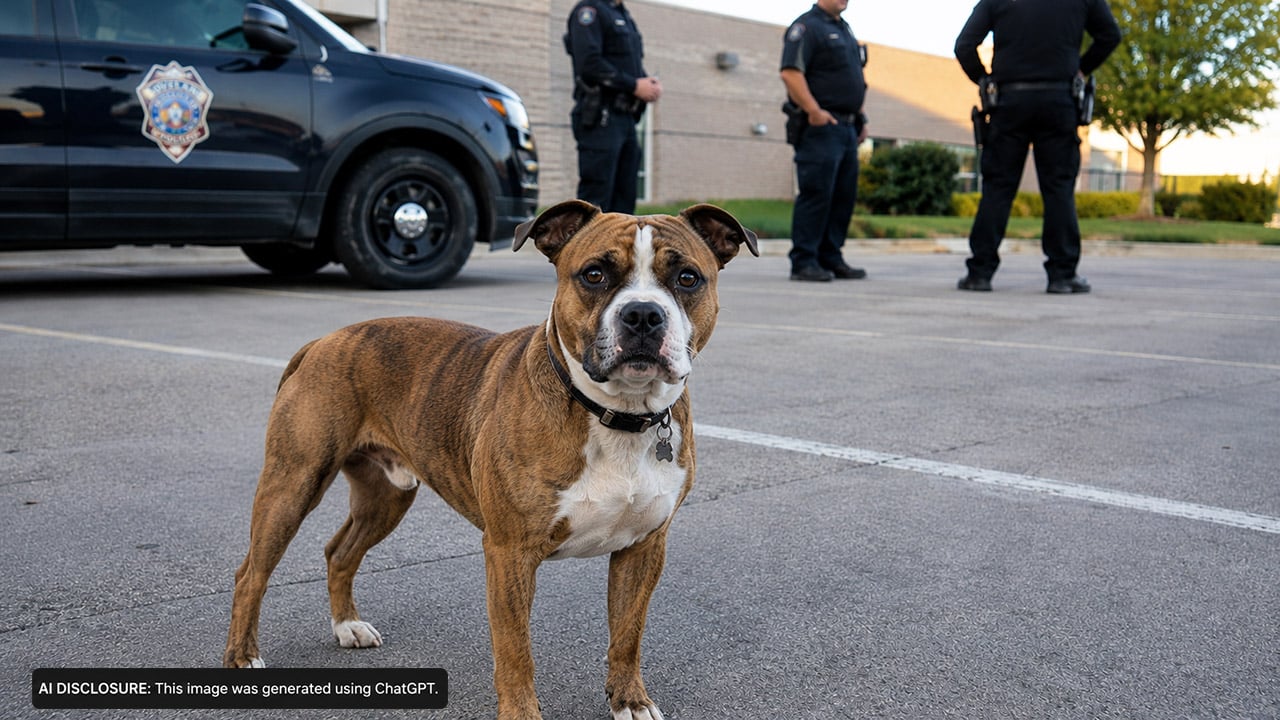
Photo credit: AI-generated image created using ChatGPT. Illustrative only
Most folks who run dogs—whether it’s a bird dog, a ranch mutt, or the family’s couch-hogging companion—know the feeling of a leash slipping or a door popping open at the wrong time. In a split second, you’re trying to get an animal back under control while a stranger decides what kind of situation they’re in.
That split second is at the center of a Loveland, Colorado settlement that’s now turning heads for its size and what it forces the police department to change. Details of the case and payout were reported in the source post, including body camera footage and the timeline that followed.
A routine call turned into a dog encounter in seconds
The incident happened June 29, 2019, when Loveland police officer Mat Grashorn responded to a call about a suspicious truck parked on commercial property. He found Wendy Love and Jay Hamm in the lot with three dogs. According to the lawsuit, the couple was making firewood deliveries and had stopped to give the dogs water.
Body cam footage released with the lawsuit shows the officer stepping out of his cruiser as one dog, Bubba, got up and ran toward him. The couple yelled for the dog to come back, and Bubba paused and turned back toward them. Then their 14-month-old dog, Herkimer—a Staffordshire terrier and boxer mix—jumped out of the truck and loped toward the officer with his tail wagging. Grashorn shot Herkimer.
The moments after the shot made everything worse
Anyone who’s had an animal hurt knows there’s an ugly instinct that kicks in: get to them, touch them, help them, do something. In this case, after the shooting, Grashorn refused to let the couple near their dog and ordered them back to their truck.
When Hamm demanded to know why the dog was shot, the officer yelled that he had “no way of knowing” whether Herkimer was friendly and that he “wasn’t in the business to get bit.” The lawsuit also alleged police wouldn’t allow the couple to retrieve Herkimer and take him to a veterinarian until a supervisor arrived.
Hamm was ticketed for having a “dangerous dog,” though that ticket was later dismissed by the district attorney. Herkimer died four days after being shot.
Loveland’s internal review called it justified—but the courts didn’t end it there
Loveland Police Department conducted an internal review and found the shooting justified. That’s a familiar pattern in officer-involved shootings, and it’s a big reason these cases don’t just fade out when the initial reports are written.
Love and Hamm filed a civil rights lawsuit in 2021, accusing Grashorn of recklessly killing their dog. The suit argued the shooting was an unreasonable seizure under the Fourth Amendment and violated their constitutional rights.
Grashorn tried to get out of the lawsuit under qualified immunity, which can shield government officials from civil liability if the violated right wasn’t “clearly established” at the time. But a federal judge ruled a jury could reasonably find Grashorn wasn’t in imminent danger when he shot the dog, and in 2025 the U.S. Court of Appeals for the 10th Circuit upheld that ruling.
A record settlement, plus recurring training requirements
Loveland has now agreed to pay $675,000 to end the lawsuit. The family’s attorney, Sarah Schielke, said it’s the largest settlement paid by a police department for a dog shooting case in Colorado history and among the largest in the country.
Along with the money, the settlement requires new recurring training for Loveland officers on how to deal with dogs. That matters because it’s the part that may actually change what happens the next time an officer steps out of a cruiser and sees an off-leash dog moving in their direction.
Schielke said in a press release, “For seven years, this family has been told by LPD’s chain of command that what Grashorn did was reasonable, was within policy, and required no changes. But today, the size of this long-awaited settlement and its terms prove otherwise.”
Why this matters to rural folks: dogs, discretion, and what “imminent danger” means
Out in the real world, dogs don’t read situations the way humans do. A dog can be loose, curious, and moving fast with a wagging tail, and it can still look like a threat to someone who doesn’t know dogs—or who’s been told to treat every unknown as a risk.
This case also created legal precedent. As a result of the rulings along the way, it’s now “clearly established,” in Colorado and other states under the 10th Circuit, that police may not shoot a dog in the absence of imminent danger. For gun owners and landowners, that’s an important line. It doesn’t remove risk from dog encounters, but it tightens the standard for when lethal force is considered lawful.
Loveland’s public relations team told CBS News Colorado the city and police department “remain committed to the continuous evaluation of policies, training, and practices intended to support public safety, transparency, and community trust.” The statement added: “The settlement totals $675,000 and includes updates to the Loveland Police Department’s dog encounter policy and training practices,” and that the agreement resolves the matter without trial, with the individuals agreeing not to pursue further legal action against the city and related entities.
Love said in a press release that she and Hamm are “hopeful that the amount of money the City’s finally had to pay sends a powerful message.” She added, “Protecting other dogs has always been [our] primary goal,” and said, “There will never be true justice for Herkimer so long as Grashorn remains employed as a police officer. But at least Herkimer’s legacy will be the significant changes his case brought about in federal law and to LPD training and policy.”
For anyone who keeps dogs around—especially folks who travel with them for work, hunting, or just life—this one is a hard reminder: when a stranger with a gun decides your dog is a threat, the window for a good outcome can be measured in heartbeats. Loveland’s payout is big, but the more important part may be what the courts and the training changes do to slow things down next time, before a “routine call” turns into a dead dog in a parking lot.
Like The Avid Outdoorsman’s content? Subscribe to our newsletter so you never miss an article.
Here’s more from us: