Photo credit: AI-generated image created using ChatGPT. Illustrative only
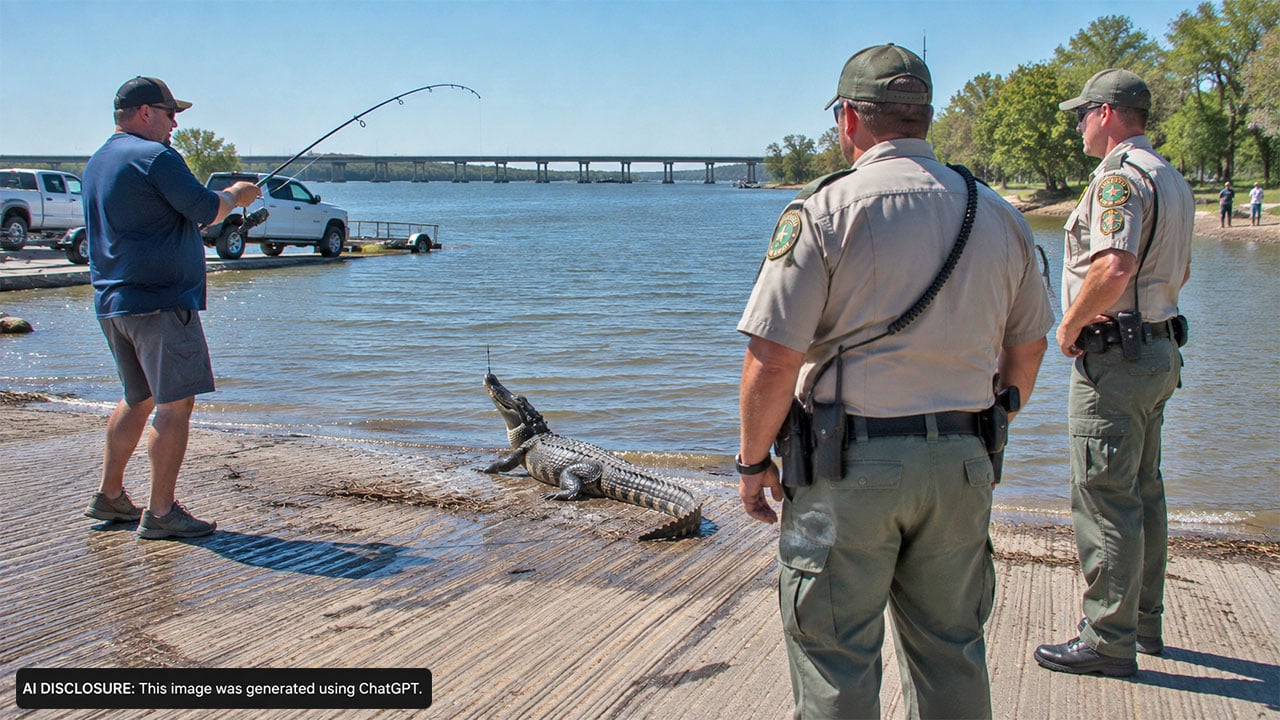
Most catfish trips are about waiting on a rod tip and keeping bait fresh. But on March 22 at Lake Arlington in Tarrant County, Texas, Mark Everett found out the hard way that sometimes what’s on the end of your line isn’t a fish at all—and what you do after the surprise matters just as much as the surprise itself.
Everett told reporters that he accidentally hooked an alligator while fishing and filmed the encounter. The details that got him in trouble, including what officials say happened onshore afterward, are laid out in the source post.
A catfish fight that turned into something else
Everett said the first sign something was wrong was how the line behaved—running around the boat and pulling it into circles. That’s not a blue cat digging for bottom. That’s a big, heavy animal doing whatever it wants.
He said he realized what it was and grabbed his camera. “The whole boat starts spinning around in circles. I said, ‘That’s a freaking alligator.’ So, I get my camera,” Everett said. “This is an unreal story, man. Nobody’s gonna believe that.”
Texas wardens say the catch wasn’t the violation
Texas Parks and Wildlife Department officials made a point that matters for every angler in gator country: unintentionally catching an alligator while fishing isn’t a violation by itself, as long as the animal is immediately released.
That “immediately released” part is the line in the sand. If a gator is hooked, the safest and smartest move is to create distance, cut the line if you need to, and let the animal go without turning it into a spectacle. Every extra minute you keep it involved is another minute you’re taking on risk—and another minute you’re drifting away from what the regulations expect.
What officials say happened next is why he was cited
According to the Texas Parks and Wildlife Department, game wardens investigated a report of an angler catching an alligator at Lake Arlington around midnight that day. Officials say the angler brought the alligator to shore to remove it from the fishing line.
From there, wardens say the situation shifted from “accidental hook-up” to “intentional contact.” Officials allege the angler livestreamed on social media for about two hours while feeding the animal and encouraging others to come take photos with it.
After the investigation, officials say citations were issued for illegal possession of an alligator, intentional feeding of a free-ranging alligator, and not having a hunter’s education certificate. Officials also said a warning was issued for hunting without a license.
Everett said he later released the alligator near where he caught it, but he was still surprised when the ticket and fine showed up. “It’s like some kind of video game, and that’s the only way I can explain it,” he said.
Feeding gators is where “cool video” turns into a safety problem
This is the part a lot of outdoorsmen already understand, but it’s worth saying plain: feeding predators is a quick way to make them problem animals. Texas wildlife officials warned that feeding alligators can cause them to become accustomed to humans and associate people with food, which increases the risk of dangerous encounters.
That risk doesn’t just land on the person doing the feeding, either. It lands on the next bank fisherman, the next family walking the shoreline, and the next kid skipping rocks. Once an alligator learns that people equal snacks, it starts showing up in places it shouldn’t, at times it shouldn’t, with a whole different level of boldness.
And from a nuts-and-bolts outdoors standpoint, there’s also the immediate danger: a gator on the bank with a crowd around it is a bad setup. You can’t “read” a wild animal like that with enough confidence to treat it like a photo prop. One lunge and it’s a life-changing injury, or worse.
What most hunters and anglers keyed in on: the “after” matters
Even without a comment section in the report, you can guess what experienced outdoors folks focus on when they hear a story like this. Not the accidental hook-up—because plenty of anglers have tied into turtles, gar, beavers, and yes, gators. It’s the decision-making after the fact.
Bringing the animal to shore, keeping it around, livestreaming for a long stretch, feeding it, and inviting others in close is the kind of chain of choices that turns an honest accident into a wardens-involved case. It also puts a spotlight on paperwork issues that might never have come up otherwise—like education requirements and licensing questions.
There’s also a bigger lesson for anyone who films their trips: cameras have a way of locking in timelines and actions. If something happens that’s questionable, the video doesn’t just make it memorable—it can make it measurable.
The simplest play when you hook a gator
Texas wildlife officials’ advice was straightforward: when you come face-to-face with an alligator, the best thing any fisherman can do is keep their distance. That’s good common sense whether you’re on a lake, a bayou, or a pond behind the house.
For anglers, that typically means ending the interaction as safely and quickly as possible. Don’t try to turn it into a show. Don’t try to “make friends.” Don’t feed it. Create space, protect your hands and feet, and get back to doing what you came to do.
Lake Arlington gave one fisherman a story he’ll never forget. But the ticket and fine are a reminder that when wildlife gets involved, the line between accident and violation can be crossed fast—usually the moment entertainment becomes encouragement.
Like The Avid Outdoorsman’s content? Subscribe to our newsletter so you never miss an article.
Here’s more from us: