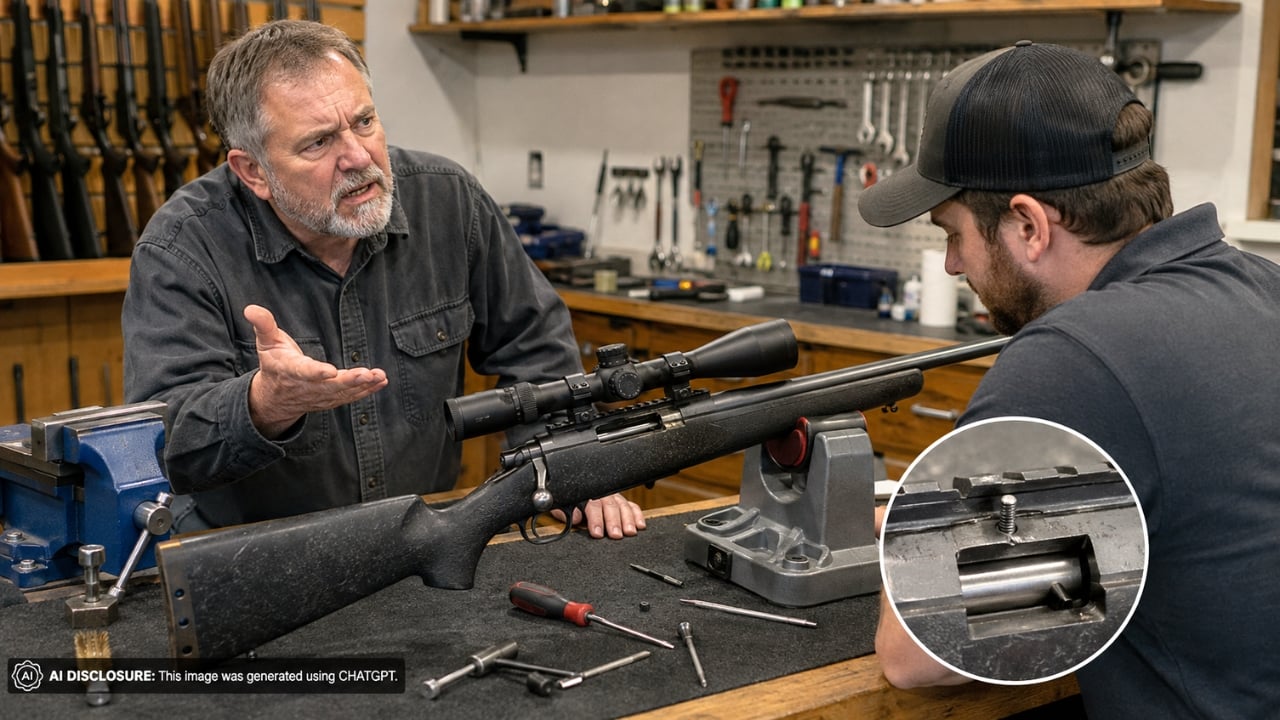
Photo credit: AI-generated image created using ChatGPT. Illustrative only
Most folks who’ve owned guns for any length of time have handed one across a counter and said, “Just mount the scope.” It sounds simple, until it isn’t. In a case shared in the original post, a Texas gun owner says a local shop’s scope job went bad enough to leave his rifle’s action rough and sticky—and the shop went quiet after promising to make it right.
The rifle in question was a bolt-action .22 that belonged to a family friend the owner calls “Bob.” It didn’t have sights, but it functioned fine. The plan was straightforward: pay the local shop about $50 to mount a scope, then get it back ready to shoot.
A basic scope install turned into real damage
After about two months, the shop returned the rifle. The owner admits he was excited and didn’t inspect it closely at the counter—something many of us have done when we’re eager to get home and see how a project turned out.
Once he got it out at home, the problems were obvious. The rails were installed crooked, and worse than that, the drilling went too deep. According to the post, the screws ended up catching on the bolt, making the action “very sticky.” That’s not just an annoyance; on a bolt gun, anything that interferes with smooth bolt travel can turn into feeding and function issues, and it can also chew up parts over time.
Crooked rails and bolt interference aren’t “close enough”
A canted rail isn’t just cosmetic. If your base isn’t square to the bore, you can run out of adjustment trying to zero, chase impacts across the paper, or end up with a scope that’s mechanically strained and never feels consistent. It’s the kind of mistake that shows up later as “my rifle won’t hold zero,” even though the real culprit is in the mounting.
The bolt interference is the bigger red flag. A screw protruding into the action area is the kind of thing that should never leave a bench. Even on a cheap rimfire, that’s workmanship that can create reliability problems at the range and frustration in the field when a quick follow-up shot matters.
The shop promised a replacement—then the updates stopped
After about a month, the owner and “Bob” were able to line up schedules and go speak with the gun shop owner in person. The owner says the shop seemed apologetic during that meeting. After some discussion, the shop owner agreed to reimburse the customer with a new .22 to replace the rifle they’d damaged.
The agreement, as described, was that the shop would contact the customer when they found a replacement rifle. They shook hands and left, expecting it wouldn’t take more than a month.
But when February came and there was still no call, the customer phoned the shop for an update. That’s where the tone shifted. The shop owner allegedly put him on hold with “just one moment,” then the customer heard him use the restroom—flush and all—while still on the phone, and then come back with, “son we have your number, I told you I would contact you when we found a replacement.”
Three months after the promise to replace the rifle, the customer says he still hadn’t heard anything from the shop.
Why this kind of delay matters to gun owners
Plenty of gun work takes time, and parts availability can be a real thing—especially if someone’s trying to match an older firearm, a certain model, or even just a specific price point. But long delays without communication are where customers get burned, because the longer a problem drags out, the harder it can be to get a clean resolution.
There’s also the reality that a lot of folks don’t have a safe full of duplicates. A .22 might be a trainer, a squirrel rifle, or just the gun you keep around for new shooters. When it’s sidelined for months over a bad scope mount, you’re not just out money—you’re losing range time and confidence in the shop that’s supposed to be the “local expert.”
And from a practical standpoint, if the shop still has the rifle or parts involved, you want a paper trail showing dates and what was agreed to. Handshakes are fine between friends. Between a customer and a business, you want something you can point to when the story changes.
What other shooters tend to focus on in situations like this
Even without seeing the comments, the themes that usually come up are predictable because most experienced gun owners have seen a version of this before. First: document everything. Take clear photos of the crooked rail, any visible screw protrusion, and any marks where the bolt is contacting hardware. Write down the dates the gun was dropped off, picked up, and when the replacement was promised.
Second: get the agreement in writing and keep communication simple. A calm, direct message—email if possible—summarizing what the shop agreed to do (“replace the rifle with a new .22”) and asking for a timeline forces clarity. Phone calls can turn into “he said, she said.” A written note is harder to brush off.
Third: don’t let the rifle bounce around. If it’s already damaged, the last thing you want is multiple shops drilling, tapping, and trying to “fix” the fix. At that point, you’re better off stopping the bleeding, documenting the condition, and deciding whether the original shop is going to replace it or pay for replacement value.
A few common-sense moves that often get results
The customer in the post worried that calling again would just irritate the shop and get him brushed off. That’s understandable, but silence almost never improves with time. A better approach is to show up in person during a calm part of the day and ask for the owner or manager, then politely request a firm date for resolution.
If the shop won’t commit, most gun owners will shift to formal, trackable communication: a dated letter or email that lays out the facts, the damage, and the promised replacement. Keep it plain, keep it factual, and keep copies. You’re not trying to pick a fight—you’re trying to close the loop.
And if the shop still refuses to follow through, the usual next step is to look at the options available for consumer disputes in your area. Folks often start with a demand letter and then consider small claims court if the amount is within the limit. The point isn’t revenge. It’s getting made whole when a paid service ruins a functioning rifle.
All of this can be avoided on the front end with one habit: inspect the work before you leave the counter. Cycle the bolt. Look down the rail. If something feels off, don’t take it home hoping it will “wear in.” A scope mount should never make a bolt sticky. When it does, it’s not a break-in issue—it’s a workmanship issue.
At the end of the day, the outdoors is hard enough on gear. A rifle shouldn’t come back from a “simple” scope install in worse shape than it arrived. When a shop makes a mistake, most folks can live with the mistake if the shop owns it and fixes it. It’s the long silence—and the lack of respect—that turns a bad job into a lesson you don’t forget.
Like The Avid Outdoorsman’s content? Be sure to follow us.
Here’s more from us: