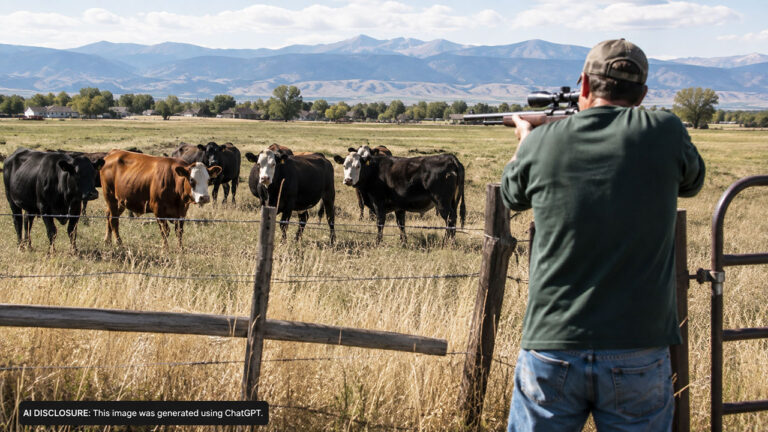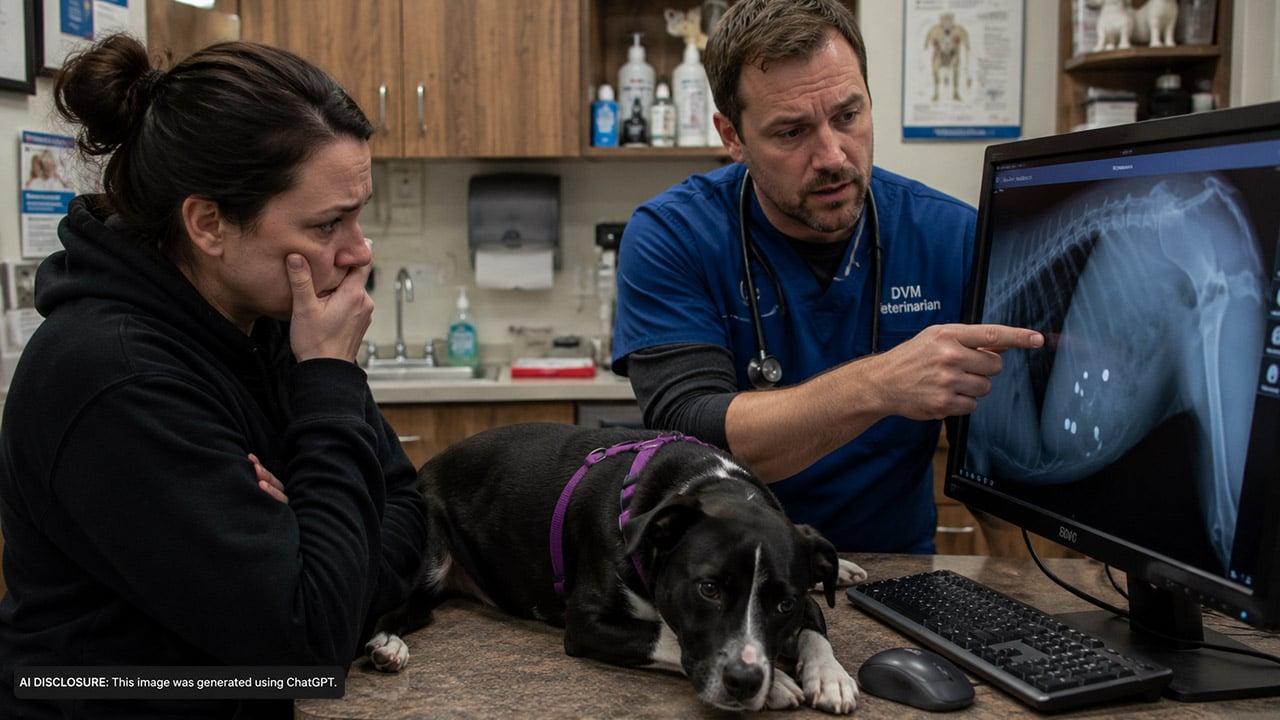
Photo credit: AI-generated image created using ChatGPT. Illustrative only
It’s one thing to take a dog in for a routine vet visit and walk out with a prescription. It’s another thing entirely to get handed an X-ray that shows your dog has been carrying around a pocketful of BBs.
That’s what happened to one woman who shared the original post after a vet took X-rays for an unrelated issue and spotted at least 10 BBs embedded in her adopted dog. She’s had the dog for five years, adopted her at around age 7, and only found out about the BBs now—raising a hard question for any rural landowner: did this happen long ago, or did it happen where they live today?
The X-ray turned a normal vet trip into a gut-check
The owner said the X-rays weren’t even meant to look for anything like this. The vet came back and explained that the dog had been shot with at least 10 BBs at some point in her past, to the point the owner described it as being used for target practice.
If you’ve spent time around farms, backyards with pellet guns, or rural properties where folks shoot for fun, you already know what makes this feel different: one BB is a “what happened here?” moment. Ten starts to look like a pattern.
A move to a 6-acre homestead added a new fear
The timeline is what has the owner rattled. She adopted the dog five years ago, and a year ago moved out of the city to a six-acre homestead specifically so the dog could have more freedom. She also noted the dog has never really gotten along with other dogs, which matters because a dog that doesn’t mix well can end up in barking matches at fence lines—exactly the kind of thing that can set off a bad neighbor.
Her worry is that the BBs might be new and that someone nearby has been taking shots at her dog. For any gun owner who takes safety and responsibility seriously, that’s not “a neighbor dispute.” That’s a serious allegation with real consequences.
Could BBs embed from 100–125 feet? Yes—depending on the setup
The owner’s key question was practical: the closest a neighbor could be and still have line-of-sight is about 100–125 feet. Would a BB from that distance penetrate and embed, or would it require closer range?
From an outdoorsman’s standpoint, the honest answer is that it depends on the gun and the BB. A typical BB gun can still put a small projectile into tissue at 100 feet under the wrong conditions—especially with higher-velocity airguns, a close-to-broadside angle, and thin hide. The BB doesn’t have to pass through to show up on an X-ray; it just has to get under the skin and stop.
That said, “can it happen?” and “is it likely?” aren’t the same thing. Distance, power, and angle all matter, and without knowing what was used or when it happened, you can’t pin the timing on the current neighbors just from range alone.
What makes the timing tough is that BBs can stay put for years
The reason this discovery hits so hard is because it’s invisible until you see the film. BBs and pellets can remain lodged for a long time if they don’t cause an infection, hit bone the wrong way, or migrate into something important. Some animals (and people) carry old shot for years and nobody knows until an X-ray is taken for something else.
In this case, the owner has had the dog for five years and only now learned about the BBs. That doesn’t prove the shooting is recent or old—it just tells you it happened at some point and wasn’t caught earlier.
And that’s what makes a rural situation like this so tricky: you can have a real problem and still not have a clean way to date it without more evidence.
The practical next steps are about safety, documentation, and preventing a repeat
When someone suspects a neighbor is shooting toward a dog—or anywhere on or near a residence—there are two tracks to think about: protecting the animal right now, and collecting the kind of information that stands up if this turns into a formal complaint.
On the immediate safety side, it may mean tightening up when the dog is outside, supervising yard time, and paying attention to where the dog tends to run or post up along a property line. If there’s a spot where you suspect line-of-sight from another property, don’t treat it like a normal part of the yard until you’re confident it’s safe.
On the documentation side, the owner already has a big piece: veterinary X-rays and a vet’s finding that there are at least 10 BBs present. That’s not a guess. If the owner believes the shooting is current, keeping records of dates, times, and any unusual sounds or activity around the property becomes important fast.
The goal isn’t to escalate. It’s to be able to say, calmly and clearly, “Here is what was found, here is what I observed, and here is why I’m concerned.”
A situation like this is a reminder of what “safe shooting” really means
Most of us learned early that you don’t point a gun at anything you don’t intend to shoot, you know your target, and you know what’s beyond it. Those rules don’t shrink just because the gun is “only” a BB gun or because someone is “only” messing around in the backyard.
If the owner’s fear is correct and someone took shots at a dog, that’s not target practice—it’s cruelty, and it’s reckless. Even a low-powered airgun projectile that won’t kill can still injure, infect, or blind an animal. And if a person is willing to shoot toward a neighbor’s property line, it’s fair to worry about where else those shots are going.
For rural folks who value good neighbor relationships, this is also a reminder to handle conflicts the right way. Don’t go looking for a confrontation. Get your facts together, protect your animals, and take the appropriate steps through proper channels if you believe a crime or dangerous behavior is happening.
The hardest part for the owner is that the X-ray answers one question—what’s in the dog—but doesn’t answer the one she really wants: when it happened. Until that’s clearer, the best move is to treat it as a safety problem first and a neighbor problem second.
Like The Avid Outdoorsman’s content? Subscribe to our newsletter so you never miss an article.
Here’s more from us: