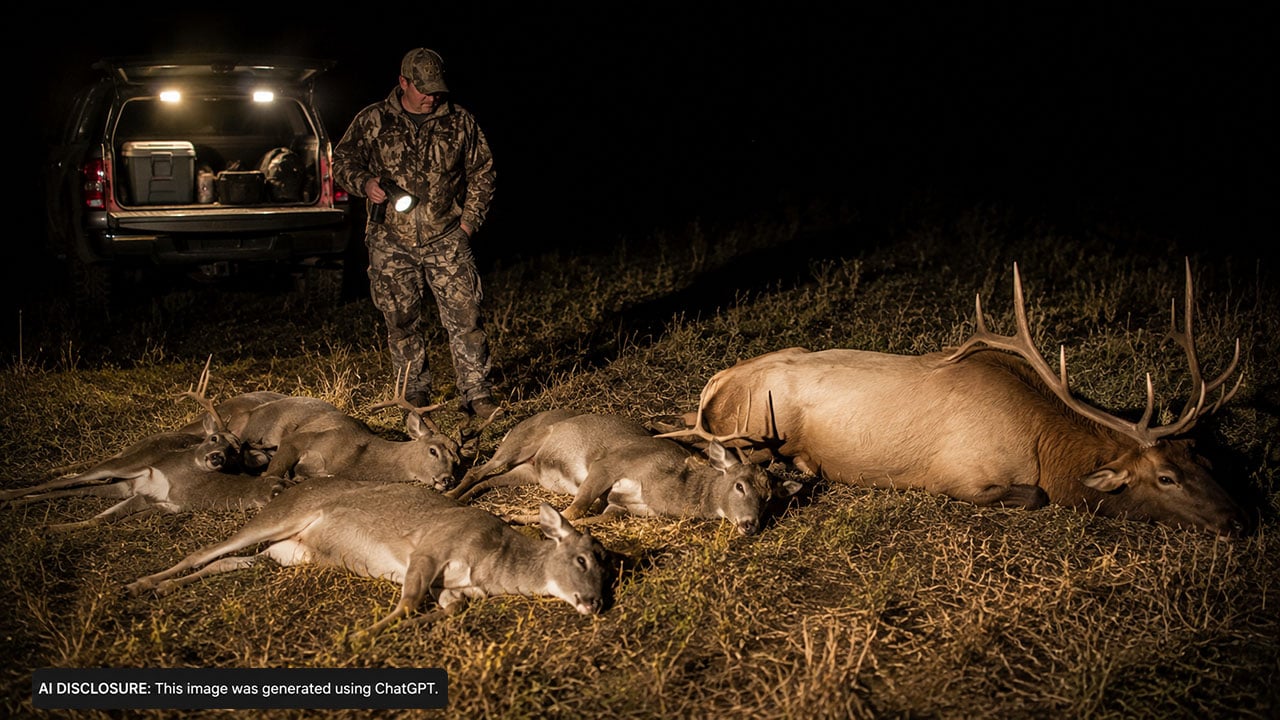
Photo credit: AI-generated image created using ChatGPT. Illustrative only
Most folks who spend time in the woods understand the unwritten contract: the resource is there for everyone, but only if we all play by the same rules. When somebody decides the rules don’t apply to them—especially after dark—every ethical hunter ends up wearing the stink.
Idaho Fish and Game says a Coeur d’Alene man has now been sentenced for unlawfully killing three white-tailed deer and an elk in North Idaho, all taken at night with the aid of artificial light. The agency laid out the details in the original post, along with a sentence that should get the attention of anyone who values their hunting privileges.
A case built around night kills and artificial light
From the information Idaho Fish and Game released, the core of this case wasn’t a gray-area tag mistake or an honest misread in the timber. The animals were killed at night, and artificial light was used to do it—exactly the kind of behavior that turns a hunting violation into something the public sees as straight-up poaching.
The man was originally charged in 2025 with two felony counts and four misdemeanor counts tied to the unlawful killing of multiple deer and one elk in 2024. Idaho Fish and Game conservation officers in the Panhandle Region conducted the investigation, and the case ran long enough that the sentencing didn’t wrap until March 6, 2026.
The penalties went way beyond a fine
When non-hunters hear “poaching,” they often assume it’s a slap-on-the-wrist ticket. That’s not what happened here. The sentence included $6,750 in restitution, along with various fines and court costs.
He also received up to five years in prison, though Fish and Game notes it was suspended. On top of that, he was sentenced to 60 days in county jail to be served immediately, four years of supervised felony probation, 200 hours of community service, and he must complete an in-person hunter education course.
Seventeen years without a hunting license is the part that hits home
If you’re a hunter, the money hurts, and jail time obviously changes your life. But the number that sticks out for a lot of outdoorsmen is the 17-year hunting license revocation. That’s nearly two decades of seasons missed—no deer camp, no quick evening sit, no taking a kid or a buddy out, no filling the freezer the right way.
And it’s more than missing out on a pastime. For plenty of rural families, hunting is part tradition and part grocery plan. Losing those privileges for 17 years is a long, long time to be on the outside looking in, especially in a state where opportunity is a big part of why people live there in the first place.
The public tip line played a role, and that matters
Fish and Game credited a call from the public to the Citizens Against Poaching (CAP) hotline as helping the investigation into the unlawful taking of the elk. That’s worth paying attention to, because most wildlife crimes don’t happen with a conservation officer parked right there watching.
In a lot of places, the public is the first line of defense—neighbors who hear shots at odd hours, landowners who notice spotlights sweeping fields, or folks who stumble onto a gut pile where it shouldn’t be. Idaho Fish and Game specifically thanked the public for staying vigilant and reminded people they can report potential wildlife crimes through the CAP hotline, by phone or online. They also noted that monetary rewards may be available when someone provides credible, detailed information that significantly helps identify suspects and leads to charges.
Why spotlighting game at night is more than “cheating”
There’s a reason night hunting big game with artificial light is treated seriously. It’s not just about fair chase, though that’s a big part of why most hunters can’t stand it. It’s also a safety problem.
When somebody’s shooting at night, visibility and target identification go downhill fast. The same light that freezes a deer can also wash out background detail, making it harder to know what’s beyond the animal. That’s how mistakes happen—shots in the wrong direction, houses and roads nearby, or someone else in the area who has no idea a poacher is working the dark.
Ethical hunters also know the ripple effect: one person’s night kills can sour access for everyone, make landowners clamp down, and give anti-hunting voices a real example to point at. That’s why cases like this draw a hard line. The resource belongs to the public, and the rules are what keep it from being taken by whoever is willing to break them.
Idaho Fish and Game also thanked the Kootenai County Prosecutor’s Office for pursuing charges consistent with the violations. That cooperation matters, because strong investigations don’t mean much if the case doesn’t hold up when it gets to the courtroom side of the house.
The clean takeaway for hunters is simple: if you’re doing it right, you’re not at risk from enforcement. But if you’re tempted to bend the rules—especially after dark—this is what it can turn into: restitution, jail, felony probation, and a hunting life put on hold for 17 years.
Like The Avid Outdoorsman’s content? Subscribe to our newsletter so you never miss an article.
Here’s more from us: