Photo credit: AI-generated image created using ChatGPT. Illustrative only.
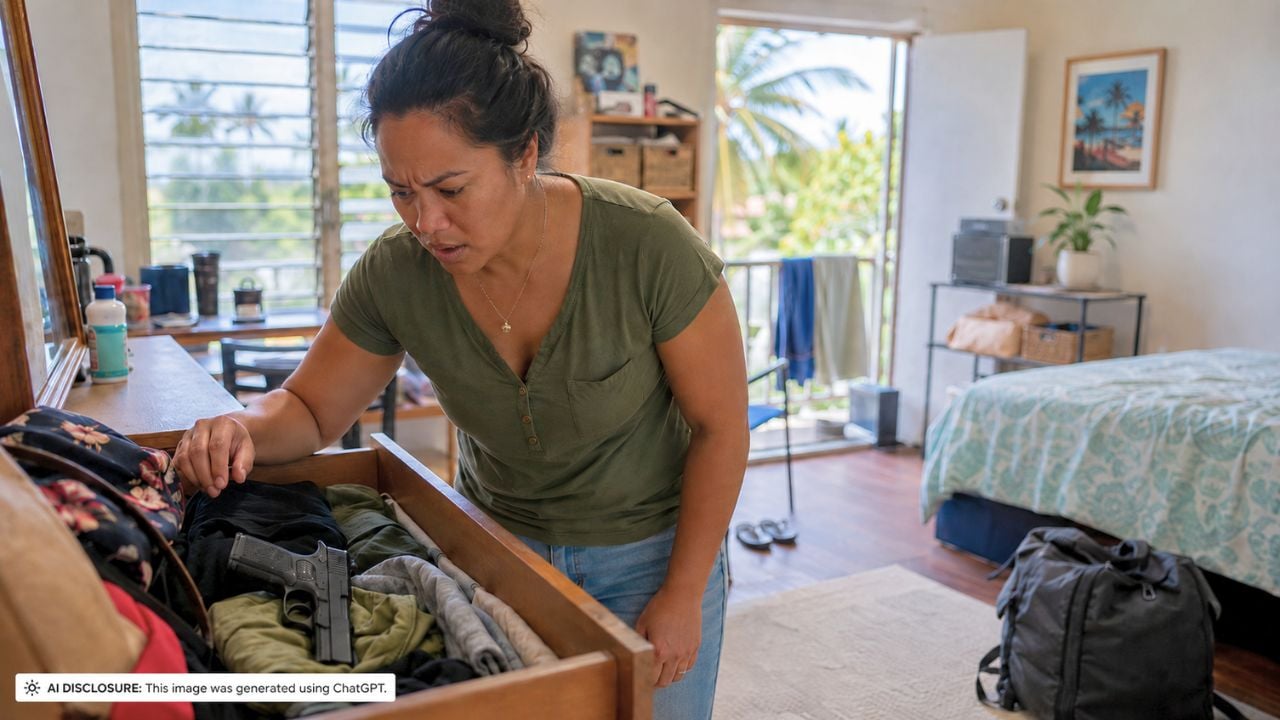
Living with roommates usually means arguing about dishes, parking spots, and who keeps cranking the AC. But one Honolulu resident found himself dealing with something that can wreck a lease—and potentially a career—fast: a handgun that never got registered after coming back from the mainland.
In the original post, the tenant laid out the worry plainly. His roommate returned from Florida with a pistol and, months later, still hadn’t registered it with the state. The poster wasn’t just thinking about a landlord finding it during a walkthrough; he was a year from separating from the military and didn’t want a roommate’s bad decision to cost him benefits.
How the gun came into the apartment raised immediate red flags
According to the tenant, the pistol was bought in Florida through a friend—bought by the friend, then “sold” to the roommate the same day—so the roommate could avoid taking a course and dealing with a waiting period. Even if you’re not a lawyer, that should set off alarms. Straw purchases and shortcuts are the kind of thing that turns a simple “paperwork problem” into a serious criminal issue.
For gun owners who try to do things right, that’s the part that hits hardest. It’s one thing to miss a deadline. It’s another to work around the system from the start, then bring the consequences home to everyone sharing the address.
Hawaii’s registration expectations were the core of the fear
The tenant said he believed Hawaii gives you “a few weeks” to register a firearm brought in from out of state, but the roommate had let it go for months. Whether that exact window is right or not, the bigger point is simple: Hawaii is not a “buy it and forget it” kind of place when it comes to handguns.
That matters for folks coming and going for military orders, seasonal work, or family reasons. A lot of outdoorsmen are used to states where your purchase paperwork is the end of the story, and the gun just goes in the safe until range day or hunting season. Hawaii plays by different rules, and deadlines don’t care if you’re busy unpacking.
The landlord angle made it feel like a trap
The poster’s landlord does occasional checks, and that’s where the situation stopped being theoretical. A landlord walkthrough is one of those moments where your home suddenly doesn’t feel private—especially in a shared apartment where one person’s gear, habits, or contraband can drag everyone else into a mess.
He worried the landlord could end the lease and even “charge us both” over the gun. Whether a landlord can actually “charge” someone in the criminal sense isn’t the point; the fear is realistic. A landlord can call law enforcement, can refuse to renew, can start eviction proceedings, and can create a paper trail that follows you. If you’re trying to keep your record clean before a military separation, that kind of heat is the last thing you want.
Can you get jammed up just for sharing the same roof?
This is the part that keeps responsible roommates awake at night: if a firearm is illegal or unregistered, does everyone in the apartment become a suspect? The tenant asked whether he could be charged “with his crimes” just because the pistol was in their apartment.
In the real world, the danger is less about some automatic “guilty by association” rule and more about what can be proven. If the gun is in a common area, if multiple people have access, if it’s not clearly controlled by one person, the situation gets muddy fast. Muddy situations are where innocent people spend money on lawyers and time trying to prove they had nothing to do with it.
Outdoorsmen understand this with trucks and gear: if you’ve got a buddy’s stuff in the back seat and it turns out he’s got something illegal in the bag, you may not get convicted for it—but you can still have the worst day of your year on the side of the road. Same idea under a shared lease.
The safety problem isn’t just legal—it’s practical
Even setting the law aside, an unregistered pistol brought in under questionable circumstances is a safety and responsibility problem. The poster didn’t describe storage, but the fact that the roommate is already cutting corners is what would bother most gun owners. Guys who ignore the easy legal steps often ignore the boring safety steps too—locking it up, keeping it secured from guests, keeping it out of the wrong hands.
And in an apartment, you don’t get to pretend a negligent discharge would only affect the person holding the gun. Neighbors are separated by drywall. Kids visit. Friends come over. Maintenance shows up. A “roommate gun” you don’t control is one of those problems that can go from quiet to catastrophic without warning.
What the tenant thought about reporting—and why that’s a heavy call
The tenant also asked if reporting his roommate would “absolve” him. That’s the sort of question you hear from people who are trying to do the right thing but don’t want to become collateral damage. Nobody wants to be the person who makes the call that blows up a living arrangement, especially when rent is high and moving is expensive.
But there’s a reason many gun owners preach a simple rule: don’t let someone else’s irresponsibility live in your home. If you’re not the owner, you can’t control how it’s stored, when it’s handled, who sees it, or what story gets told if something goes sideways. Reporting isn’t the only option in life, but pretending it’s not happening is usually the worst one.
From a practical standpoint, the cleanest path is often the boring one: create distance. That can mean pushing hard for the roommate to correct the issue immediately, changing living arrangements, or making sure the gun is not accessible to you and not in common spaces. The poster’s military timeline adds urgency—because even being questioned or wrapped up in an investigation can create headaches that last far longer than a lease.
This situation is a good reminder that “my roommate’s problem” doesn’t stay that way for long when the issue is a firearm with paperwork baggage. If you’re going to share a roof, you need more than matching sleep schedules—you need matching standards on legality, storage, and basic responsibility. When those don’t line up, it’s usually cheaper to fix it early than to fight it later.
Like The Avid Outdoorsman’s content? Subscribe to our newsletter so you never miss an article.
Here’s more from us: