Photo credit: AI-generated image created using CHATGPT. Illustrative only.
A 22-year-old Arizona tenant thought he was doing everything the right way: he inherited three handguns and a rifle after his dad passed, kept them locked in safes, and lived quietly in a shared townhouse with three roommates. For more than a year, nobody raised an issue—until a sudden phone call from his landlord changed the temperature in the house.
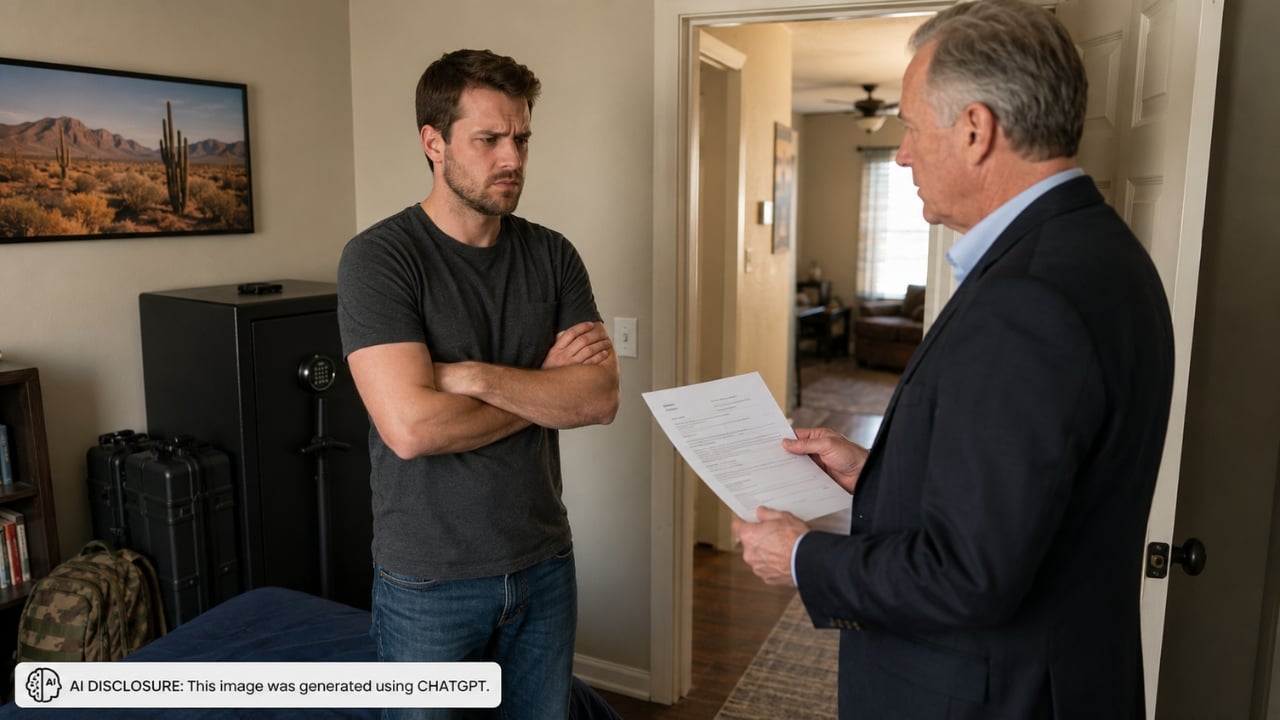
In the original post, the tenant says the landlord called “out of the blue” and told him it was “unacceptable” to have guns in the home. He was given a deadline—“until the end of the week”—to “get rid of them,” with no explanation offered beyond that.
A legal firearm, a locked safe, and a house that suddenly wasn’t comfortable
The tenant’s setup wasn’t unusual for a lot of outdoorsmen. He’s an adult, says he has a clean record, and says he’s the legal owner of the firearms in Arizona. The guns weren’t laying around the living room or tucked under a mattress—they were stored in safes, and he says everyone in the house had even gone shooting with him.
That detail matters, because the conflict wasn’t framed as a safety scare caused by careless handling. Instead, the tenant described it as a switch that flipped once the landlord “only found out this week,” despite the guns being in the home for over a year.
The roommate connection turned a quiet disagreement into a pressure point
The living arrangement has an extra wrinkle: one of the roommates is the landlord’s son. The tenant says the son had previously told him it was okay to keep firearms in the house and that he didn’t need to report them to the parents.
But by late summer, the tenant and that roommate weren’t on speaking terms. They were still living under the same roof, “respectfully,” but the relationship had gone cold. Not long after that, the landlord called with the demand to remove the firearms, which led the tenant to wonder if this was less about policy and more about leverage.
The lease didn’t mention firearms, and that’s where the argument started
If you’ve rented long enough, you know the first place to look is the paperwork. The tenant says he checked the rental agreement and lease and found “nowhere” that mentioned a no-firearms policy or even addressed weapons at all.
That’s what put him in a bind. On one hand, he didn’t want to lose the only tangible things he says he inherited from his dad. On the other hand, he didn’t want to get steamrolled by a “rule” that wasn’t in writing when he signed. The practical question he raised is one a lot of gun-owning tenants have asked: can a landlord just invent a new rule mid-lease and demand compliance immediately?
The landlord talked about an addendum, and the tenant started making a plan
After the initial call, the situation moved from tense to tactical. The tenant added an update saying the house held a roommate meeting. Two of the other roommates had his back, but the landlord claimed they were going to send an addendum adding a no-firearms policy.
Whether an addendum like that sticks can depend on the lease terms and whether both sides agree to it, but the tenant’s reaction was straightforward: he didn’t want to gamble his housing situation over a fight that could drag out. A church friend offered to store the guns, giving him a safe place to keep them while he looked for a new living arrangement.
His stated plan was to move at the end of the semester. He also said he intended to tell the landlord’s son that the pressure “made me sell the last remaining thing I have left of my late father.” That’s not a legal strategy—it’s a human one—and it shows how personal these disputes get when family heirlooms and Second Amendment rights collide with a roof over your head.
What people zeroed in on: storage, paperwork, and avoiding a blow-up
The tenant thanked commenters for “advice and knowledge,” and you can infer the themes from what he did next. He double-checked the lease, took the threat seriously, and lined up alternate storage rather than letting the guns become the match that lit the whole house on fire.
For gun owners, that’s the part worth paying attention to: even when you’re right on the facts—legal ownership, safe storage, no lease restriction—housing is still a power game. The person who controls the property can create stress fast, especially when family dynamics are involved. The smarter move is usually to protect your rights without escalating inside the home: keep everything locked up, communicate in writing where possible, and don’t give anyone an excuse to claim you were reckless or threatening.
And if you ever have to store firearms elsewhere during a dispute, treat that like you would any serious storage decision: keep them secured, make sure the arrangement is lawful where you live, and avoid casual “hand it to a buddy” decisions that create new problems.
At the end of the day, this wasn’t a story about somebody being careless with guns. It was about a tenant who says he handled his firearms responsibly, then found out how quickly a living situation can change when relationships sour and a landlord decides to press. He found a temporary solution—secure storage with a trusted friend—and set his sights on moving, which is often the cleanest way out when the home stops feeling like home.