Photo credit: Banana Ballistics/YouTube
Walk into any gun shop, and you’ll see the split plain as day. One rack holds bolt guns—tried-and-true, slow and steady. The other rack’s full of semi-autos, all rails and capacity. And everyone’s got an opinion. Some hunters won’t leave home without their bolt-action .308, while others are slinging AR-10s through the elk woods. Both get the job done in the right hands, but if you spend enough time in the field, you start to see where one starts pulling ahead. It’s not always about speed or tradition. Sometimes it’s about the stuff that doesn’t show up on a spec sheet. Here’s where it really shakes out.
A bolt gun still demands discipline
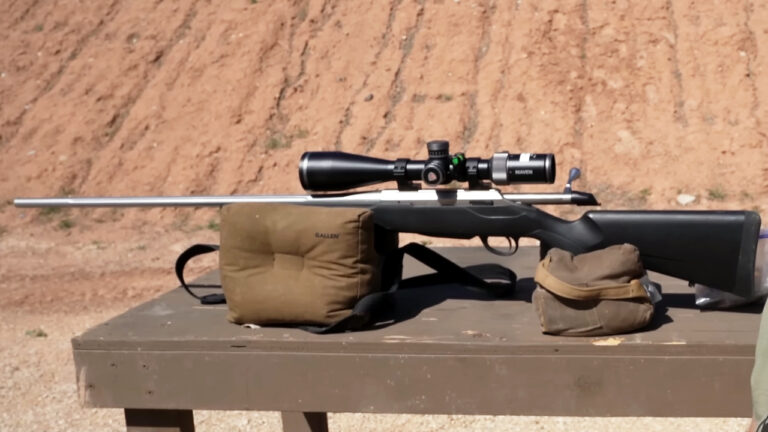
Bolt-actions make you slow down. That’s not always a bad thing. You pick your shot with more care because you know you’ve got to work the bolt before you get another. And in the mountains or woods, that often means making your one round count. A bolt gun makes you patient, and patient shooters wound less game. You also don’t blow through a box of $60 ammo in one sit. For guys who like to shoot tight groups and tighten their own screws, the bolt gun still teaches you something.
Semis win on second chances

That said, when the first shot doesn’t drop the animal—or you’re facing multiple hogs, coyotes, or even a charging bear—a fast second shot matters. Semi-autos bring follow-up speed that a bolt just can’t match. That doesn’t mean you spray and pray, but if you’re steady and trained, you can stay on target and cycle rounds with barely a shift in grip. In some terrain and scenarios, that speed isn’t optional—it’s what keeps you in the game.
Accuracy used to be the bolt gun’s edge
Years ago, if you wanted tight groups past 300 yards, it had to be a bolt-action. But that’s changing. Good semis—especially in 6.5 Creedmoor, .308, or even .223 Wylde—can shoot sub-MOA with the right load. Triggers are better. Barrels are better. Platforms are stiffer. No, your average factory AR still won’t outshoot a well-set-up bolt, but we’re not living in 1987 anymore. The gap is shrinking, and fast.
Weight and bulk still go to the bolt

Every ounce counts in the backcountry, and most bolt guns are still lighter, cleaner, and easier to sling. They don’t need buffer tubes, charging handles, or all the extras. That makes a difference when you’re hiking elevation or crawling into a blind. There’s less to snag, less to clean, and fewer parts to gum up with mud. For backwoods hunting, a stripped-down bolt-action still punches above its weight.
Magazine capacity favors the semi
Let’s not dance around it—having 10, 20, or 30 rounds on tap changes how you approach the shot. If you’re hog hunting at night or chasing predators, a bolt gun’s three to five shots can feel like a limitation. And while you might never need 15 rounds for a whitetail, there are real-world field uses where that capacity pays off. Semi-autos offer options, and that flexibility is something more and more hunters are getting used to.
Reliability depends on the conditions

A good bolt gun will run in anything. Sand, snow, rain—slam it shut and it’ll go bang. Semi-autos aren’t unreliable, but they need maintenance. Dirty gas systems and fouled bolts can lock one up at the worst time. In miserable conditions, fewer moving parts matter. That’s why guides in Alaska, guys hunting the Rockies, and old-school trackers often lean on their bolts. It’s not sentiment—it’s earned trust.
Hunting laws and attitudes still shape the choice
In some states, semi-autos are still restricted for hunting certain game. Even where they’re legal, some folks look sideways when you show up to camp with one. That’s changing, slowly, but the bolt gun still carries that cultural weight. It’s not always fair, but if you’re trying to keep the peace or stay compliant, it’s something to think about. The rifle you bring can say as much about you as your camo or your tag.
Like The Avid Outdoorsman’s content? Be sure to follow us.
Here’s more from us:
The worst deer rifles money can buy
Sidearms That Belong in the Safe — Not Your Belt
*This article was developed with AI-powered tools and has been carefully reviewed by our editors.