Photo credit: The Avid Outdoorsman
The carrier noticed something most people probably would have missed.
A gun.
Not his gun. Someone else’s.
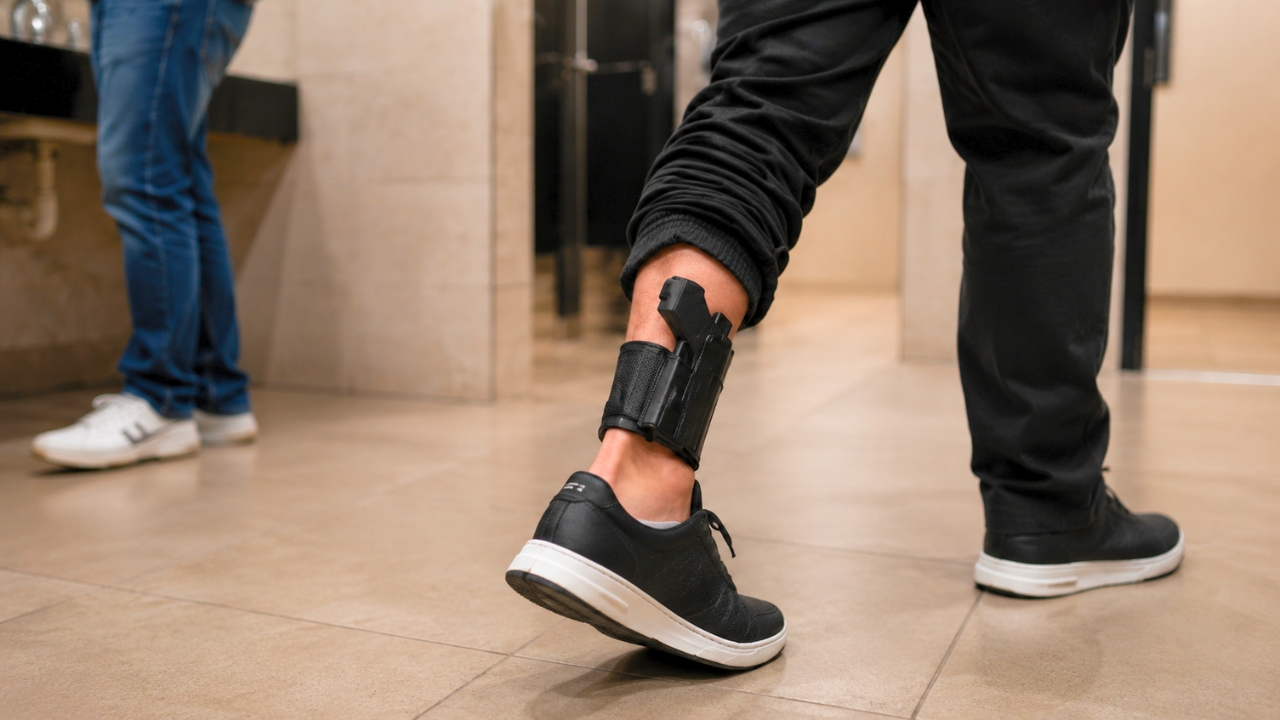
In a Reddit thread, concealed carriers were talking about times they had been called out for printing or accidentally exposing a firearm. One story involved a man whose ankle-carried gun was visible or snagged after a bathroom break, leaving another carrier in that awkward spot where he had to decide whether to say something.
That is a weird moment.
Because on one hand, it is none of your business. A stranger’s carry method, clothing, and concealment are not usually something you want to comment on in public. Nobody likes being approached by a random person and told, “Hey, I can see your gun.” That can feel intrusive, embarrassing, or even threatening if it is handled badly.
On the other hand, if someone’s gun is exposed, snagged, loose, or drawing attention, ignoring it may not be the best move either.
Ankle carry already has its own set of problems. It can work for backup guns or certain clothing situations, but it is also easy to expose at the wrong time. Pants ride up when sitting. A pant leg can catch on the grip. A bathroom break can leave fabric bunched or snagged. When the person stands back up, the gun may stay visible without him realizing it.
That seems to be the issue here.
The man carrying may have gone into the restroom fully concealed and walked out with his ankle rig showing. To him, nothing felt different. He may have adjusted his clothes, washed his hands, and gone on with his day. But to someone looking from the outside, the gun was no longer hidden.
And that matters.
A visible ankle gun can create problems quickly. Someone may panic. Someone may call security. Someone may call police. Someone with bad intentions may notice it. A kid may point it out. A store employee may ask him to leave. The carrier himself may have no idea any of that is possible because he thinks everything is still covered.
That is why warning him could be the helpful thing to do.
But it has to be done carefully.
You do not want to loudly announce, “Your gun is showing!” across a restroom or store. That defeats the whole purpose and may make the situation worse. You also do not want to walk up too aggressively, reach toward him, point at the gun, or use language that makes people nearby think there is an immediate threat.
The best approach would be quiet, calm, and short.
Something like, “Hey man, your pant leg is caught on your ankle holster,” said low enough that only he hears it. No lecture. No debate. No weird interrogation about whether he has a permit. Just the information he needs to fix it.
That is the balance.
Carriers tend to notice other carriers. Clips, printing, shirt movement, stiff posture, ankle bulges, pocket shapes — once you know what to look for, you see more than the average person does. But noticing does not mean you should always insert yourself. Sometimes it is just a faint print nobody else will care about. Sometimes it is a clear exposure that could become a problem.
This sounds like the second category.
The bathroom angle makes it even more understandable. Bathrooms are where concealment often fails because clothing gets shifted in ways the carrier may not fully check afterward. A holster can move. A shirt can tuck behind a grip. A belt can twist. A pant leg can hang on an ankle rig. The person may walk out feeling normal while the gun is visible enough for another trained eye to catch.
That is why a post-restroom check matters.
Before leaving the stall or restroom, a carrier should make sure everything is back where it belongs. Shirt down. Belt set. Holster covered. Pant leg clear. Spare mag in place. Nothing exposed, nothing hanging, nothing shifted. It takes a few seconds and prevents exactly this kind of awkward public moment.
The man with the ankle gun likely did not mean to expose it. Most carriers do not. He just missed a clothing issue after a normal bathroom break.
That is how a lot of concealment failures happen.
Not because someone is careless in a dramatic way, but because real life moves clothing around. Sitting, standing, reaching, bending, using the restroom, getting in and out of cars — all of it tests the carry setup. If the method depends on a pant leg staying perfectly positioned all day, the carrier needs to check it regularly.
Especially after the bathroom.
The other carrier’s dilemma was the interesting part. Say something and risk an awkward exchange, or say nothing and let the man keep walking around exposed. There is no perfect answer, but if the gun is truly visible, a discreet warning is probably the decent move.
Responsible carriers should want to know.
Nobody wants to find out from a manager, police officer, or panicked stranger that their concealed gun has been showing for the last 20 minutes.
A quiet heads-up from someone who understands the issue is embarrassing for five seconds.
The alternative can be a lot worse.
Commenters mostly agreed that if a firearm is clearly exposed, a quiet warning is usually the right call.
Several people said they would want another carrier to tell them if their gun was showing. It may be embarrassing, but it is better than walking around unaware and risking a bigger scene.
Others warned that the delivery matters. Do not announce it loudly, do not point dramatically, and do not touch the person or the gun. Keep it calm, discreet, and simple.
A lot of commenters focused on bathroom checks. After using the restroom, carriers need to make sure shirts, belts, pant legs, and holsters are back in place before stepping out into public.
Some also pointed out that ankle carry is especially easy to expose when pants ride up or snag. It can work, but it needs more attention than people expect.
The main takeaway was simple: concealed means concealed, and if another responsible carrier quietly helps you keep it that way, that is probably a favor.