Photo credit: The Avid Outdoorsman
It started as the kind of quick walk you don’t expect to remember later.
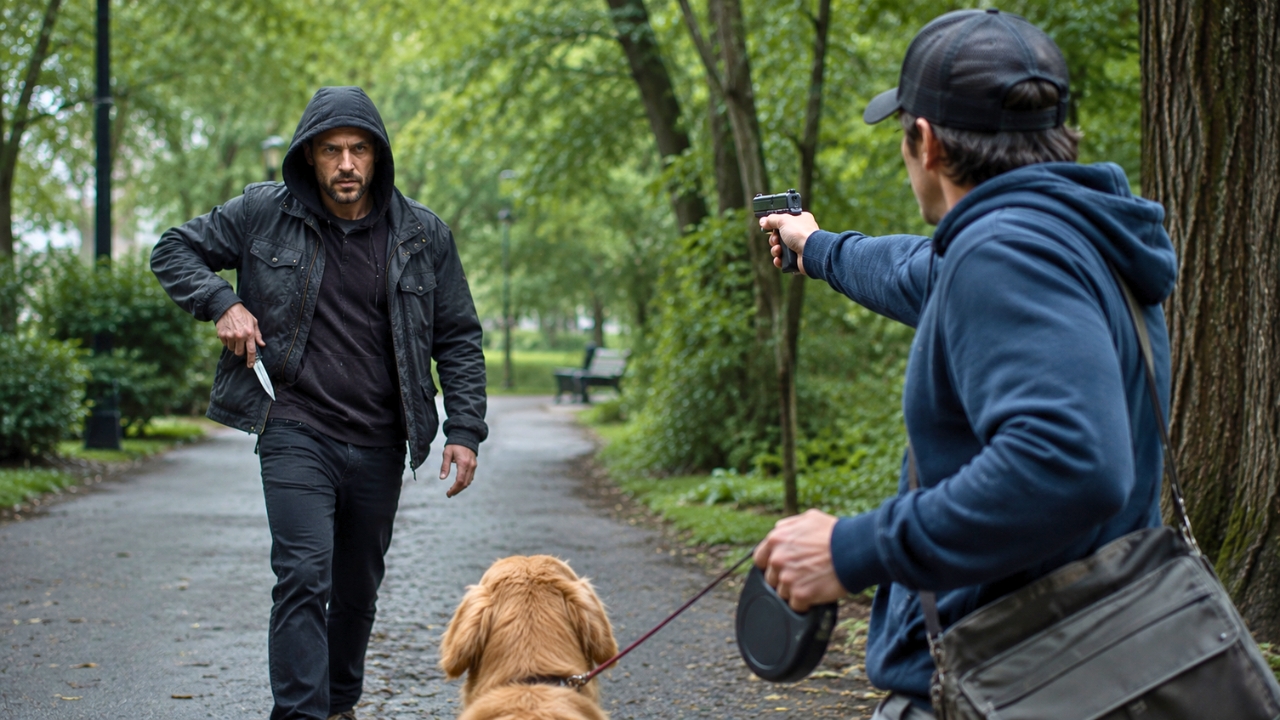
A concealed carrier in Seattle said he had finished dinner and needed to take his dog outside, so he headed to the park across from his building. In his Reddit post, “Longish story about when I had to draw my CCW and what it taught me,” he explained that the park was usually decent, but it sat only a few blocks from Aurora/Hwy 99, where trouble sometimes drifted through.
He wasn’t planning on being out long. The sun was still up, he was wearing basketball shorts, and he did not want to change just to walk the dog. So instead of carrying something larger, he grabbed a small Kahr .380 and holstered it at 3 o’clock.
That decision would bother him later.
Once he crossed into the park, he noticed a man in the middle of it who appeared to be under the influence of something. That alone was enough to change the plan. Instead of cutting through the park, the carrier decided to skirt around the edge and walk through the neighborhood instead.
Then the man noticed him.
According to the carrier, the man dropped to all fours and started crawling toward him while barking like a dog. His own dog, a shepherd/Rottweiler mix, started looking back and growling as they kept moving away. At that point, the carrier wasn’t trying to challenge anybody. He was trying to create distance without turning the whole thing into a chase.
But the man kept following.
After about a block, the carrier decided to say something. He tried to keep it calm, telling the man he was just trying to walk his dog and asking if they could both go back to what they were doing. That did not calm the man down. It did the opposite.
The man stood up and started screaming at him. The threats became direct. The carrier said the man was yelling about how he should murder him while slowly closing the gap. The carrier kept facing him and backing away, but that is a bad way to move when the other person is walking forward normally. What had started at a distance had closed to roughly 15 yards.
Running crossed his mind, but it wasn’t simple. His dog was locked on the threat. If he suddenly turned and sprinted, he worried the dog might not follow cleanly, or worse, might engage the man. Dropping the leash was not something he wanted to do either. A protective dog rushing forward at a man who was already unstable could have turned a bad situation into a bloody one fast.
So he tried one more time.
He asked the man to stop following them. That was when the man reached into his waistband and pulled a knife.
The carrier drew with the hand that was not holding the leash. He also shifted his position so the grassy hill was behind the man, giving him something safer as a backstop if he had to shoot. That detail says a lot about how much was happening in only a few seconds. He was watching the knife, holding the dog, backing away, drawing one-handed, and still trying to think about where a round might go if this went any further.
He did not fire.
Instead, he decided that if the man took another step toward him with the knife, he would shoot. The two stood there staring at each other for what felt much longer than it probably was. Then the carrier backed away, and the man did not follow.
Once he put enough distance between them, he turned a corner, reholstered, and ran. He called police after that. By the time officers arrived, the man was gone. The carrier said others in nearby apartments had already called as well, but police still took about an hour to get there.
Nobody got stabbed. Nobody got shot. His dog made it home. But the whole thing left him looking hard at the little choices that had stacked up before the knife ever came out.
The big one was the gun. He said the .380 would have been better than nothing, and he had practiced with it, but he also admitted he chose it mostly because he was being lazy. He had better options available and simply didn’t want to dress around them for a quick walk. After that night, he said he stopped making carry decisions that way.
He also walked away thinking about one-handed draws. On a square range, it is easy to practice with both hands free, a clear garment, and a perfect stance. In real life, he had a leash in one hand and a protective dog that could not simply be dropped from the equation. Had he let go, he believed the dog might have rushed the attacker and been stabbed, forcing him into an even uglier decision.
Commenters zeroed in on the leash almost immediately. Several said one-handed draw practice matters because real confrontations rarely happen when both hands are empty. Others talked about training with the support hand, carrying the leash in the non-dominant hand, and building habits that keep the gun hand free during ordinary errands or walks.
There was also a lot of discussion about carrying on “quick trips.” Some commenters admitted they sometimes tell themselves they are only going outside for a minute, then decide not to carry. The thread pushed back on that mindset pretty hard. The point was not that every walk turns dangerous. It was that the carrier had no warning that this one would.
Like The Avid Outdoorsman’s content? Subscribe to our newsletter so you never miss an article.
Here’s more from us: