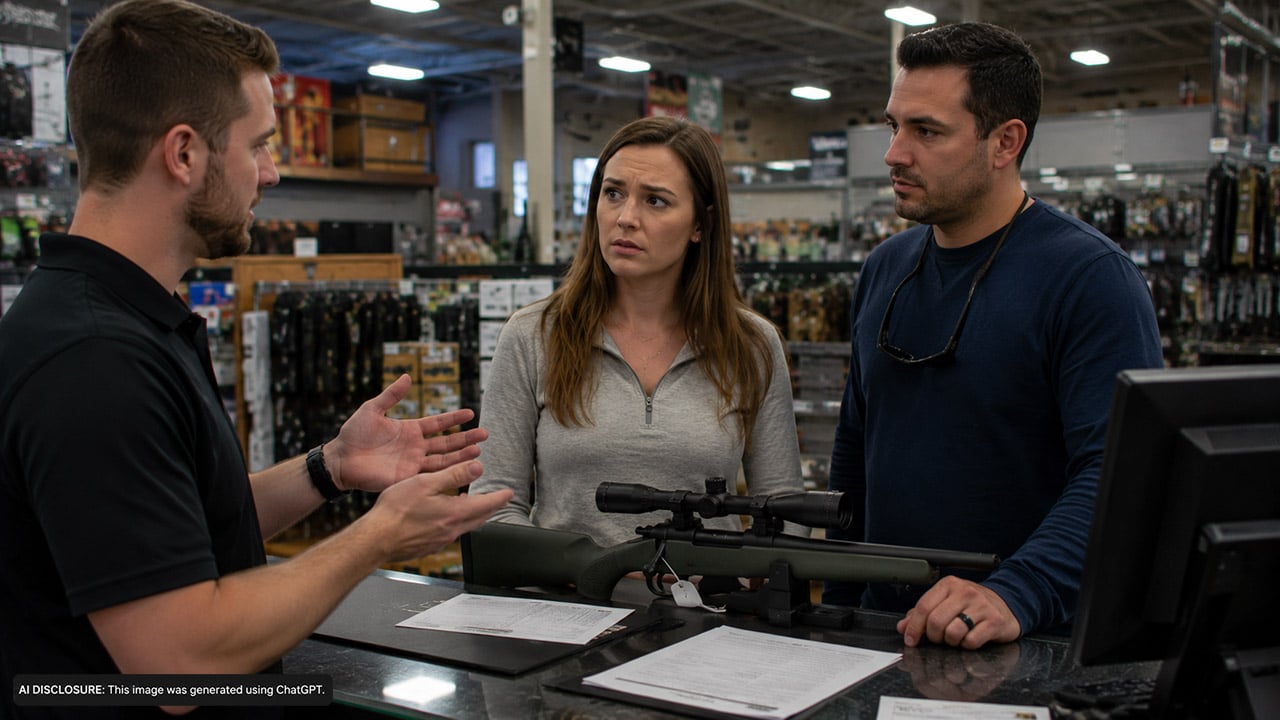
Photo credit: AI-generated image created using ChatGPT. Illustrative only
Buying a rifle ought to be straightforward: pick what you want, fill out the paperwork honestly, pass the background check, and go home. But one couple’s stop at Academy turned into a 30-day headache when an employee decided the wife’s purchase “looked” wrong—even though, by their account, she was the actual buyer and was trying to do everything by the book.
The details come from the original post, where the husband laid out how a routine shopping trip for an AR-15 ended with his wife being “flagged” for a suspected straw purchase after she attempted to buy the rifle under her own name.
A normal family errand turned into an interrogation at the gun counter
According to the account, the husband, wife, and their small child walked into Academy and headed to the gun counter. The wife—already a gun owner—told the employee she wanted to buy an AR-15. That should’ve been the end of the “who’s buying what” part of the conversation.
Instead, the employee asked for the husband’s ID. The wife clarified that the purchase was going to be under her name. That’s where the tone shifted. The employee reportedly pressed the husband on why the rifle wouldn’t be purchased under his name, even after the husband explained the gun was for his wife.
The employee kept circling back to the same suspicion
The couple says the employee questioned the wife about the rifle—company, caliber, and other basic details—then returned again to why the husband couldn’t buy it himself. The employee allegedly told them it was “uncommon for a women to buy an AR-15,” and asked the wife, after she said it was for her, “Are you sure?”
If you’ve spent any time around gun counters, you know there’s a fine line between a clerk doing due diligence and a clerk turning personal assumptions into policy. From the couple’s perspective, they answered the same question multiple times and still couldn’t get past the employee’s suspicion.
Inventory pushed them to a second store—then the real trouble started
Here’s the part that would frustrate any practical-minded gun owner: the couple didn’t even get to the point of completing a sale at the first store because the rifle wasn’t available in the color the wife wanted. She pointed out the one she liked, but it was brown, not black.
They asked which nearby location had it in black. The employee suggested an Academy across town that should have it in stock. So they did what most folks would do—loaded back up and drove to the other store to finish the purchase.
At the second Academy, the wife handed over her ID, expecting a clean transaction. Instead, she was told the store couldn’t sell her any gun because she had been flagged at the previous store and would have to wait at least 30 days before making another purchase.
Why “straw purchase” fears hit regular couples so hard
Every gun owner should understand why retailers are sensitive about straw purchases. A straw purchase is when someone buys a firearm for another person who can’t or won’t buy it themselves, and federal paperwork is built to stop exactly that. Gun shops and big-box counters have to take it seriously because their license is on the line.
But the hard truth is that married couples and families shop together all the time. One spouse often knows more about a particular platform, or they’re simply along for the trip. That’s especially common with ARs, where one person might follow the market and another just wants a reliable rifle that fits.
When an employee decides that a woman buying an AR “isn’t common,” that’s not a legal standard. It’s a personal assumption—and assumptions are a poor substitute for what actually matters: who the actual buyer is, who is filling out the ATF Form 4473 truthfully, and whether the store’s process is being followed.
The couple went back for answers and got none
After getting shut down at the second store, the couple headed back to the first Academy and asked to speak with a store manager. The husband says he explained what happened and asked a reasonable question: why would an employee recommend they go across town if his wife was going to be flagged anyway?
In his telling, the manager offered no answer and no apology. The husband asked for a store number and said he would follow up with a complaint.
Later, he posted a small update: both he and his wife made separate phone calls, were given a case number, and were told they would hear back soon. That’s not exactly immediate relief if you’re the one who just got told you can’t buy a firearm for 30 days.
What gun owners tend to focus on in situations like this
Even without a full back-and-forth from the store, this kind of story usually puts gun owners in a practical mindset: what could have been done differently to avoid the flag, and what’s the cleanest way to resolve it?
For starters, it’s a reminder that when one person is buying, that person should be the one driving the interaction—asking for the rifle, answering the questions, paying, and handling the paperwork. That doesn’t mean a spouse can’t be present. It just means you want the transaction to look exactly like it is: a lawful purchase by the actual buyer.
It also highlights how inconsistent policies can be from counter to counter, even within the same chain. One employee’s “gut feeling” can create a denial that follows you to another location, and in this case the couple says it resulted in a 30-day no-go period for any gun purchase.
Finally, it’s worth remembering that big retailers often run on strict internal rules that go beyond the minimum legal requirements. Whether that helps public safety or just frustrates lawful buyers depends on the situation, but the outcome is the same: if they won’t sell, they won’t sell.
In the field we like systems that are simple and reliable—rifles that run, gear that holds up, and rules that make sense. A lawful buyer being treated like a suspect because of who she is, then getting effectively benched for 30 days after being sent to another store, is the kind of mess that leaves folks shaking their head. If nothing else, it’s a good reminder to keep the purchase process clean and clear, and if a counter starts going sideways, it may be better to pause, ask for a manager early, and avoid getting caught in a “flag” that’s hard to undo.
Like The Avid Outdoorsman’s content? Subscribe to our newsletter so you never miss an article.
Here’s more from us: