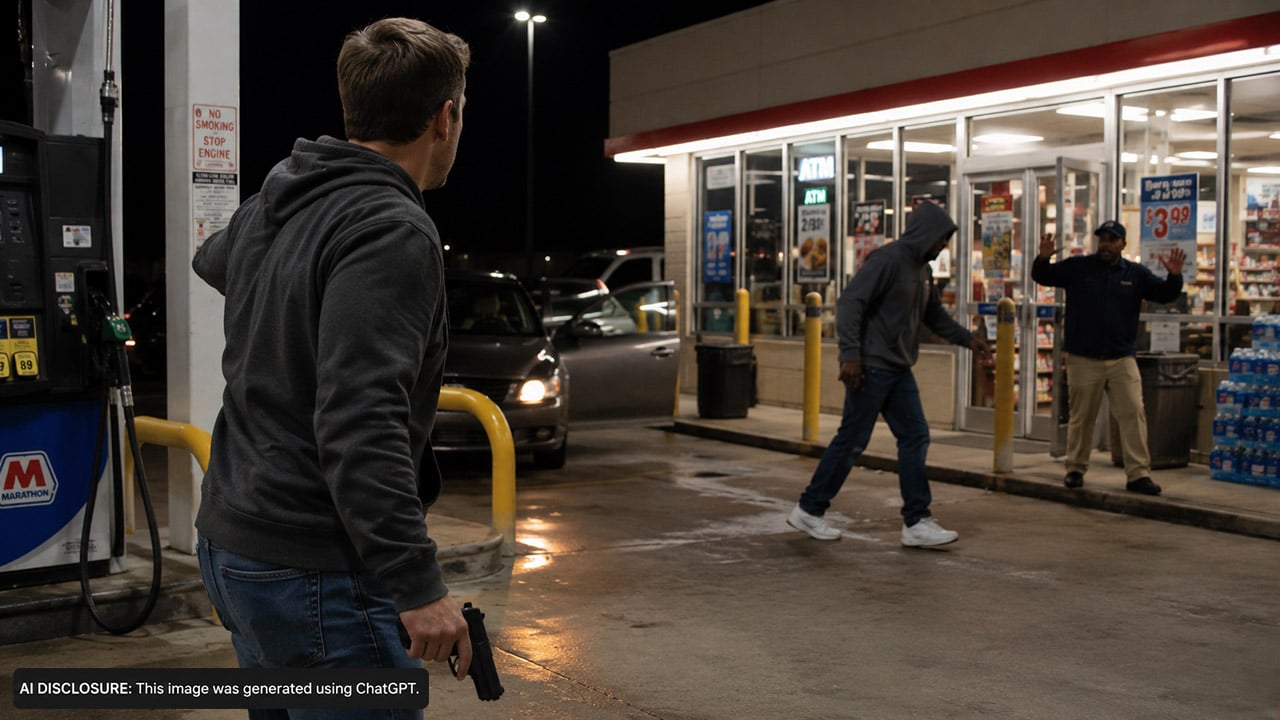
Photo credit: AI-generated image created using ChatGPT. Illustrative only
Most folks who carry or keep a gun close have played the “what if” game in their head. It’s usually some clean, simple script where the bad guy shows up, you do the right thing, and everybody goes home. Real life isn’t that tidy.
In the original post, one man described a late-night stop at a neighborhood gas station that turned into a split-second fight over a handgun, followed by two shots into the ceiling—shots he now worries could put him on the wrong side of the law.
A late-night coffee run turned into a robbery in progress
The man said he was inside a gas station near his apartment grabbing coffee and snacks so he could stay up studying. While he was in an aisle a couple rows away from the register, a “short, small homeless-looking man” walked in.
He noticed the man right away because he looked unsteady and intoxicated. According to the account, the man went straight to the cashier, pulled a pistol, waved it at the employee with his finger on the trigger, and slurred out demands for money while threatening to kill him.
He chose to close distance and fight for the gun
The cashier froze. The customer watching it unfold said he felt the cashier was smaller than him and that the robber didn’t seem mentally alert, so he figured he could take the gun away.
He moved up behind the gunman quickly, close enough that the robber didn’t even turn around. When he reached him, he lunged for the pistol, forced the muzzle toward the ground as best he could, and bit the man’s arm hard enough that he believed his teeth sank in. The gunman yelled, let go, and turned to run for the door.
The turning point: firing after the threat was already moving away
Once the man had the gun and the robber was running, he fired twice into the ceiling over the fleeing man’s head. He admitted he had already decided, before grabbing the gun, that he was going to fire it “as soon as I have it” to confirm it worked and was ready in case he had to shoot the robber.
That detail matters because it shows the shots weren’t described as a reflex during the struggle. By his own telling, the robber was already leaving, and the shooting was tied to checking the gun’s status rather than stopping an immediate, unavoidable threat.
Outside, he saw the man keep running. He went back in, placed the gun on the counter, and the employee responded with a stunned “holy” reaction. Then the adrenaline hit, and he realized those two rounds might be the part that comes back to bite him.
Police arrived fast, and he tried to keep his words tight
Someone called 911, and officers showed up within minutes. The man said police separated him from the employee and also spoke with a woman who had been in her car. She reportedly didn’t see the inside of the incident—only the suspect running off and the man stepping outside with the gun.
When questioned, the man said, “he came in demanding money and threatening to kill him, I feared for my life and I acted to protect our lives.” After that, he told officers he wanted to cooperate but didn’t want to talk further “as a legal precaution thing,” and he repeatedly declined to explain his specific actions.
He described the officers as annoyed, more in a “why are you making this difficult” way than in a “you’re going to jail” way. After a while, they told him he wasn’t being arrested and he could leave. He walked away but watched from a distance while officers stayed on scene for hours and continued talking with the employee.
Where the self-defense line gets blurry for gun owners
Outdoorsmen tend to see self-defense through a practical lens: a deadly threat shows up, you stop it, and you stop shooting when the threat stops. That last part is where a lot of otherwise good people get in trouble, especially when stress, anger, or adrenaline keeps the moment rolling after the danger is fading.
In this account, there are really two separate events. The first is the fight for control of the gun while a robbery threat is active. The second is discharging the firearm after the suspect is already retreating—shots sent into a ceiling in a public business, with unknown construction above and unknown people beyond.
Even if the first part sounds like defense of life, the shots can get viewed as reckless or unnecessary, depending on the laws where it happened and how investigators interpret the timeline. And in a gas station—thin walls, bright lights, people coming and going—there’s not much room for error.
There’s also the hard truth many armed citizens don’t like to hear: stepping into a robbery that isn’t directly aimed at you may not be treated the same as defending yourself in your home. Some states are friendlier to “defense of others” than others, and some are very particular about when deadly force is justified.
The practical lessons: win the fight, then manage the aftermath
This story has a few takeaways that apply whether you’re in town buying coffee or out at a rural gas station off a county road. First, disarming a gunman is a high-risk move that can turn you into the primary target instantly. The fact that the robber didn’t notice him doesn’t make it a reliable plan—just a piece of luck.
Second, firing “warning” shots—or shots not clearly directed at stopping an immediate deadly threat—can be a legal and safety nightmare. Bullets don’t care about intentions. Shooting into a ceiling doesn’t guarantee a safe backstop, and it can endanger people you can’t see.
Third, what you say right after the incident matters. He gave a brief statement focused on fear for life and protecting lives, then stopped talking. Whether that helps or hurts depends on the full circumstances, but it’s worth remembering that the first story told often becomes the frame everyone else builds on.
Finally, if you ever find yourself in a situation like this—especially one involving shots fired in public—expect follow-up. The man asked how he’d know if anything “comes up,” and police told him they’d mail him or come by. That’s the part that keeps a person staring at the mailbox for days.
Most gun owners want to do the right thing, and a lot of us feel the pull to protect a stranger behind the counter. But in the real world, the clean “good guy stops bad guy” story can turn into a messy investigation fast—especially when rounds are fired after the suspect is already running for the door.
Like The Avid Outdoorsman’s content? Subscribe to our newsletter so you never miss an article.
Here’s more from us: