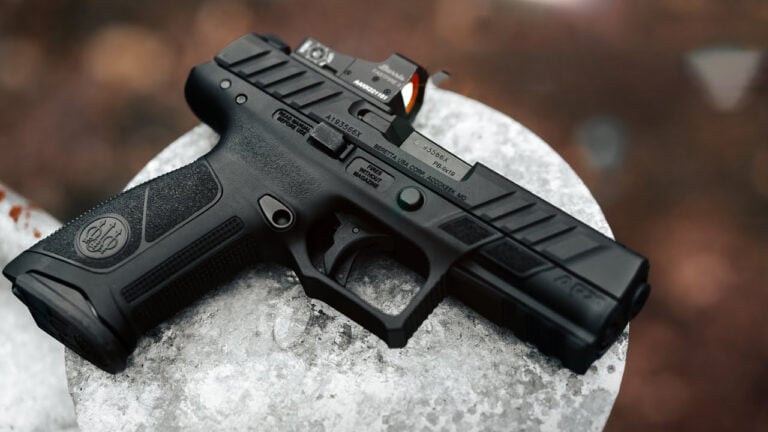
Photo credit: Nomad_Soul/Shutterstock.com
Federal gun policy is shifting from a narrow focus on who may not own a firearm toward a broader question of who counts as a regulated gun buyer, seller, or carrier in the first place. As proposals stack up in Congress and in the executive branch, you are seeing a patchwork of licensing and permitting ideas that reach from homemade “ghost guns” to interstate concealed carry. Across that landscape, the one requirement that keeps surfacing is not a formal training mandate, but a baseline expectation that anyone moving guns into commerce must be visible to the background check system.
That is why so many of the current fights revolve around definitions like “engaged in the business” of dealing, or whether a state permit should substitute for a federal check. Instead of converging on a national training standard, federal proposals are converging on a simpler throughline: if you are profiting from firearms, you should be on the books, and your customers should be screened before they walk away with a gun.
The crowded field of federal gun proposals
When you look across Capitol Hill and the executive branch, you are not seeing a single comprehensive gun licensing bill so much as a series of overlapping efforts that would change who needs permission to buy, sell, or carry. Several federal bills remain pending that would adjust background checks, tighten or relax dealer oversight, and reshape reciprocity for concealed carry permits, and together they amount to a quiet rewrite of how you interact with the legal gun market. Rather than a unified licensing code, you are watching a set of parallel tracks that all try to decide which transactions should trigger federal scrutiny and which should be treated more like private conduct, a tension that runs through every major proposal.
On one side of that debate, you have measures that would broaden the universe of regulated actors, such as efforts to clarify when someone is “engaged in the business” of selling guns and therefore must run checks on buyers. On the other, you have initiatives that would nationalize the most permissive state rules, including a federal concealed carry reciprocity mandate that would let visitors bring their home state standards into jurisdictions with stricter laws. The result for you as a gun owner, dealer, or neighbor is a policy environment where the same handgun can be treated as a tightly controlled product in one context and a lightly regulated personal item in another, depending on which of these proposals ultimately prevails and how they interact with existing law.
Ghost guns and the push to capture homemade firearms
One of the clearest examples of this shift toward visibility is the federal government’s treatment of so called “ghost guns,” the build it yourself kits and unfinished frames that let you assemble a working firearm at home. Earlier this year, the Supreme Court of the United States, referred to as SCOTUS, upheld a Biden era rule from the Bureau of Alcohol, Tobacco, Firearms, and Explosives that treats certain partially complete receivers and kits as firearms for regulatory purposes, closing a gap that had allowed people to buy them without a background check. On March 26, 2025, that decision effectively confirmed that these components can be regulated like any other gun, which means you, as a buyer or seller, may now face the same paperwork and screening requirements that apply to a fully completed, newly manufactured handgun, a change detailed in guidance that highlights how the Supreme Court of the United States and Biden administration have approached these items.
The same rulemaking effort also zeroed in on the way these kits are marketed and transferred, reflecting concern that untraceable weapons were undermining the broader background check system. In a Quick summary of new gun laws and proposed changes, regulators describe how the federal government now calls these items ghost guns and insists that commercial sellers treat them as firearms, which pulls more transactions into the National Instant Criminal Background Check System and reduces the space where someone can acquire a weapon with no questions asked. For you, the key point is that the federal response to ghost guns is not about mandating training for home builders, it is about making sure that if you are effectively buying a gun, even in pieces, the law treats that purchase as a gun sale subject to the same checks as any other.
Dealer definitions and the expanding net of “engaged in the business”
Another major front in the licensing debate is the effort to define who counts as a firearms dealer, a question that determines whether you must obtain a federal license and run background checks on your customers. The Department of Justice has published a new rule that, as its own summary notes, is For Immediate Release and states that the Rule Seeks to Implement Provisions of the Bipartisan Safer Communities Act and Provide Clarity on what it means to be engaged in the business of dealing in firearms, which is a technical way of saying the government wants fewer people operating in a gray area between hobbyist and commercial seller. If you regularly sell guns with the principal objective of livelihood and profit, the rule is designed to make it harder to claim you are just thinning a personal collection, and easier for regulators to insist that you obtain a license and comply with federal record keeping and background check obligations.
The ATF has followed up with a detailed Final Rule that spells out conduct that is presumed to constitute engaging in the business of dealing in firearms, and that is presumed to demonstrate when a person is not doing so, including guidance on when sales from a personal collection are exempt. By setting forth this conduct in granular terms, the agency is signaling that if you are advertising guns, renting tables at shows, or otherwise acting like a retailer, you should expect to be treated as one, with all the licensing and oversight that entails. Again, the emphasis is not on requiring you to complete a safety course before you sell, but on ensuring that your buyers are screened and that your role in the chain of commerce is visible to federal regulators.
Background checks as the quiet common denominator
When you step back from the legal jargon, a pattern emerges across these federal moves: background checks remain mandatory for most retail gun purchases, and policymakers are trying to close the remaining gaps rather than layering on a universal training requirement. As one overview of new gun laws notes, Several federal bills are pending that would tweak how checks are conducted, how dealer oversight works, and how reciprocity is handled, but they all start from the premise that the National Instant Criminal Background Check System is the backbone of federal gun control. For you as a buyer, that means the most consistent requirement you face is not a class or a test, it is the expectation that your name will be run through NICS before you walk out of a store with a firearm.
That same analysis underscores that background checks remain mandatory for purchases from licensed dealers, and that certain accessories and rapid fire devices may be treated as dangerous weapons, which can trigger additional regulatory scrutiny. The throughline is that federal law is less interested in how skilled you are with a gun than in whether you are legally allowed to have one, and it uses the licensing of dealers and the definition of regulated firearms to enforce that line. For you, the practical takeaway is that any proposal that expands who must be licensed or what counts as a firearm is, in effect, expanding the reach of background checks, even if it never mentions training or education at all.
Concealed carry reciprocity and the clash over state standards
While executive branch rules are pulling more sellers into the federal system, some members of Congress are pushing in the opposite direction by trying to nationalize the most permissive state carry laws. Lawmakers in Congress have introduced a measure that would create a federal concealed carry mandate, allowing people with permits from one state to carry hidden, loaded guns in other states, even if those states have stricter standards or do not issue permits at all. Key Takeaways from opponents emphasize that this would override local rules on who may carry in public, including age limits, training requirements, and restrictions on people with certain criminal records, which means you could find yourself sharing a subway car or a grocery aisle with armed visitors who would not qualify for a permit under your own state’s law.
The proposal, called The Constitutional Concealed Carry Reciprocity Act of 2025, appears in Congress as H.R. 38 in the House and S. 65 in the Senate, and critics warn that it would force states to honor permits from jurisdictions that have minimal or no standards. By citing the figures 38 and 65, they highlight how the bill would let people from states with weak or nonexistent training and screening rules carry guns in states that have invested heavily in vetting and instruction, effectively exporting the lowest common denominator nationwide. For you, this is the rare federal initiative in the current landscape that would actively undercut training and licensing standards rather than reinforcing them, a reminder that the emerging consensus around background checks does not extend to how, or whether, people should be trained before carrying in public.
ATF enforcement shifts and what they mean for license holders
Even as definitions tighten, the way federal agencies enforce gun laws is also changing, which affects how you experience licensing on the ground. Under a set of Active ATF Changes that are Effective as of mid 2025, the agency announced that its prior Zero Tolerance Policy Repealed approach to dealer violations would be scaled back, signaling a move away from automatic license revocations for certain paperwork errors. On April 7, ATF officials described a more nuanced enforcement strategy that still targets willful misconduct and unlawful transfers, but gives some breathing room to licensees who make good faith mistakes, a shift that matters if you run a small shop and worry that a clerical slip could cost you your livelihood.
At the same time, the ATF has been updating technical guidance that affects how certain firearms and accessories are classified, including a June initiative described in a resource titled ATF Changes in 2025: What Every FFL Needs to Know, which explains how The Bureau of Alcohol, Tobacco, Firearms, and Explosives and the Department of Justice are interpreting existing statutes. In June, ATF introduced Ruling language that clarifies when particular configurations fall under the National Firearms Act, which can trigger registration, a tax, and all NFA requirements, and a separate section labeled 1 – “One Big Beautiful Bill” outlines how the agency is consolidating prior guidance to make it easier for you to understand your obligations and prevent unlawful firearm transfers. None of these enforcement tweaks require you to take a class, but they do shape the compliance environment you navigate if you hold a federal firearms license.
How recent federal statutes quietly harden eligibility rules
Beyond agency rules, recent federal statutes are also reshaping who passes a background check, which indirectly affects how licensing feels to you as a prospective buyer. The Bipartisan Safer Communities Act and the Consolidated Appropriations Act, often shortened to BSCA and CAA, added new disqualifying events that must be considered during NICS transactions, including certain juvenile records and domestic violence related orders that previously might not have blocked a sale. An official notice explains that, in particular, as described below, the CAA and BSCA added new disqualifying events for consideration during NICS transactions under 18 U.S.C. 922(t) and 34 U.S.C. 40901(l), which means that even if your state has not changed its permitting rules, the federal system may now flag you based on information that was once ignored.
For you, this tightening of eligibility criteria is another example of how federal policy is converging on background checks as the central tool for regulating access to guns. Instead of requiring you to log hours in a classroom, Congress has chosen to refine the list of red flags that can stop a sale, trusting that a more complete picture of your history will produce safer outcomes. That approach leaves training and education largely to states and private actors, while Washington focuses on who may legally possess a firearm at all, and on making sure that anyone selling guns for profit is plugged into the system that enforces those rules.
State permitting experiments that go beyond federal baselines
Because federal law stops short of mandating training, states are filling the gap with their own permitting experiments, which can give you a preview of what a more robust licensing regime might look like. California, for example, has recently adopted an Extension of Concealed Carry Weapon rules that allow CCW Permits to be issued to Non Residents under certain conditions, a move that expands who can legally carry while still insisting on state level vetting. A detailed overview of California’s approach notes that the state has also moved to ban certain rapid fire devices and regulate firearms in public buildings, illustrating how a jurisdiction can pair broader access with tighter controls on where and how guns are carried.
When you look at how California handles basic gun ownership, the contrast with federal policy is even sharper. A guide to Buying a Gun in California explains that, regardless of age, everyone who purchases a firearm must obtain a Firearm Safety Certificate, which requires a written test, and that is on top of waiting periods and background checks. One of the striking features of this system is that it treats training and knowledge as prerequisites for ownership, not optional extras, which shows you what a true licensing model looks like in practice. At the federal level, by comparison, the focus remains on eligibility and traceability, leaving it to states like California to decide whether you should prove your competence before you are allowed to buy or carry.
What genuine training mandates look like in practice
If you want to understand what a real training requirement entails, you can look to sectors where carrying a gun is treated as a professional responsibility rather than a personal right. In the private security industry, for instance, All security officers who carry firearms are required to go through mandatory training, testing, registration, and continuing education to comply with state standards, a regime that treats firearms proficiency like any other licensed skill. That means if you work as an armed guard, you are typically subject to recurring qualification shoots, legal update courses, and background checks that go beyond what is required for ordinary civilian ownership, and your license can be suspended or revoked if you fall short.
Other countries offer similar examples in the civilian context, such as Canada’s approach to Authorizations to Transport restricted firearms. An analysis of that system notes that Making Authorizations to Transport a condition on a firearms license and standardizing them across the country may seem like a bureaucratic tweak, but it reflects a philosophy that sees gun ownership as a regulated privilege tied to ongoing obligations. For you, the lesson is that where training and licensing are taken seriously, they are built into the structure of the law from the ground up, with clear expectations about education, renewal, and oversight, rather than tacked on as optional recommendations.
Like The Avid Outdoorsman’s content? Be sure to follow us.
Here’s more from us: