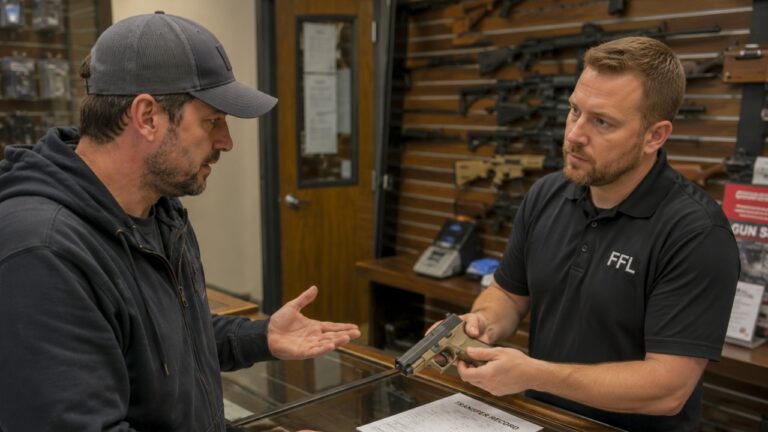
Photo credit: AI-generated image created using ChatGPT. Illustrative only.
If you hunt, fish, or work the rural side of a state line, you already know how easy it is to cross an invisible border and suddenly be “wrong” without meaning to be. One minute you’re fueling up, grabbing bait, or running into town for a part—next thing you know, your carry setup is being looked at like contraband.
That’s the worry behind the discussion from an Indiana resident who lives near Illinois and still has an Indiana license to carry even though Indiana has moved to constitutional carry. The question was simple and practical: if a law-abiding person with no record ends up in Illinois with a sidearm, what does law enforcement typically do in real life—warning, citation, gun confiscation, or a trip to jail?
The border problem that bites outdoorsmen
Plenty of folks who live near a state line treat the next state over like the next county over. You go where the work is, where the family is, where the deer lease is, or where the boat ramp makes sense. But carry laws don’t care about your routine.
In this case, the poster laid out a very common Midwest setup: Indiana resident, close to Illinois, and used to having a license from the days when it was required back home. They understood Illinois doesn’t recognize Indiana’s carry permissions the way Indiana recognizes its own, and they’d heard the stakes could be up to a year in jail and a fine. The real question was how it actually plays out for someone who isn’t a criminal and isn’t looking for trouble.
Why “I’m legal at home” doesn’t travel well
A lot of gun owners learn carry law like they learn fishing regulations: you know what your state allows, and you assume the next one over is close enough. Sometimes it is. Sometimes it absolutely isn’t.
Indiana going constitutional carry adds another layer of confusion. Folks who kept their license (or never bothered to renew it) can start to assume the license itself is the golden ticket. But once you cross into a place that doesn’t honor that license—or has its own rules about how, where, and whether you can possess a loaded handgun—you’re dealing with a totally different set of expectations.
And outdoorsmen are especially prone to getting caught in that gap because we travel with gear. A pistol in a console, a hunting handgun in a pack, or a “I always carry” mindset can drift across a line faster than you can say “I’m just going to the store.”
What “typically happens” can depend on the stop, the context, and the officer
The poster wasn’t asking how to get away with anything. They were asking the down-to-earth question most responsible carriers think about sooner or later: in practice, what’s the usual outcome if you’re found with a sidearm where your permission doesn’t count?
Even without getting into case-specific predictions, there are a few realities any seasoned gun owner recognizes. Police encounters are highly context-driven. A traffic stop where nothing else is going on is different than contact during a disturbance call. A calm disclosure (where required), safe demeanor, and clear lack of criminal history is different than an officer finding a gun during a tense interaction.
That’s why the “typical” answer can feel slippery. Some situations end with the gun secured temporarily and returned later. Some end with a citation. Some end with an arrest and a night in jail even if the person is otherwise squeaky clean. The statute on the books matters, but so does what the officer believes they have probable cause to do in the moment, and what local policy pushes them toward.
The gun itself: confiscation is a real possibility, even if you did everything else right
One of the poster’s biggest concerns was whether the firearm would be confiscated. That’s not paranoia—it’s a realistic concern for anyone who carries a pistol they trust, have tuned their holster setup around, and may rely on daily.
In many real-world encounters, officers will secure a firearm during the stop for safety. That’s separate from “confiscation,” but it can feel the same when your gun is being handled, unloaded, and put somewhere you can’t reach. If the encounter turns into an alleged violation—especially in a state that treats your possession as unlawful—then the firearm may be taken as evidence or held under whatever process that jurisdiction uses.
And here’s the part gun owners hate: even if you eventually get it back, the process can be slow, paperwork-heavy, and expensive. Meanwhile, you’re without the tool you chose for protection, and you may be shopping for a replacement just to keep your daily routine intact.
Why a clean record doesn’t guarantee a “break”
The poster specifically asked what happens to “a person with no criminal record,” and that’s the mindset most of us have—if you’re not a bad guy, you’ll get treated like you’re not a bad guy.
Sometimes that’s true. But a clean record isn’t a force field. When a law is written as a criminal offense and an officer believes the elements are met, the officer may treat it like any other weapons charge: detain, seize the gun, and start the booking process. That can happen even if you’re polite, even if you were trying to be responsible, and even if you genuinely didn’t know your carry status changed the moment you crossed the line.
This is the part that hits outdoorsmen hardest. You can do everything “right” by your own standards—safe handling, quality holster, no drinking, no drama—and still wind up in cuffs because your map app took you three miles into a state that doesn’t play by your home rules.
How to keep a simple errand from turning into a weapons case
The strongest lesson in the original question is that the risk isn’t theoretical. It’s practical. If you live near a border and you carry, you need a routine that’s just as habitual as checking your chamber or locking your truck.
That starts with knowing reciprocity (or lack of it) and understanding that constitutional carry at home doesn’t mean “legal everywhere.” It also means thinking through “what am I doing today?” If you might cross into a non-recognizing state, make a deliberate decision before you leave the driveway—don’t let it happen accidentally while your pistol is riding in the same spot it always rides.
It also means being honest about your lifestyle. If you’re regularly in the neighboring state for work, family, or access to property, the best time to sort out lawful options is on a quiet Tuesday night at the kitchen table—not on the shoulder of the road with flashing lights behind you.
At the end of the day, carry is about being prepared. Prepared doesn’t just mean having the gun. It means having your legal footing under you, too—especially when the next state over can turn a normal day into a booking photo and an evidence tag on your sidearm.