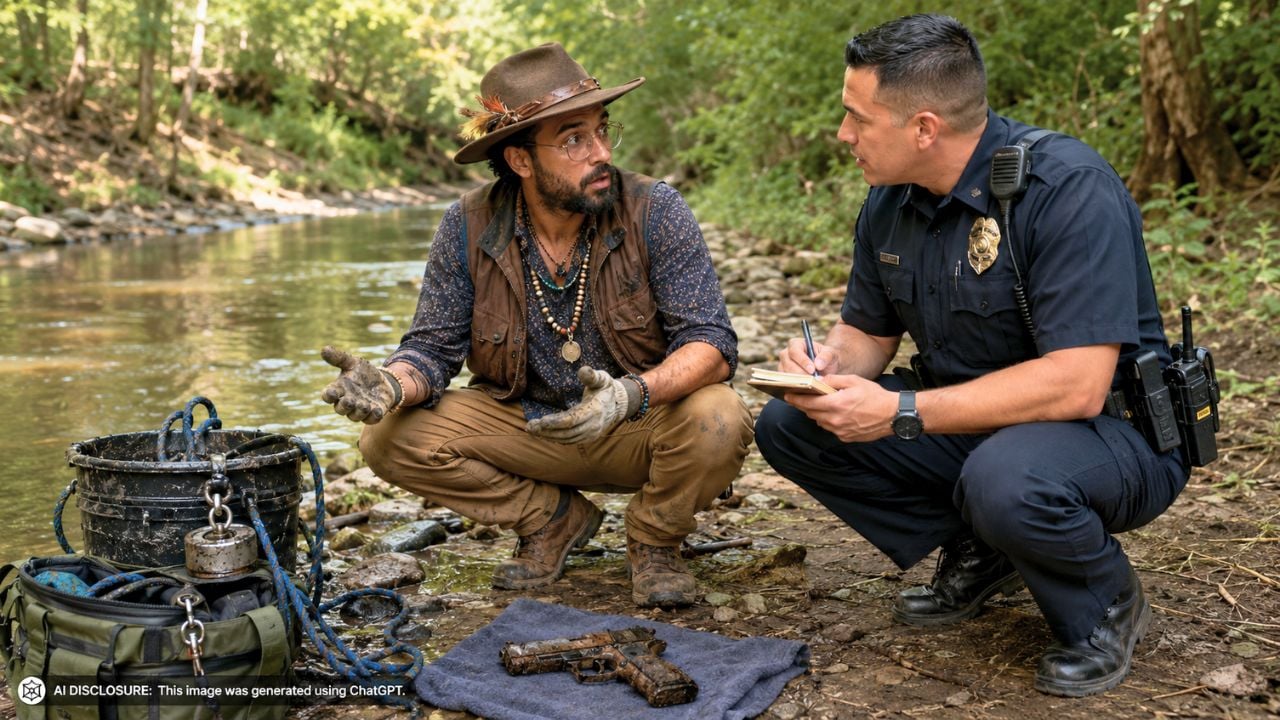
Photo credit: AI-generated image created using ChatGPT. Illustrative only.
Magnet fishing is one of those hobbies that looks like harmless fun until the magnet comes up heavy and you realize you’re not holding scrap metal—you’re holding someone’s problem. That’s exactly the kind of scenario an outdoorsman raised in the discussion after asking whether “finders keepers” applies if you pull a typical pistol out of a Texas lake or creek.
The question sounds simple on the surface: Texas doesn’t require registration for most firearms, and many adults can legally own a handgun. So if a non-felon finds a standard pistol while magnet fishing, is there any legal duty to report it? The real answer is where folks get surprised—because “found property” and “legal to possess” aren’t the same thing, and in some states keeping that gun can put you on the wrong side of a felony.
The moment a magnet fisherman pulls up a pistol, the rules change
Most magnet fishing days are spent sorting out rusty tools, fishing lures, maybe a set of keys. But a handgun is different—because you’re not just dealing with trash or treasure anymore. You’re dealing with something that could be stolen, could be tied to a crime, or could be loaded and unsafe the second it breaks the surface.
Even if it looks like a “typical pistol,” there’s no way to know its story by looking at it. Outdoorsmen tend to think in practical terms: “Is it mine now? Can I clean it up?” That’s where this gets dicey. A firearm can be lawful to own generally, but unlawful to keep if you obtained it the wrong way.
“Texas doesn’t register guns” doesn’t mean “no paper trail matters”
The original question leaned on a common Texas talking point: in general, you don’t have to register most guns and you don’t need a license just to own one. That’s mostly true in everyday life, but it doesn’t answer the “found gun” problem.
Found property laws don’t disappear because the item is a gun. If you pick up something that belongs to somebody else and keep it, that can fall under theft-type statutes depending on the facts. And with firearms, law enforcement tends to treat it more seriously, because the stakes are higher if that gun later turns out to be stolen or connected to something bad.
This is where people get tripped up: gun laws and property laws overlap. You can be legally allowed to possess a handgun and still commit a crime by keeping a handgun you found.
Why keeping a found firearm can become a felony in some states
Plenty of states treat “theft by finding” (or similar concepts) as a real offense. The basic idea is simple: if you find property and you know—or reasonably should know—it belongs to someone else, you can’t just decide it’s yours. If the value crosses certain thresholds, it can jump from misdemeanor territory into felony territory.
A handgun doesn’t have to be a high-dollar collector’s piece to be worth enough to raise the stakes. Even a beat-up, waterlogged pistol can still be valued as a firearm, and that value can matter when charges are decided.
Also, firearms bring an extra layer of scrutiny. If that gun was reported stolen, keeping it can turn into a possession-of-stolen-property situation. If it was tossed to hide evidence, you don’t want to be the guy who “found it” and then took it home, cleaned it up, and put it in the safe like a souvenir.
The “grey area” feeling comes from how normal magnet fishing is
The person asking the question described magnet fishing in plain language: tie a strong magnet to a rope, throw it in a lake or river, and see what comes up. And they’re right about what gets found—everything from jewelry and sunglasses to guns and even grenades.
That normal, weekend-hobby vibe is what makes the legal side feel murky. You’re not breaking into a truck or buying a gun from a shady guy behind a gas station. You’re standing knee-deep in a creek pulling metal out of the mud. It feels like cleanup. It feels like a public service.
But legality doesn’t run on vibes. Once a firearm is involved, the “just cleaning up the waterway” argument won’t protect you if your state views keeping found property as theft. And if the gun is later traced, you’re the last known person to have it—because you kept it.
What practical-minded outdoorsmen should do instead
If you pull up a gun magnet fishing, the smartest move is to treat it like it could be loaded and like it could be evidence. Don’t start messing with it. Don’t try to “see if it works.” Don’t take it to the buddy’s shop to “free it up.” And definitely don’t post it online like a trophy.
From a real-world standpoint, you want distance between you and a bad outcome. The cleanest path is to contact local law enforcement and let them handle it. If it’s nothing, you’ve lost a little time. If it’s something, you’ve just saved yourself a pile of trouble.
If you’re magnet fishing on private property with permission, it still doesn’t change the main issue: that gun isn’t automatically yours. And if you’re on public water, you’ve got even less claim that a firearm you pulled from the bottom is now your personal property.
There’s also a safety angle nobody should ignore. Guns pulled from water can be in any condition—rusted, jammed, or still functional. A corroded firearm can have weakened parts and unpredictable behavior. Even handling one carelessly is a bad roll of the dice, and transporting it around in your vehicle without a clear plan can make a simple day outdoors feel like a traffic-stop nightmare.
The bigger lesson: “Finders keepers” is a fast way to get burned
The heart of the original question was whether “finders keepers” applies to firearms found in Texas waters. That’s the exact kind of common-sense phrase that gets outdoorsmen in trouble, because it’s not how the law usually works with valuable property—especially guns.
If you want magnet fishing to stay the fun, family-friendly hobby it’s become, you’ve got to have a plan for what happens when the magnet grabs something serious. A pistol isn’t a lucky find. It’s a legal and safety situation. And depending on your state, treating it like a prize can be the kind of mistake that follows you for years.