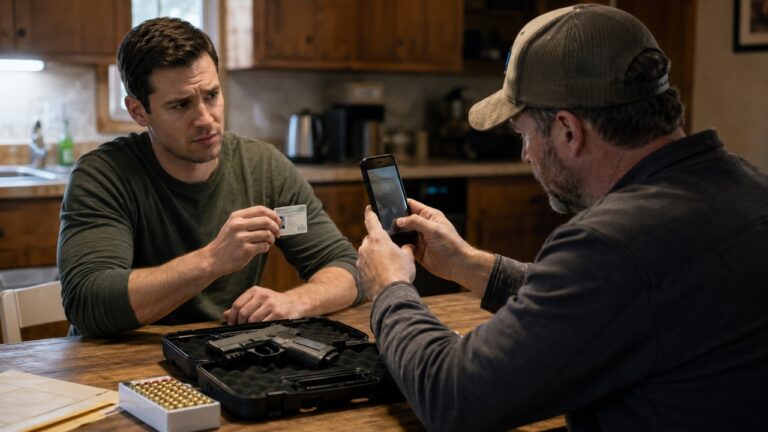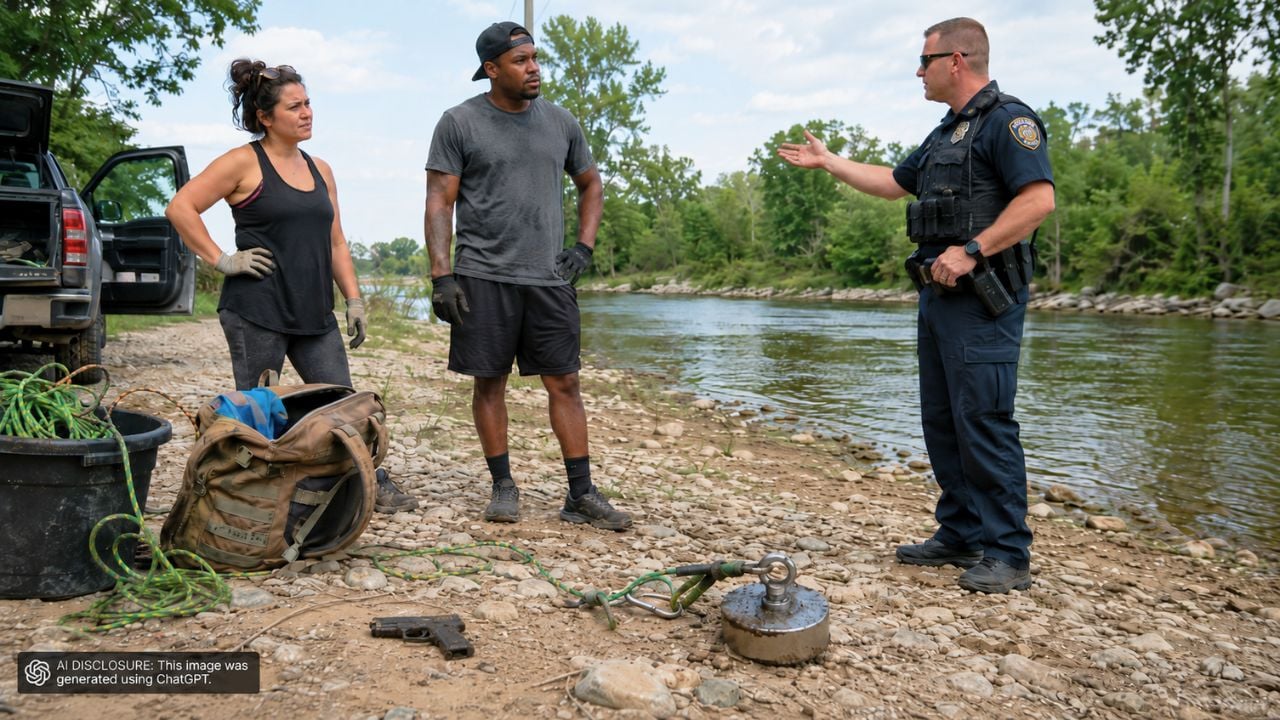
Photo credit: AI-generated image created using ChatGPT. Illustrative only.
Most folks who mess around with magnet fishing expect to pull up bikes, scrap, maybe an old knife. But every so often, the magnet grabs something that changes the whole day—like a handgun coming out of the river with enough integrity left that you can’t just shrug it off as junk.
That’s the situation shown in the source post, where a magnet fisher explains how they handle firearms they find and shares a video that’s basically a case study in what can go sideways when you try to do the “right thing.” They called police, waited roughly three hours for an officer to show up, and then got a response they didn’t expect: the officer wanted them to throw it back.
A river gun isn’t always “just a rusted paperweight”
The poster makes a point that most non-gun folks don’t realize: a lot of firearms pulled from water are so far gone they’re effectively dead weight. In their experience, the majority are “paperweights,” rusted blocks with no realistic chance of being made functional again.
But not all of them. Their personal rule is pretty straightforward: if it looks fresh and functional—or if they can still read identifying numbers—they treat it differently. That’s where magnet fishing stops being treasure hunting and turns into a public-safety and legal headache.
Their decision point: condition, serial numbers, and signs of a recent dump
In the post, the magnet fisher lays out the way they sort finds into buckets. A “fresh” gun that still looks functional? Call law enforcement, specifically the non-emergency number for the county they’re in. A gun with readable numbers that looks like it could’ve been dumped within the last couple decades? They’ll bring it to a station rather than calling for a response on the bank.
Then there’s the other end of the spectrum: an obviously old firearm that’s basically fossilized. Those, they say, they’ll often keep—especially if it’s so far deteriorated that it doesn’t appear to be usable and they’re not confident it has any investigative value. If they’re unsure, they’ll still bring it in rather than gambling.
Calling police sounded simple—until it turned into a three-hour wait
The conflict in this story isn’t really about whether turning in the gun is the right move. It’s about what happens when regular people try to do the responsible thing and hit the reality of understaffed departments, shifting priorities, and an officer who may be thinking purely in terms of “is this usable evidence?”
The poster frames the whole situation around that question. If a gun can’t be tied to anything and isn’t in a condition to provide evidence, some agencies may not want to take custody of it, store it, log it, and deal with the paperwork. From the magnet fisher’s perspective, that can leave you standing there with a wet handgun and no clear, common-sense next step—especially after waiting hours for an officer to arrive.
“Throw it back” is where common sense and real-world safety collide
An officer telling someone to toss a handgun back into the river is the part that’s hard for most outdoorsmen to swallow. Even if a firearm is trashed, it’s still a firearm. It’s also a chunk of metal that doesn’t belong in the water, and it’s potentially something a kid, swimmer, or another magnet fisher could recover later.
There’s also the personal-liability angle. If you’ve already recovered it, you’ve already handled it. If it’s wrapped, taped, or bagged—as the poster notes—there’s a higher chance it was deliberately dumped, and a higher chance somebody doesn’t want it found. At that point, “put it back” feels less like a solution and more like passing the problem downstream.
What experienced magnet fishers actually do when they find a firearm
The most useful part of the post is the practical rule set the magnet fisher uses—because it’s based on repetition, not theory. Their “call versus carry it in” breakdown is built around the idea that you don’t need a squad car on the shoreline for every rusted hunk, but you also shouldn’t be casual with anything that looks recent or identifiable.
They also point out something that matters if you travel to fish, hunt, or camp across state lines: rules aren’t the same everywhere. They note that some places have much tighter restrictions, and in those areas it’s not a good idea to assume you can keep any firearm you pull from the water. Their approach in a different state is to call non-emergency and ask whether the local agency prefers pickup or drop-off.
One more firm line they draw: if the firearm is full-auto, they always turn it in because it’s illegal in their state to possess without the proper licensing. That’s not a detail to gloss over. If you don’t know what you’re looking at, that’s another reason not to play “cleanup crew” on your own.
The takeaway for outdoorsmen: don’t let someone else’s laziness make you sloppy
This is the kind of situation that can happen to anglers, shed hunters, and landowners too. You stumble onto something that shouldn’t be there, you call it in, and the response you get is a mixed bag. The poster’s best advice is the most grounded: if you’re unsure, turn it in—bring it to the station—and if they don’t want it, they’ll tell you.
If you magnet fish, it’s worth thinking through your plan before you ever make a cast. Know the non-emergency number where you’re fishing, have a safe way to keep people back from the find, and treat every recovered firearm like it could still be loaded until proven otherwise. And if someone in authority tells you to do something that feels unsafe or irresponsible, slow down and choose the option that keeps you on the right side of safety and the law.