Photo credit: AI-generated image created using ChatGPT. Illustrative only
It’s one thing to find an old horseshoe or a rusted-out can while doing chores around a rural place. It’s another thing entirely to turn up a handgun and realize it might have a story attached to it.
That was the situation a family in rural Arizona found themselves talking through in the original post—a gun discovered near their home years earlier that never got reported. With a move coming fast, a long-buried decision suddenly became a right-now problem.
A yard-work find turned into a “don’t touch that” moment
According to the account, the father had found a handgun in the desert near the home about 10 years earlier. Instead of calling the sheriff’s department and letting law enforcement handle it, he brought it home and stuck it in a closet.
That kind of “I’ll deal with it later” choice is more common than folks want to admit, especially in wide-open country where you can find all sorts of dumped property. But a gun isn’t a fence post. It can be evidence, it can be stolen, and it can be tied to something a whole lot darker than littering.
Moving day pressure made the decision unavoidable
The issue came to a head while the family was packing up to move out of state—from Arizona to Nevada. During the scramble of boxing up a house, they uncovered the gun again, and the argument started: report it or hide it.
The father reportedly worried that calling the sheriff would “tie him up with legal issues.” In his mind, it was safer to bury it in the backyard or take it along to the new home and keep quiet. But once you cross state lines with a firearm that may be stolen or connected to a past crime, you’re no longer dealing with a simple “found item” question—you’re stacking risk.
The real red flag: it was stored loaded with no safety measures
What pushed the situation from questionable to urgent was the way the gun was being kept. The family member explained it was hidden back in the closet, loaded, with no case, no lock, and no real safety plan.
Plenty of responsible gun owners keep a defensive firearm accessible, but that’s not the same thing as stashing an unknown, found handgun for years and forgetting about it until moving day. A loaded firearm of unknown condition—unknown maintenance history, unknown mechanical state—handled by someone described as older and clumsy is a recipe for a negligent discharge at the worst possible time.
Why “just bury it” is how a bad situation gets worse
In rural country, people sometimes talk themselves into the idea that burying a problem is the same as solving it. With firearms, that’s a quick way to turn one bad decision into several.
For starters, hiding a gun doesn’t make it disappear—it just makes it more likely to be found later by the wrong person. Maybe it gets dug up by a future homeowner, a kid messing around, or even during landscaping. And if that firearm was ever reported stolen—or tied to a case—you’ve now added another layer: you didn’t just fail to report it, you concealed it.
Then there’s the transport idea. Hauling an unknown found handgun to another state, especially when you can’t say where it came from or why you’ve had it for years, is not the kind of roadside conversation anyone wants to have.
The practical advice was simple: tell the truth and let law enforcement collect it
The family member wasn’t asking for ways to get cute with it. They wanted clarity: would calling law enforcement automatically lead to disaster, or was it the best move?
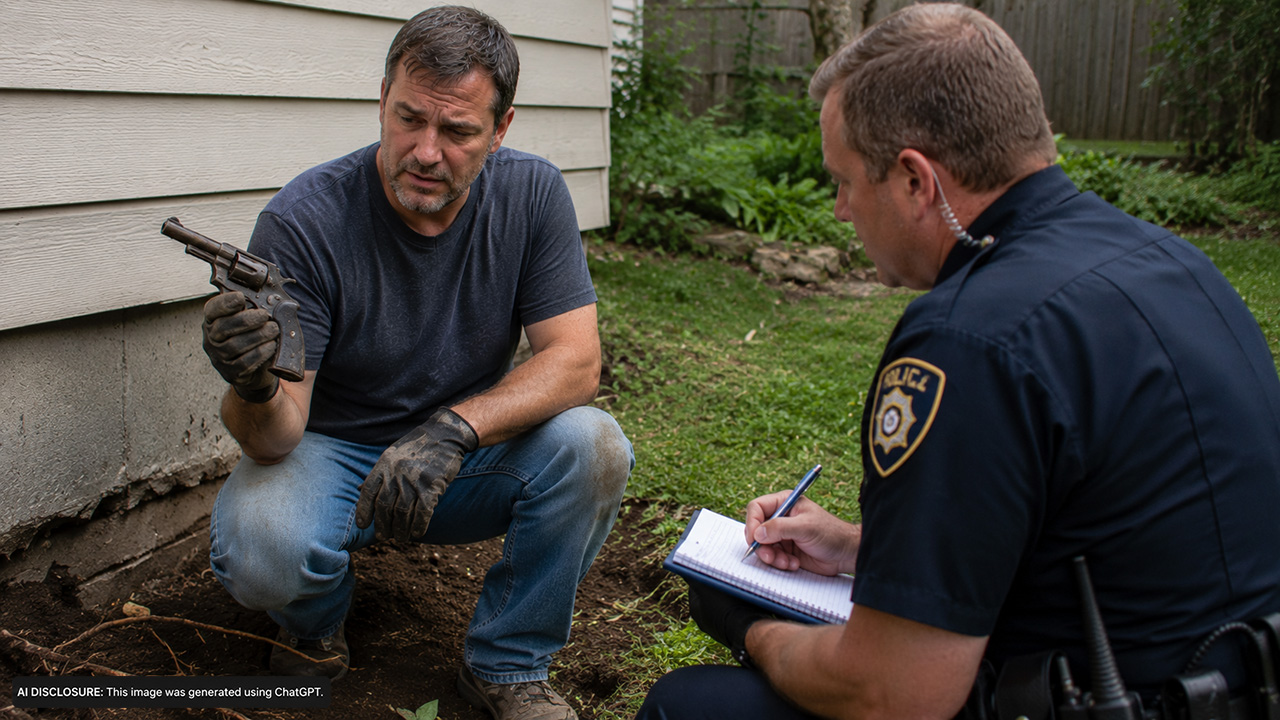
The update makes the ending pretty straightforward. After some hard conversations, the father agreed to call. The sheriff’s office came out, collected the gun, and—based on what the family shared—there were no intense interrogations or drawn-out drama. The gun left the closet and went where it should’ve gone in the first place.
That’s often how it goes when someone does the smart thing early and sticks to the truth. Law enforcement would generally rather safely recover a firearm than have it floating around a household in unknown condition, especially when a family is in the middle of packing and stress is high.
What gun owners and landowners can learn from this
This is a good reminder that “found gun” situations aren’t like finding a stray tool. Even if you’re a lawful gun owner, you don’t know the backstory—stolen property, prior owner, or whether it was dumped to get rid of evidence. And if a gun was stolen from a neighbor years earlier, the person who “found” it and held onto it can still end up answering tough questions when it finally comes to light.
The other lesson is more basic: safe storage isn’t optional just because the gun isn’t part of your regular rotation. If a firearm is in your home, it should be secured in a way that fits your household—locked up, unloaded unless it’s a deliberately staged defensive gun, and stored so it’s not accessible to anyone who shouldn’t handle it.
In this case, the best outcome wasn’t fancy. It was a phone call, a truthful explanation, and letting the sheriff’s office take possession. Sometimes the most “outdoorsman” solution is the one that keeps everybody safe and keeps you out of trouble down the road.
Like The Avid Outdoorsman’s content? Subscribe to our newsletter so you never miss an article.
Here’s more from us: