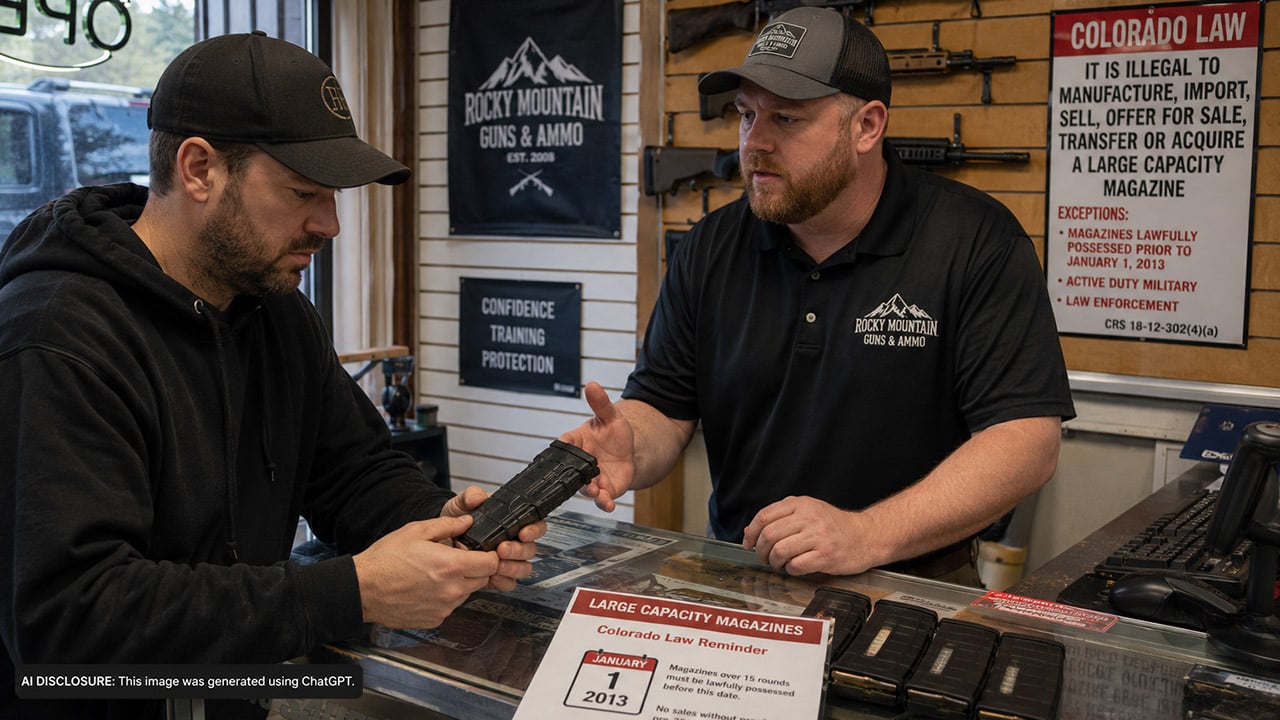
Photo credit: AI-generated image created using ChatGPT. Illustrative only
A move to a new state is enough to keep a person busy—new routes, new rules, and a fresh list of places to buy fuel, groceries, and gear. For one new Colorado resident, that learning curve hit close to home after he bought a Glock pistol from a reputable local shop and walked out with three 17-round magazines.
Only later did he learn Colorado’s magazine-capacity law generally limits magazines to 15 rounds unless they were owned before the 2013 cutoff. That realization, laid out in the original post, left him with the kind of question that makes any gun owner’s stomach tighten: “My question now is what do I do?”
A normal purchase that turned into a legal gut-check
The buyer said he’d recently moved to Colorado and purchased a Glock handgun from a gun store that had the pistol already in its own stock. This wasn’t a private sale, a gun show table, or a shipment coming in from out of state. By his description, it was a “very nice store,” not a sketchy operation.
Before buying, he asked what the gun came with and was told it included three magazines and a speed loader. He returned the next day, filled out the required paperwork, and the staff brought out the Glock case with the magazines and other accessories. Everything looked routine—until he later realized those magazines held 17 rounds.
Colorado’s 15-round limit—and the part people miss
Colorado’s magazine rule is one of those laws that sounds simple until you actually live under it. The buyer said he’d come to understand that magazines over 15 rounds must have been purchased before some time in 2013. That pre-2013 detail is the part that trips up newcomers, and honestly, plenty of long-timers too.
On the ground, the confusion usually comes from two places. First, many common pistols ship with standard-capacity mags—Glock 17-rounders are about as normal as it gets. Second, “legal to own” and “legal to buy/sell/transfer” can diverge quickly depending on how a state wrote the law and how it’s enforced.
The buyer emphasized the magazines were not altered, pinned, or blocked down to 15. In the condition they were sold, they could accept all 17 rounds.
Why the store’s role matters, but doesn’t make the worry go away
When you buy something across the counter at a storefront gun shop, most people assume that means it’s automatically squared away. Usually that’s a fair assumption. Shop owners live and die by compliance, and most are careful because one ugly mistake can bring heat down on their whole operation.
But the buyer’s concern is understandable: if the state restricts the sale/transfer of magazines over 15 rounds unless they’re grandfathered, a brand-new resident doesn’t have the “I’ve owned these since before the cutoff” comfort that a Colorado local might claim. Even if a shop did the wrong thing, the customer is still stuck holding the item that might not fit the rules.
There’s also a practical problem here that gun owners recognize right away: proving a magazine’s age can be murky. Unless a magazine is clearly marked with a production date (many aren’t in an obvious way to the casual buyer), “pre-2013” can be hard to demonstrate without packaging, receipts, or other documentation.
What the buyer was really asking: risk management for regular gun owners
His question—what do I do—wasn’t just about winning a legal argument. It was about staying out of trouble while still being able to run the gun the way it was designed. A 17-round Glock magazine isn’t some exotic accessory; it’s the standard setup that comes in the case for a lot of models.
In a state with capacity limits, though, the safe, practical mindset shifts. Outdoorsmen and shooters tend to think in terms of “What’s the cleanest way to make this right?” not “How close can I get to the line?” Especially for someone new to Colorado, the last thing you want is a bad day turning into a court date because you didn’t understand a state-specific rule.
The post doesn’t describe what he ultimately decided to do, but it does show the pressure point many gun owners feel: if you keep the mags, are you taking on legal risk? If you get rid of them, are you throwing money away because a store made a mistake—or because you misunderstood what was allowed?
The real-world options people consider in this situation
When a magazine law hinges on a date cutoff, most responsible gun owners start with the same basic approach: stop using the questionable mags in public, store everything safely, and get clarity before you keep rolling like nothing happened. That’s not panic—that’s just good judgment.
One obvious step is to go back to the store and ask direct questions: Were these magazines represented as compliant? Are they blocked to 15 (these weren’t)? Does the shop have any documentation about the magazines being pre-2013, or was there confusion at the counter? A reputable store may offer a swap to compliant mags or another remedy, especially if it was an honest mistake.
Another option many folks look at is simply using 15-round magazines going forward, keeping life simple. Glock 15-round mags (depending on model) and compliant options exist, and while nobody loves buying extra mags, it’s cheaper than legal trouble and easier than living with uncertainty.
And if someone wants an authoritative answer for their specific circumstances, that usually means consulting a qualified attorney familiar with Colorado firearms law. That’s especially true when the issue involves possession versus transfer rules and how “grandfathered” status is treated.
A good reminder for anyone buying guns after a move
This is the kind of story that makes you double-check your own habits. A new state can change what “normal” looks like fast, even when you’re doing everything the way you’ve always done it—buying from a clean shop, filling out forms, and walking out with what comes in the factory case.
The best habit to build is simple: before you buy, ask about magazine capacity and compliance the same way you’d ask about twist rate, ammo preference, or whether a rifle is drilled and tapped for your rings. It’s not being paranoid. It’s just part of being a competent gun owner—right up there with safe storage, good muzzle discipline, and knowing what’s beyond your target.
Like The Avid Outdoorsman’s content? Be sure to follow us.
Here’s more from us: