Photo credit: AI-generated image created using ChatGPT. Illustrative only.
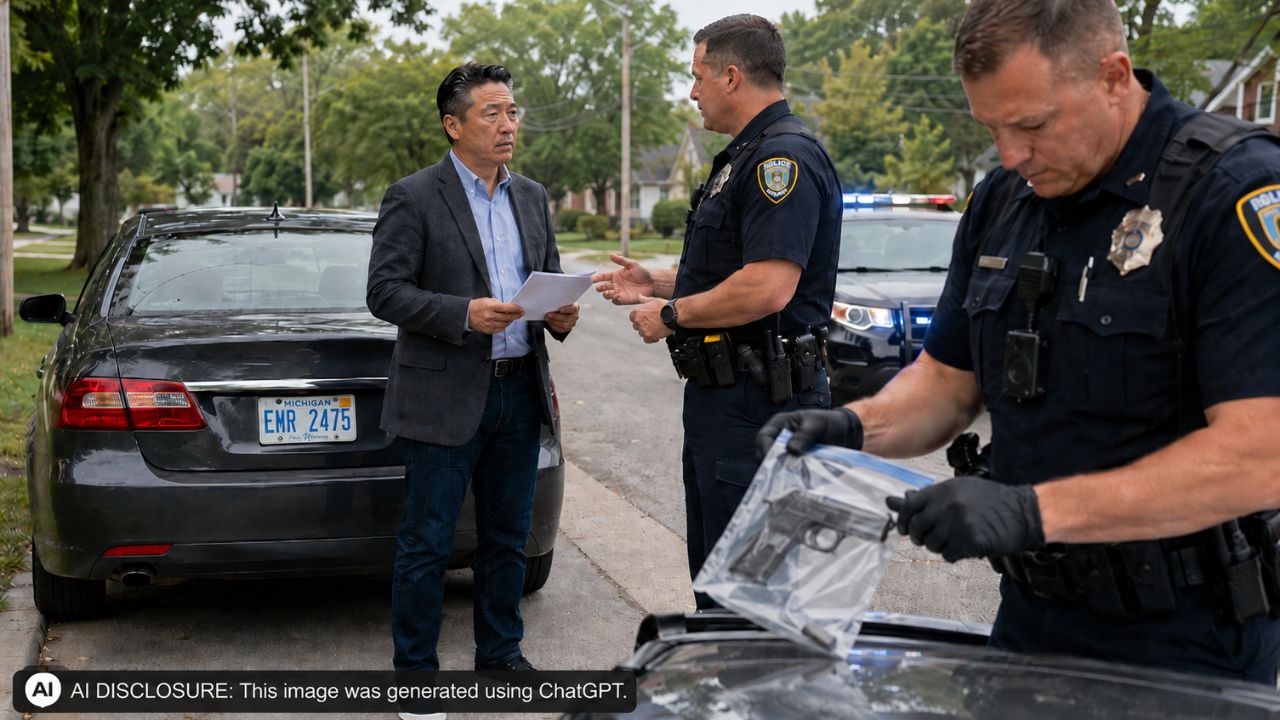
A routine traffic stop in Michigan turned into the kind of headache every concealed carrier hopes they never deal with: you do what the law says, you stay polite, and you still go home without your gun.
That’s the situation laid out in the original post, where a gun owner says he was carrying a pistol with a valid concealed pistol license when he got pulled over for a minor violation. He says he immediately informed the officer he had a firearm—exactly what Michigan requires—only to be told later he’d have to go to court to get his pistol back.
He did the “right” thing, and the stop still went sideways
The gun owner describes it plainly: once he notified the officer he was armed, the officer had him step out and disarmed him. That part isn’t shocking to anyone who carries. Plenty of officers will temporarily secure a firearm during a stop, even when everything is legal, because it lowers the temperature and removes one more variable.
But the surprise came at the end. The driver says the rest of the stop was uneventful, he received his ticket, and then he asked for his pistol back. The officer’s response, according to the post, was that the driver would have to go to court to retrieve it.
Why the “we’ll return it” language matters to gun owners
The part that really threw him was what he’d read from the Michigan State Police: “The police officer will return the pistol at the end of the stop unless the individual is being charged with a violation of the act or any other law that allows for the weapon to be seized.” In his mind, that language meant this should have been simple—ticket issued, firearm returned, everyone goes home.
And that’s the practical expectation most outdoorsmen have, too. If you weren’t arrested, you weren’t charged with a weapons crime, and the gun isn’t stolen or tied to something else, the gun comes back when the stop ends. When it doesn’t, you’re instantly in a gray area where you can’t hunt, can’t carry, and can’t even properly secure your own property—because it’s not in your possession anymore.
“Go to court” can be a costly answer, even when you’re right
The driver’s next thought was one a lot of working people have: is it going to cost more to fight this than the gun is worth? He says he already had an appointment with a local attorney the next day to look at options, but he was worried the legal process would be more expensive than buying a new pistol.
That’s where the real-world pain sets in. A seized pistol isn’t just a missing tool—there’s the cost of replacement, the gap in personal protection, and the lingering concern about how it’s being stored and handled. Even if you eventually get it back, it can take time, and time is money. Taking days off work, paying filing fees, hiring counsel, and making court appearances adds up fast.
How a lawful stop can still end with a gun held
From the details provided, he was not describing an arrest, a resisting situation, or anything that escalated beyond a standard stop. But there are still a few practical reasons a firearm might not be handed back immediately, even if the carrier believes the law is on his side.
Sometimes it comes down to procedure—an officer’s interpretation of policy, uncertainty about the permit status in the moment, or a belief (right or wrong) that the safest way to resolve the encounter is to let the court sort it out. Other times, a gun might be retained while documentation is verified, or because the officer believes some separate legal hook exists that allows seizure. The problem is, from the gun owner’s perspective at roadside, none of that is clear—and “you’ll have to go to court” feels like a brush-off instead of an explanation.
And that uncertainty is exactly why this situation hits a nerve with carriers: you can do everything by the book and still find yourself trying to claw your property back through a system that moves slow.
What the gun owner did next: lawyer up and weigh the cheapest path
To his credit, the driver didn’t talk about confronting anyone or trying to force the issue on the shoulder of the road. He went straight to the most sensible next step—meeting with a local attorney to figure out options.
That’s usually the grown-up move when you’re dealing with property held by government. Whether it’s a firearm, a bow you use every fall, or a truck impounded after a misunderstanding, the fastest way to make it worse is to get emotional and turn it into a confrontation. The second-fastest way is to do nothing and hope it fixes itself. He chose a third option: get advice, then decide if the fight is worth the cost.
The practical lesson for concealed carriers during traffic stops
This story is a reminder that carrying legally is only part of the battle. The other part is navigating the human element—different officers, different interpretations, different agency cultures—and doing it calmly while you’re standing on the roadside trying to stay respectful and stay safe.
If you carry in Michigan (or anywhere else), it’s worth thinking through what you’ll do if your firearm is temporarily taken, and what you’ll ask—politely—if it isn’t returned. Not to argue the law on the shoulder, but to understand what happens next: where the gun is going, what paperwork exists, and what the process is to retrieve it. When “go to court” is the only answer you get, that’s when you’re in the realm of phone calls, documentation, and, sometimes, paying an attorney to help you get your own property back.
For outdoorsmen who carry daily, it’s an uncomfortable reality: even a minor traffic stop can turn into months of hassle if a firearm gets pulled into the system. Staying calm, staying compliant, and getting competent local legal advice is often the only way back to normal.
Like The Avid Outdoorsman’s content? Be sure to follow us.
Here’s more from us: