Photo credit: The Avid Outdoorsman
The agent probably knew the situation was bad before anyone else fully understood it.
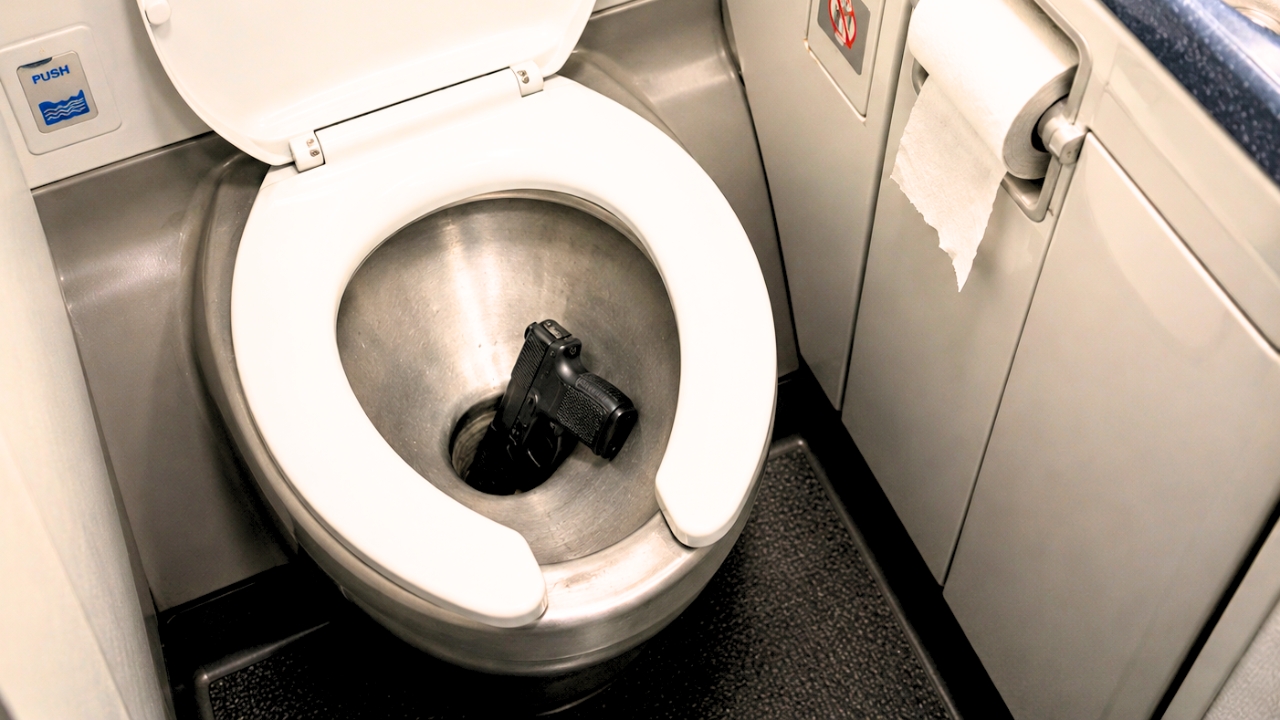
A gun in an airplane bathroom is already enough to make the whole cabin feel smaller. A gun that falls into the toilet and gets stuck there mid-flight is even worse, because now the problem is not only embarrassing. It is trapped inside a sealed metal tube in the sky with nowhere simple to handle it.
In a Reddit thread, concealed carriers were talking about guns being left or mishandled in public bathrooms when one commenter brought up the infamous kind of duty-gun nightmare: a Secret Service agent’s pistol reportedly flipping into an airplane toilet and getting lodged in the drain.
That is the kind of mistake people do not forget.
Airplane bathrooms are not built for grace. They are tiny, awkward, loud, and cramped enough that even regular tasks feel more complicated than they should. Add a duty weapon, a belt, tight movement, and the strange geometry of an aircraft lavatory, and suddenly the room gives you very little margin for error.
A firearm should never become loose in that environment.
But once it did, everything got worse.
A pistol falling into a normal bathroom toilet is gross and embarrassing. A pistol falling into an airplane toilet is a different problem because there is no easy way to step back, gather tools, and deal with it privately. The gun may be wedged somewhere hard to reach. The plumbing system is not exactly designed for firearm recovery. The aircraft is in flight. Crew may need to get involved. The agent cannot just pretend it did not happen.
And because it was a duty gun, the accountability is even heavier.
A regular concealed carrier losing control of a gun in a bathroom is serious enough. A Secret Service agent doing it with a service weapon carries a different level of public embarrassment and professional consequence. There are expectations attached to that role. The weapon is not just personal property. It is issued equipment tied to training, policy, and responsibility.
That makes the image of it lodged in a toilet drain almost unbelievable.
But the lesson is not hard to understand.
Bathrooms are where carry routines often break. The belt comes loose. The holster shifts. The gun gets removed. The carrier tries to create room. A small movement becomes awkward. Something slips. The firearm leaves the secure system, and now the person has to recover from a mistake that never should have had a chance to happen.
On an airplane, that mistake gets amplified.
There is no privacy once help is needed. The crew may have to know. Other passengers may notice something is wrong. Maintenance or security may have to deal with it after landing. Reports may follow. The story may travel much farther than the flight itself.
That is probably the worst part professionally. Nobody wants to be the person whose bathroom carry failure becomes an example in a Reddit thread, a news story, a training room, or a workplace warning. But duty-gun mistakes have a way of becoming cautionary tales because everyone understands how bad they could have been.
The firearm being lodged in the drain also raises the safety concern. If the gun stayed secure, did not fire, and remained inaccessible to passengers, that is the lucky version. But it was still out of the agent’s control. A firearm should not be floating, lodged, slipping, or trapped somewhere the handler cannot immediately secure it.
The whole point of carrying is control.
Control of the weapon. Control of access. Control of the trigger. Control of where it is and who can touch it.
The second it goes into the toilet, all of that control is compromised.
The practical fix is simple in theory and difficult only because people get lazy or improvise. The gun stays holstered. The holster stays attached. If the restroom situation is cramped, the carrier needs a routine that keeps the firearm connected to the body or clothing, not set on a surface or handled loose. If a duty belt or carry method makes that nearly impossible, the person needs a trained, repeatable process before stepping into a tiny aircraft lavatory.
Not a plan invented mid-flight.
This story also shows why “it won’t happen to me” is not a carry strategy. If a trained federal agent can have a bathroom firearm disaster, regular carriers should not act like they are above building careful habits. The problem is not always knowledge. Sometimes it is environment, distraction, awkward movement, and one second of bad handling.
That is all it takes.
The agent likely recovered from the incident professionally in some form, but the story itself is the kind that sticks because it is so specific and so preventable. A pistol in a toilet drain is funny only because nobody was hurt. It is also a bright red warning about what happens when carry gear leaves a secure system in the worst possible place.
A bathroom break should not become an aircraft security problem.
But once a gun goes into the toilet, that is exactly what it can become.
Commenters treated the airplane bathroom story as extreme, but the lesson was the same as every bathroom-carry mistake.
Several people said the firearm should never be removed and set loose in a restroom if there is any way to avoid it. Once the gun is separated from the holster or body, the chance of dropping it, forgetting it, or losing control goes up fast.
Others focused on how cramped airplane bathrooms are. If a carry setup cannot be managed safely in tight spaces, the person carrying needs a better routine before entering that environment.
A lot of commenters pointed out that duty guns come with even higher expectations. A civilian carry mistake is serious; a service weapon mishandled in public can become a professional and security issue immediately.
Some also joked because the image is hard not to laugh at, but the practical warning stayed clear: if the gun is lodged somewhere you cannot easily retrieve it, you have lost control of it.
The main takeaway was simple: bathroom carry needs a plan everywhere, but especially in tight public spaces where one dropped gun can become everyone’s problem.