Photo credit: The Avid Outdoorsman
The owner was trying to answer the question every carry gun eventually has to face.
How reliable is reliable enough?
That sounds simple until a gun gives you just enough trouble to make the answer uncomfortable. Not constant failures. Not a complete disaster. Just a couple of malfunctions spread across enough shooting that you cannot tell whether you are looking at a serious issue or normal mechanical reality.
That was the problem here.
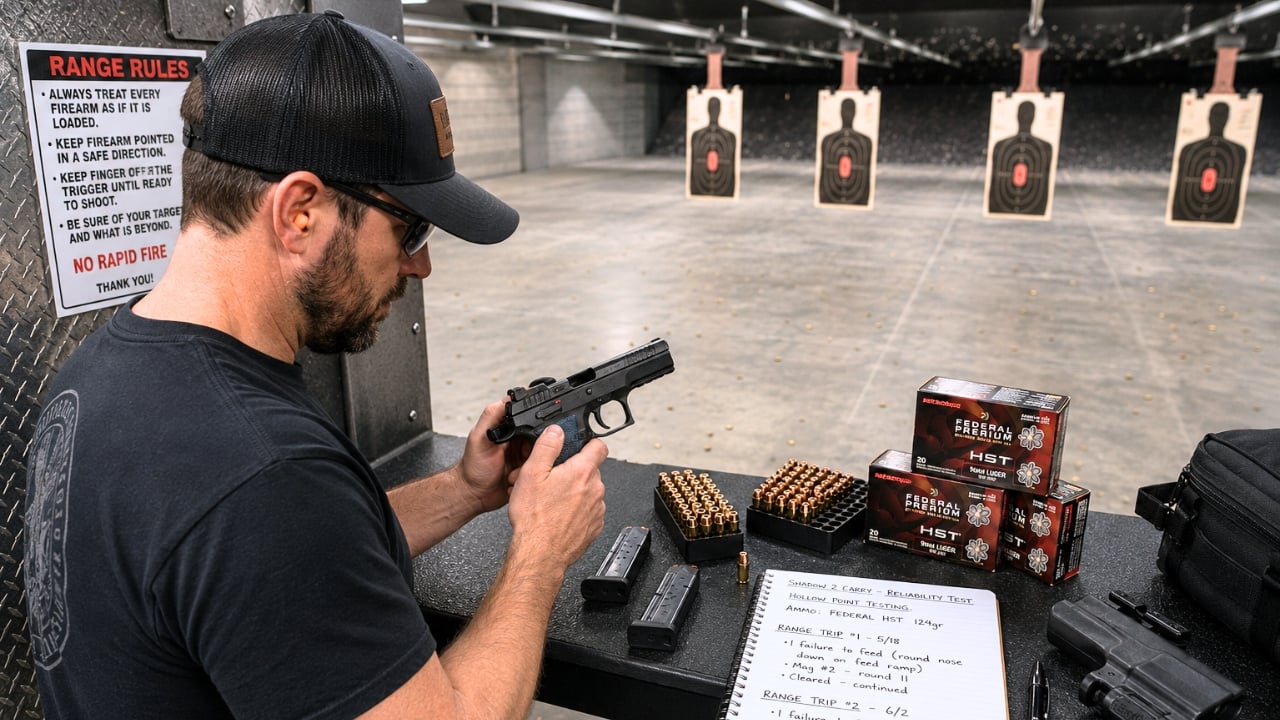
In a Reddit post, the owner talked about reliability concerns after his Shadow 2 Carry had two hollow-point failures across two range trips. The pistol had not turned into a jam machine, but it had failed enough with carry ammo that he started wondering where the line should be.
That is a fair question.
A range gun can be forgiven for a lot. A match gun can be tuned, cleaned, adjusted, and fed exactly what it likes. A carry gun lives under a different standard. It does not have to be perfect in some imaginary way, but it does need to be trusted without bargaining. If the owner is loading hollow points and quietly wondering whether the next one will feed, the setup has not earned confidence yet.
The tricky part is that two failures do not tell the whole story by themselves.
What kind of failures were they? Did the rounds nose-dive into the feed ramp? Did the slide stop short of battery? Did it happen with the same magazine? The same ammo? The same round position in the magazine? Was the gun new? Clean? Dry? Was the shooter using a firm grip? Did ball ammo run fine? Did other hollow points work?
Those details matter because a malfunction is not just a number.
Two failures in 20 rounds is very different from two failures in 500. Two failures with one magazine tells a different story than two failures across every magazine. Two failures with one hollow-point load may mean the gun does not like that bullet profile. Two failures with several defensive loads may point back toward the pistol.
That is why reliability testing has to be more specific than “it jammed twice.”
A Shadow 2 Carry is also an interesting gun for this kind of question because the Shadow line comes from a competition background. The Carry version is built for a different role, but owners still expect a lot from it. They expect it to shoot well, feel refined, and run like a serious pistol. So when hollow points stumble, the disappointment hits harder.
But expectations do not clear malfunctions.
If the gun is going to be carried, it has to run the load chosen for carry. Not just full metal jacket. Not just range ammo. The hollow points need to feed from full magazines, partially loaded magazines, first round, last round, and every magazine the owner plans to use.
That is where the owner’s concern made sense. Hollow-point failures are the exact thing carry testing is supposed to uncover. A defensive round can have a wider mouth, different profile, or slightly different overall length than ball ammo. Some feed ramps and magazine designs handle that beautifully. Some combinations are pickier.
It does not matter how good the ammo is in general if that gun does not run it.
The owner had a few paths forward. He could try a different defensive load with a more forgiving profile. He could mark magazines and see if the failures follow one mag. He could inspect the feed ramp, extractor, recoil spring, and chamber. He could clean and lubricate the pistol, then run a more structured test. He could contact the manufacturer if the issue repeats.
What he should not do is ignore the pattern and carry it anyway because he likes the gun.
That is the temptation with expensive or well-liked firearms. Nobody wants to admit the gun they wanted to trust may need work. Nobody wants to switch ammo after buying several boxes. Nobody wants to run another expensive test. But the gun does not care how much it cost or how much the owner likes it. It either feeds the chosen carry load or it does not.
The “how much reliability is enough” question gets argued endlessly, but the practical answer is simpler than people make it.
The owner needs enough clean testing with his actual carry setup that he is no longer waiting for the next failure. That may mean 100 rounds of carry ammo for one person, several hundred for another, plus regular practice with cheaper ammo and periodic function checks. There is no magic number that makes a bad pattern disappear.
A gun that fails twice with hollow points needs an explanation before it gets trusted.
The good news is that the failures happened at the range. That is where a carry gun should reveal its weak spots. The owner had time to stop, inspect, ask questions, and make changes. That is annoying, but it is also the point of testing.
A carry setup is not proven by reputation.
It is proven by boring repetition.
If the Shadow 2 Carry can run the right hollow point through the right magazines without repeating the issue, confidence can come back. If it keeps stumbling, the answer is clear no matter how good the gun feels in hand.
A defensive pistol has to do more than shoot well.
It has to feed when it counts.
Commenters mostly treated the failures as something that needed more structured testing before the gun could be trusted for carry.
Several people said two failures are not enough detail by themselves. The owner needed to track the magazine, ammo, round position, and exact type of stoppage to figure out whether the problem was the gun, the mag, or the hollow-point load.
Others focused on trying different defensive ammo. A gun can dislike one hollow-point profile and run another perfectly. The fix may be as simple as switching loads, but that has to be proven with live fire.
A lot of commenters said magazines should be marked and tested separately. If both failures came from the same magazine, the answer may be much easier than blaming the whole pistol.
Some were stricter and said they would not carry any gun that had recent hollow-point failures until it ran a solid follow-up test without issues.
The main takeaway was simple: reliability is not a feeling. If a carry gun fails with defensive ammo, find the cause and make it prove itself again.