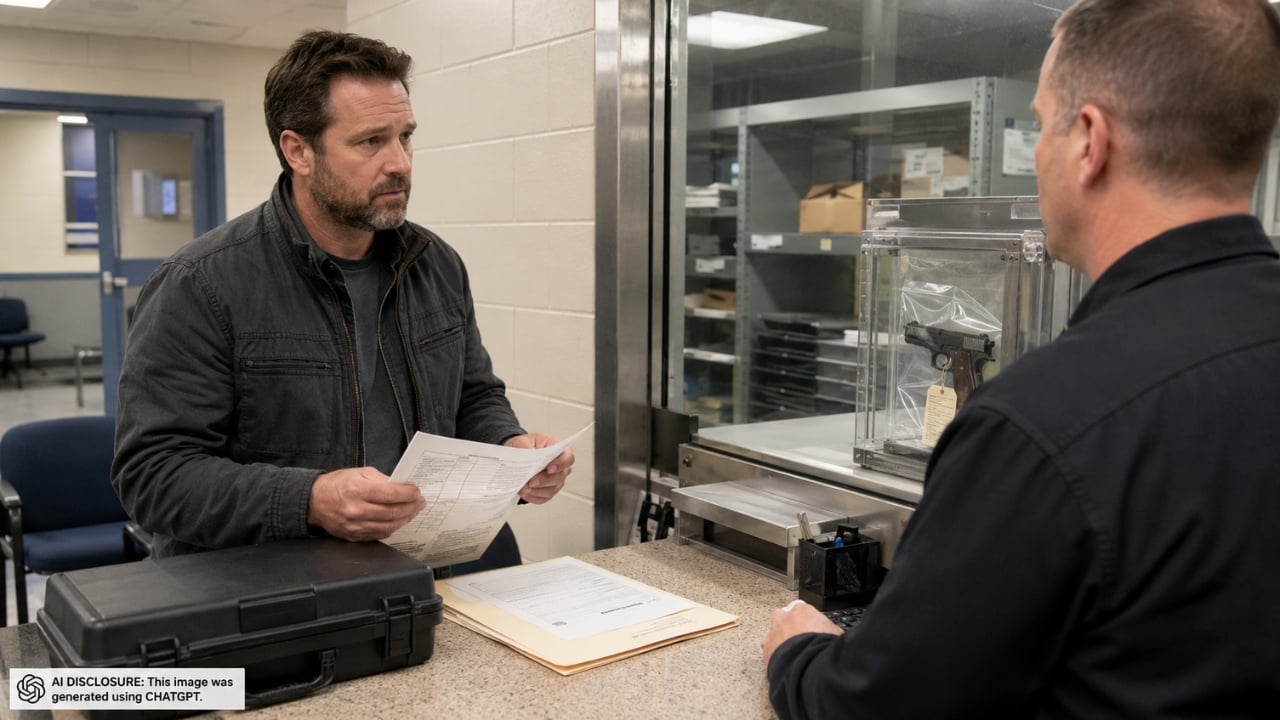
Photo credit: AI-generated image created using ChatGPT. Illustrative only
Most gun owners understand that when the police seize firearms after an arrest, getting your property back can turn into a long, slow grind—even if the case falls apart. One Washington man says that’s exactly what happened to him after an incident in November 2023, when he was arrested based on claims he says later proved false.
In the original post, he explains that the charges were eventually dismissed with prejudice. The city returned his other firearms, but kept one pistol—built on an 80% lower—arguing it qualified as an “untraceable firearm” under a Washington statute that he says shouldn’t apply to a build completed well before the law’s cutoff date.
Charges gone, but one pistol stayed behind
According to his account, the arrest happened in November of 2023. He doesn’t lay out the full incident in detail, but he does say the other party’s claims were false and the end result was clear: all charges against him were dismissed with prejudice.
That phrase matters in regular-guy terms. It means the case is dismissed and can’t simply be refiled the same way later. In his mind, that should’ve been the end of it—especially where his personal property was concerned.
The city returned the rest—then drew a line at an 80% build
He says city police confiscated his firearms during the arrest process. When the criminal case was dismissed, he got back everything but one gun: a pistol built on an 80% lower he completed “well before 2019.”
For plenty of outdoorsmen, that detail is familiar. A lot of people built personal-use firearms years ago, kept them secured at home, and never caused any trouble with them. But in this case, that one firearm became the sticking point, and it stayed in evidence even after the criminal side was over.
The law the city cited hinged on dates—and that’s where the fight was
The city attorney, he says, refused to return the pistol under RCW 9.41.326(2), treating it as an “untraceable firearm.” The owner’s pushback was straightforward: Washington’s definition of “untraceable firearm,” in RCW 9.41.010(52), centers on guns “manufactured after July 1, 2019.”
His position was that his pistol doesn’t meet that definition because it was built before that date. And he says the city hadn’t issued any new charges or infractions related to the pistol even while continuing to keep it.
That’s the part that makes gun owners uneasy. When your charges are dismissed but the government keeps your property anyway, it stops feeling like evidence and starts feeling like a punishment that didn’t go through court.
Two options offered: serialize it through an FFL, or surrender the lower
In an update the next day, he wrote that he spoke directly with the city attorney. The city attorney offered two paths forward.
The first: release the pistol to an FFL so it could be serialized. The second: dismantle the gun, forfeit the unserialized lower, and get back “all the other parts.” If you’ve ever priced out a quality build, you know the lower isn’t the only expense—but it’s the regulated part, and it’s the piece that turns a box of parts into a firearm in the eyes of the law.
He also noted a real-world snag that people run into fast: he had not yet found an FFL willing to do the serialization due to “conflicting state and federal laws.” Whether that’s a paperwork concern, a policy concern, or simply a shop deciding it’s not worth the headache, the end result is the same. An option that looks simple on paper can be hard to execute in the real world.
He told the city attorney his thoughts on the legal definition and says the attorney agreed to look into it and call back. Importantly, he also says the city attorney agreed not to dispose of the pistol while options were being worked through.
Finding an attorney was its own battle
If you’ve ever tried to hire a lawyer for something that’s not a clean, straightforward case—especially when you’re not currently facing charges—you know how many doors can close fast. He wrote that he called “so many attorneys” and couldn’t get help. Several told him they don’t take cases like this, or to call back if charges were filed.
That’s a tough spot. On one hand, you’re being told you don’t need a criminal defense attorney because you aren’t charged. On the other hand, you still can’t get your firearm back, and you’re watching the calendar roll while the government holds your property.
By June 13, he reported he had hired an attorney, and that attorney was communicating with the city attorney. He didn’t claim victory at that point, but he sounded more optimistic once he had representation.
A deadline came and went, then the city shifted
On June 24, he posted another update: his attorney gave the city a deadline to return his property. He says the city missed that deadline and didn’t respond to communications, and he expected some kind of court action could be filed soon.
Then, just a few days later, things moved. On June 27, he wrote that the city attorney “agrees with our analysis” of the laws that “effectively grandfather” the pistol and gave the green light for police to release it.
Even then, it wasn’t as simple as walking in and picking it up. He said he was waiting on a background check to come back before he could take possession. And on June 28, he reported that the background check did come back and he had an appointment to pick it up the following Monday.
That’s often how these things end—not with a big public apology or a neat press conference, but with a quiet appointment and a lot of time and attorney fees burned along the way.
What gun owners can take from this kind of mess
This man’s story—based on his own updates—reads like a warning label for anybody who owns guns in a state with fast-changing firearms law. If a firearm gets swept up in an arrest, even an arrest that doesn’t stick, getting it returned can turn into a separate fight with separate rules.
It also shows how much hinges on definitions and dates. The core dispute here wasn’t about whether he was allowed to own firearms after the case was dismissed. It was about whether one specific pistol fit a legal definition the city was relying on, and whether that law applied to something built before the cutoff.
And finally, it’s a reminder to stay calm and methodical. He kept communicating, pushed back on the interpretation, worked through the options offered, and eventually brought in an attorney when it became clear the city wasn’t going to resolve it quickly on its own.
If you ever find yourself in a similar situation, the practical play is the boring one: document what you own, keep receipts and build dates where applicable, store your gear safely, and don’t assume “dismissed” automatically means “returned.” Sometimes you have to fight that battle separately—one phone call, one letter, and one deadline at a time.
Like The Avid Outdoorsman’s content? Be sure to follow us.
Here’s more from us: