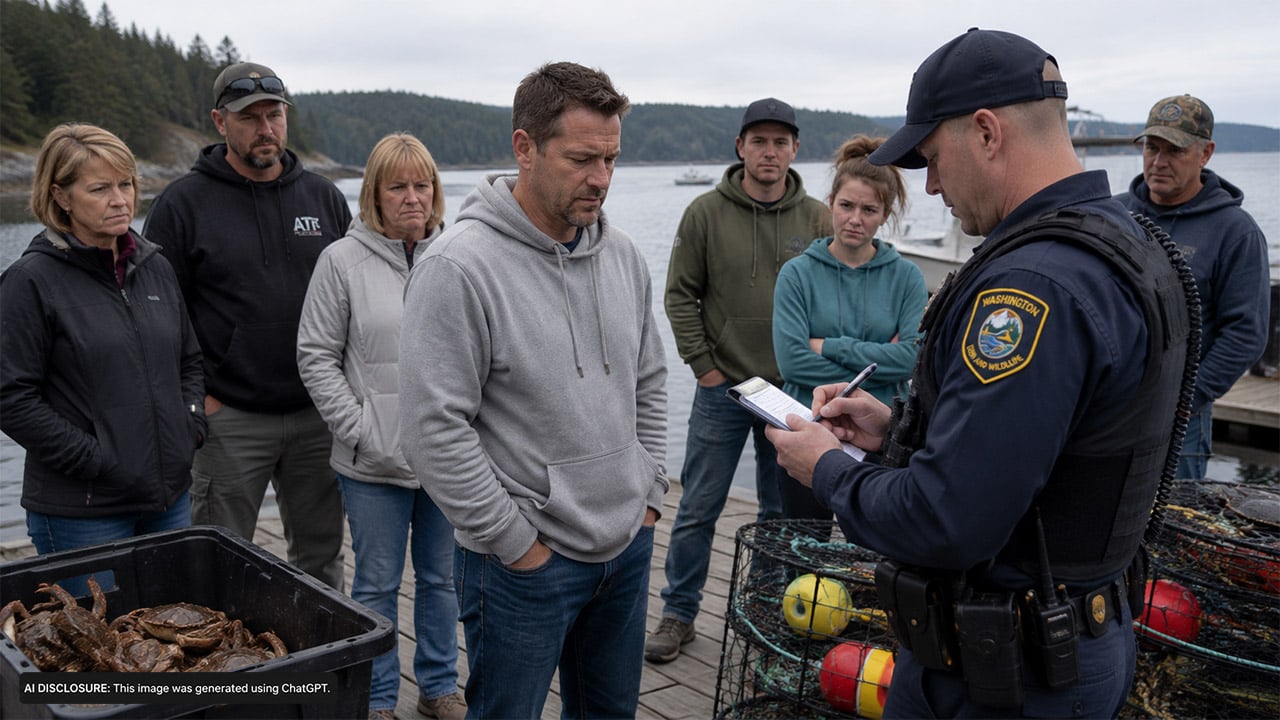
Photo credit: AI-generated image created using ChatGPT. Illustrative only
A family reunion campout on Camano Island, Washington, turned into the kind of headache that can follow an outdoorsman for a long time—especially when licenses and limits get loosey-goosey. In the original post, a man said he joined his girlfriend’s family for their annual get-together, where crabbing is a tradition and this year they had a boat to run pots.
Six relatives bought crabbing permits. He didn’t. He still got asked to help because the pots were heavy and other folks had already pulled them earlier. He agreed, was handed someone else’s permit, and assumed that meant he was covered. On the water, an enforcement boat rolled up, and that assumption got expensive fast.
How a “helping hand” became fishing without a license
According to the account, he wasn’t trying to be the hero or the captain—just extra muscle. Anyone who’s pulled crab gear in current knows it can be real work, especially if you’re doing it by hand and the pot comes up loaded with seaweed, rocks, or a surprise tangle.
But Washington’s rules don’t treat “helping” the same way families do around a campsite. The enforcement officers told him you can’t touch the pots unless the permit is in your name. In other words: if you’re pulling, setting, or actively participating, you’d better be legal under your own license—no matter who owns the boat or whose buoy is on the line.
The wildlife officers found more than one problem
The stop didn’t revolve around a single oversight. The officers asked for a measuring device, and the group didn’t have one on board. That’s a basic piece of crabbing gear that should live in the tote with your bait and gloves, right next to your license holder.
Then they checked the crab and determined some were “soft” and undersized. Whether that was a misunderstanding of what was kept versus what was supposed to be tossed back, or simple inexperience, it didn’t matter in the moment. It stacked the situation from “paperwork issue” into “multiple violations,” and that’s where things start to feel criminal instead of just inconvenient.
The citations: RCW 77.15.380 and a court date
He said he received a criminal offense citation and a court date, with two violations of RCW 77.15.380—one for fishing without a permit and one for obtaining undersized Dungeness crab. He described it as a second-degree misdemeanor and worried about it going on his record.
That’s the part a lot of anglers don’t think about when they’re tossing gear in the truck for a weekend. Fish and wildlife enforcement isn’t like forgetting to renew your tabs. When the state writes something as criminal—especially when it involves taking wildlife—your clean record and “good intentions” don’t automatically keep it out of the system.
The moment the stop got worse: false names on the boat
Later, he added a detail that changes the tone. There were three people on the boat: him, his girlfriend’s dad (“Bob”), and another person (“Fred”). When the sheriff asked for names, Fred allegedly gave false names in an attempt to match the names on the crab pots.
The poster said both he and Bob were caught off guard, but when officers asked them to confirm the false names, they did—what he called a “big mistake.” Officers ran the names, confronted Bob because the picture didn’t match, and Bob admitted his real name. Then the officers asked the poster if he had given his real name; he said no and then provided it.
Bob received an additional violation for using someone else’s permit. The poster said he did not receive an additional violation for the lie, but he was concerned it would still be in the report—and that’s a fair concern. Once a stop involves dishonesty, even briefly, it changes how enforcement and courts view the whole event.
The practical lesson outdoorsmen learn too late: licenses don’t “loan out”
Most of us grew up with the idea that family shares tools, gas money, and chores. In the outdoors, the state doesn’t care about that logic when it comes to tags, permits, and daily limits. The poster said he believed being handed someone else’s permit made him legal to crab, especially because they were with an “experienced crabber.”
That’s the trap: experience doesn’t transfer legal responsibility. Your name is either on the license or it isn’t. If you’re on the boat and doing the work—pulling pots, handling crab, sorting keepers—you should assume enforcement will consider you a participant. The cleanest way to avoid this is simple: everyone who’s going to do anything beyond ride along gets their own permit, and the measuring device is on board before the boat leaves the dock.
Attorney money versus self-representation: why the price tag didn’t surprise anyone
He contacted a couple attorneys and was quoted $1,500–$2,000 to try to keep the misdemeanor off his record. He wondered if lawyers were eager because it was an “easy case” he could get reduced on his own, or if he should pay to play it safe.
After the false-name detail came out, Bob hired an attorney for $2,000, and the same attorney offered to represent the poster for $1,500 since he didn’t have the third violation. Whether that’s “fair” depends on local practice, the exact charging language, and what kind of deal—if any—a prosecutor might consider. But from an outdoorsman’s perspective, the bigger point is this: once you’ve got a criminal citation tied to wildlife, plus undersized crab, plus a stop that included false names, you’re no longer in “I’ll just explain it to the judge” territory.
This is also where people get burned by thinking a clean record guarantees mercy. It helps. It doesn’t erase the elements of the alleged offense. And self-representation means you’re learning court procedure, negotiation, and evidentiary pitfalls on the fly—while your record is on the line.
Crabbing with family is supposed to end with a cooler and a fish fry, not a court date. The grounded takeaway is pretty plain: don’t pull gear without your own permit, keep the gauge on the boat, and if enforcement asks questions, don’t play games with names. The water is a bad place to improvise, and the courthouse is an even worse one.
Like The Avid Outdoorsman’s content? Be sure to follow us.
Here’s more from us: