Photo credit: Willy Mobilo/ Shutterstock.com
When you hike alone, you’re not automatically “bait,” but you do change the math for any predator that’s watching. One set of eyes, one set of footsteps, one brain trying to navigate terrain, weather, and fatigue at the same time. Predators don’t need you to be weak, just predictable. A solo hiker tends to stop more often, drift off-trail to glass a ridge or filter water, and move quieter than a pair talking. In real use, that’s what matters: the conditions that create a window for a stalk, not the internet myth that “predators hunt people.”
Most predators don’t want the smoke. They want low risk, high payoff, and an exit route if things go sideways. The animals most likely to stalk a solo hiker are the ones built for ambush, the ones that already see large mammals as food, and the ones that have learned people can be distracted or sloppy with food and pets. Region, season, time of day, and your behavior decide what’s “likely” where you are, but the pattern stays the same: you look most interesting when you’re quiet, alone, near cover, and acting like you don’t know you’re being watched.
Why solo hikers get targeted differently than groups
A stalk usually starts with information. Predators read sound, cadence, scent, and routine, and a solo hiker gives them a cleaner signal. A group creates noise that changes constantly, and that unpredictability is a risk flag to an animal that makes a living on timing. Alone, you’re also more likely to wear earbuds, stop to check a map, crouch to tie a boot, or stand still to take photos. Those pauses matter because ambush hunters are looking for moments when you’re not scanning and your body language says “not alert.” In thick timber, brushy draws, or broken rock, you also lose long sight lines, and that’s where stalking becomes practical instead of theoretical.
The other factor is response cost. Two or three adults can face a predator, throw rocks, shout, and look big from multiple angles. One adult can still do all of that, but it’s easier for the animal to maintain the psychological edge because it only has to manage one set of eyes. If you add a small dog on a long leash, the risk picture can get worse fast. A lot of serious incidents start with the dog racing ahead, surprising an animal, then sprinting back to you with the animal following the commotion like it’s part of the chase. That’s not “the predator hunting humans,” it’s the predator responding to a trigger and you being the biggest object at the end of the leash.
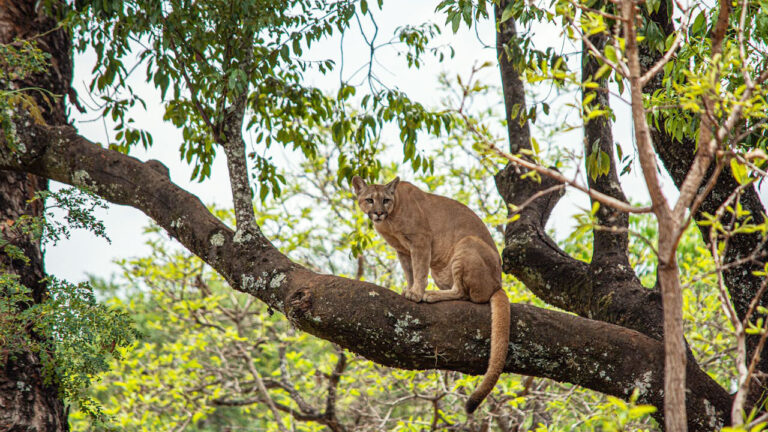
Mountain lions are the classic stalkers for a reason
If you’re asking “what’s most likely to stalk me,” mountain lions sit at the top because stalking is literally their tool kit. They’re wired for quiet approach, close range commitment, and a fast finishing bite, and they use terrain like a piece of gear. Edges are their friend: the line where timber meets meadow, the shadow under a rimrock ledge, the brushy cut bank along a trail. Dusk and dawn matter because their advantage grows when your eyes struggle, and a solo hiker moving in and out of shade is exactly the kind of target profile that can hold their attention. The lion isn’t thinking about your hiking résumé; it’s thinking about distance, cover, and whether you noticed it.
Most lion encounters don’t become attacks, and that’s worth saying out loud. But when attacks happen, the common threads are familiar: a lone person, low light, and a lion that committed inside of about 30 yards because the cover let it. Cats also key on movement. If you turn your back and jog, or you crouch in a way that looks like prey posture, you can flip a switch. That’s why the best real-world response is boring and effective: face it, talk loud, keep your feet, and make it think you’re a problem, not a meal. If you’ve got pepper spray, it’s for the moment the distance collapses, not as a warning shot into the air that does nothing but waste time.
Bears don’t “stalk” often, but certain situations can look like it
Black bears usually aren’t stalking you the way a cat does, but they absolutely can shadow you when food is involved or when they’re trying to sort out what you are. In some areas, bears have learned that hikers equal calories because people drop snacks, leave packs open, or camp with food smells baked into their clothing. A bear that follows you down a trail at 40 to 80 yards, ducking into brush when you turn, can feel like you’re being hunted, and in a way you are, just not as prey. You’re being evaluated as a moving food opportunity. The mechanism is simple: bears have incredible noses, they pattern high-traffic routes, and they’ll take a low-effort chance if they think you’re careless.
Where it gets serious is when you combine surprise distance with a defensive bear, especially a sow with cubs or a bear on a carcass. Dense alder, noisy creeks, wind in your face, and a tight corner on trail are the classic ingredients. You come in quiet and close, the bear gets a spike of threat, and the charge is about making you leave. That’s why bear safety isn’t mystical. It’s practical: manage noise in blind terrain, watch wind, don’t run, and don’t let curiosity pull you toward fresh digs, a dead animal smell, or a pile of birds acting weird. If you’re alone, your margin is smaller because nobody else is scanning while you’re filtering water or messing with gear.
Grizzlies and brown bears are about space, surprise, and season
In grizzly country, the problem isn’t usually “a bear stalking a hiker,” it’s a bear and a hiker colliding at the worst possible distance. The outcome can still look like you were targeted because the bear may keep coming after the first contact, but the engine under it is defensive aggression. Spring green-up, late summer berries, and fall hyperphagia are the big feeding windows, and that’s when bears are motivated and less tolerant of surprises. Add a headwind that covers your sound, or a creek that eats your footsteps, and you’ve set the table for a close encounter without meaning to.
A solo hiker has to treat terrain like it’s part of the safety plan. If you’re side-hilling through thick brush, crossing a salmon stream, or pushing through a saddle with no visibility, you need to assume something big could be right there. That means calling out, clapping, or talking before you hit the tight spot, not after. It also means keeping your deterrent where your hand already lives, not buried under a rain shell in the pack. In the real world, the “failure point” is usually access and time: people see a bear at bad distance, their brain freezes, they fumble gear, and the moment is already gone.
Wolves and coyotes are rarely the stalkers, but they can shadow you in the wrong context
Healthy wild wolves almost never treat adult humans as prey, and most “wolf stalking” stories are wolves paralleling a trail out of curiosity or tracking a dog. Still, if you’re solo in deep snow, running a ridgeline at dusk, or moving through a drainage where a pack is working, you may see animals that keep pace at a distance. That feels predatory because it’s a predator doing predator things, but the key question is what they’re focused on. If you have a dog, you’ve increased the odds of interest dramatically because canids understand dogs as competitors or potential targets, and that can pull them closer than they would come for a person alone.
Coyotes are similar but scaled down, and the biggest risk factor is habituation around towns, trailheads, and campgrounds where they learn people don’t punish bold behavior. A coyote that lingers, follows, or tries to “escort” you off an area is often guarding a den or testing boundaries, and a solo hiker who freezes or backs away nervously can make it worse. The mechanism is confidence. Canids push when they sense uncertainty, and they back off when you act like the bigger, meaner animal. Loud voice, aggressive posture, and throwing rocks on purpose, not in panic, usually ends it fast.
Feral dogs are the most underrated stalking problem on foot
If you want a predator that actually does stalk and harass humans with regularity, feral or free-roaming dogs deserve more attention than they get. They’re common near rural edges, oilfield roads, desert towns, reservations, and anywhere dumping and neglect turn into packs. They understand trails and road cuts, they’ll use cover, and they’re comfortable closing distance because they’ve spent their whole lives reading people. The behavior can look like a wolf encounter, but the difference is willingness. Dogs are more likely to test you, circle you, and push in for a bite because they’re used to being around human spaces without consequences.
The failure points here are predictable: people turn their back, people run, people scream and flail, or people try to “be nice” and de-escalate with submissive body language. If a dog pack is keyed up, running is an invite, and bending down to pick something up can get you bit in the face. The practical answer is layered: keep distance with voice and posture, put a tree or rock at your back if you have to, and be ready to use a deterrent if they commit. This is one scenario where a bright handheld light at dusk and a firm stance can matter as much as anything else, because dogs feed off movement and doubt.
How you cut your odds without turning the hike into a tactical exercise
The best anti-stalk strategy is simple awareness applied at the right moments. In low light, slow down in edge habitat and stop doing the “head down, power through” thing that makes you blind. When you have to stop, choose a spot with visibility and put your back to something solid so you’re not surrounded by cover. If you’re filtering water, don’t kneel in brush with your pack ten feet away; keep your gear close, stay upright when possible, and scan between steps. Wind matters more than most people admit. If it’s in your face, you’re walking into an animal’s nose zone without warning it, so make noise before you round the bend, especially in thick stuff.
If you carry bear spray, carry it like you mean it. That means chest strap, belt, or a pocket you can access with either hand, not buried in the pack lid. Most failures aren’t because spray “doesn’t work,” they’re because the person never got it out in time or never trained the motion under stress. Practice drawing it, flipping the safety, and indexing the nozzle without looking. Also be honest about your behavior: earbuds, hoodie up, and staring at a phone on a narrow trail is how you turn a manageable situation into a close-range surprise. You don’t have to be paranoid. You just have to stop giving predators the exact conditions that make stalking easy.
Like The Avid Outdoorsman’s content? Subscribe to our newsletter so you never miss an article.
Here’s more from us: