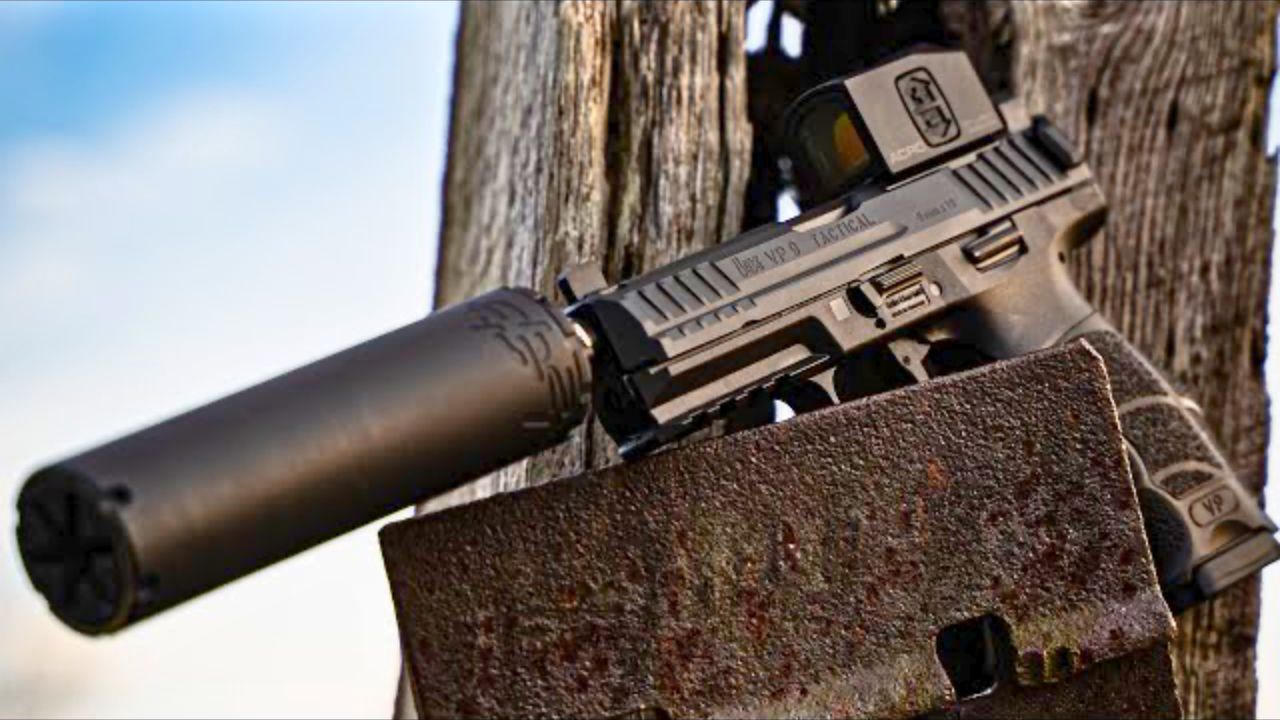
Photo credit: Alabama Arsenal/YouTube
Dealers are not talking about a vague rush on suppressors. They are looking at a specific collision of policy changes, ATF capacity, and manufacturing limits that could leave you waiting months for a can that would have been on the shelf a few weeks earlier. With the long standing $200 tax stamp about to disappear and new rules reshaping how approvals work, the warning from behind the gun counter is simple: if you wait for “FREE,” you may be stuck in the longest line the NFA world has ever seen.
Why dealers see a suppressor crunch coming
You are hearing more shop owners quietly tell regulars to buy now because they see a rare alignment of incentives that will pull a huge wave of buyers into a system that still moves slowly. For years, the $200 tax stamp kept suppressors in a niche, but once that cost drops to zero, the only real friction left is time, and time is exactly what the ATF and manufacturers are short on. Dealers are looking at their own inventory, their distributors’ backorders, and the pace of current approvals and concluding that the pipeline is about to clog.
That concern is rooted in the way the National Firearms Act has worked for nearly a century, with each suppressor tied to an individual tax payment and a separate background check. As of mid 2025, electronic filing has helped, but even optimistic estimates of current processing still describe a system that can be pushed back into the long delays of the past if volume spikes, especially if paper forms continue to face slower processing and longer backlogs, as outlined in Cost Considerations for Buyers. When you remove the $200 barrier for millions of potential buyers without proportionally expanding capacity, a bottleneck is not a hypothetical, it is a near certainty.
The $200 tax stamp that kept demand in check
For decades, the $200 tax stamp has functioned as a de facto gatekeeper, turning what could have been a routine accessory into a regulated luxury. You have probably done the math yourself: on a $500 can, that $200 fee is a 40 percent surcharge before you even factor in fingerprints, photos, and the wait. Many casual shooters, and even some serious hunters, simply walked away at that point, which is exactly why dealers are so attuned to what happens when that cost disappears.
The current framework still requires you to decide whether to file now and pay the $200 or hold off in hopes of a cheaper path later, a choice laid out explicitly for Prospective owners. That same analysis notes that the longstanding $200 tax stamp fee has been a barrier for many buyers, which is exactly why its removal is expected to unleash pent up demand. When you combine that with a culture that increasingly treats suppressors as basic hearing protection rather than exotic gear, the stage is set for a surge that overwhelms the old NFA infrastructure.
On January 1, 2026: when “FREE” changes everything
The real inflection point is already circled on every dealer’s calendar. On January 1, 2026, the $200 NFA tax stamp for suppressors and other NFA items drops to $0, a shift that marketing materials are already calling FREE in all caps. You do not need a degree in economics to predict what happens when a mandatory $200 fee vanishes overnight for a product category that has been price sensitive for years. Every shooter who has been on the fence suddenly has a powerful reason to jump in at once.
Retailers know that the word FREE does not just move product, it changes behavior, especially when it is backed by federal law rather than a short term rebate. The same guidance that spells out that the NFA tax stamp will be FREE also reminds you that The ATF approval step still exists, which means the line at the counter simply shifts from the cashier to the examiner’s queue, as explained in the overview of On January 1, 2026 NFA changes. Dealers are warning that if you wait to file until the tax hits zero, you will be filing alongside a national wave of buyers who all had the same idea.
President Trump’s “Big Beautiful Bill” and the legal reset
The political catalyst for this shift was not subtle. President Trump signed legislation on July 4, 2025 that cut the $200 NFA tax stamp to $0 for suppressors, SBRs, SBSs, and AOWs, a centerpiece of what supporters quickly dubbed the “Big Beautiful Bill.” For you, the practical effect is that the financial penalty tied to the NFA is being stripped away while the registration and background check framework remains in place, at least for now.
Legal analysts have framed the change as more than a discount, describing it as a recognition that the NFA registry is unconstitutional without the tax, a point highlighted in a detailed breakdown that opens with the phrase The Short Answer. A separate briefing aimed at gun owners underscores that $200 tax stamps for suppressors, SBRs, SBSs, and AOWs are reduced to $0 starting January 1, 2026, reinforcing that this is a structural change, not a temporary holiday, as laid out in the H.R.1 2025 update. Dealers read those same memos and see a future where far more buyers are funneled into the same approval pipeline, which is why they are sounding the alarm now rather than waiting for the rush to begin.
How Long Are Suppressor Wait Times Right Now?
Before you can judge how bad a bottleneck might get, you need to understand where wait times stand today. Thanks to recent ATF improvements, it is being reported that suppressor approvals are moving faster than the horror stories you may remember from a decade ago, with electronic submissions shaving months off the process. That has lulled some buyers into thinking the system can absorb any surge, but dealers who lived through earlier waves are less confident.
One widely shared explainer framed the current environment under the heading How Long Are Suppressor Wait Times Right Now and credited ATF with cutting down the long delays of the past. At the same time, it acknowledged that those gains are fragile, dependent on staffing levels and technology that have not yet been tested by a truly national buying frenzy. Dealers are warning that the same improvements that make it easier for you to file also make it easier for everyone else, which means the queue can swell far faster than it can be processed.
What this means for suppressor buyers weighing “now” versus “later”
If you are trying to decide whether to buy a suppressor before or after the tax drops, you are not alone. The core tradeoff is simple: pay $200 now and likely enjoy shorter waits and better selection, or hold your cash, file after the change, and risk being stuck in a crowded system with empty shelves. Dealers are increasingly blunt in their advice that if you want a suppressor in your hand now, order your suppressor now, rather than timing your purchase to the exact moment the fee disappears.
One guidance document aimed squarely at consumers even frames the issue under the line What This Mean for Suppressor Buyers, urging you to think less about saving $200 and more about when you actually want to be shooting with your new can. Dealers echo that sentiment, pointing out that the cost of a single hunting season or training cycle without the gear you planned to use can easily exceed the tax you were hoping to avoid. In their view, the real risk is not overpaying, it is being sidelined by a backlog that could stretch well beyond what most shooters are prepared to tolerate.
Empty walls and early signs of a run on cans
Some of the strongest warnings from dealers are not theoretical at all, they are based on what has already happened when legal news broke. In one widely circulated account, a shooter walked into a local shop for a box of 308 and found that the suppressor wall was “damn near empty,” a snapshot of how quickly inventory can vanish when Word gets out that rules are changing. That story, shared in a video titled “Gun Stores WIPED OUT Overnight After Supreme Court …,” captured the speed at which a rumor or a ruling can clear shelves before slower moving buyers even realize what is happening.
The same clip, which anchors its narrative around the phrase After the Supreme Court decision, has been passed around among dealers as a cautionary tale. You may not see that kind of overnight wipeout in every town, but the pattern is familiar: a legal trigger, a rush of buyers, and a supply chain that cannot replenish stock fast enough. With a nationwide tax change looming rather than a single court ruling, shop owners are bracing for a similar run on suppressors, only this time on a much larger scale.
ATF Blackout fears and the risk of a processing freeze
On top of raw demand, there is a more ominous concern that keeps coming up in dealer conversations: what happens if the ATF’s digital systems stumble just as the flood of applications hits. A widely discussed video titled “ATF Blackout: What Does This Mean for You?” warned that On December 26th at 12:00 a.m., the agency’s systems could face a blackout scenario that would halt new submissions and stall existing files. Even if you treat that as a worst case, it illustrates how vulnerable the process is to any disruption at the exact moment volume is set to spike.
The same discussion, which ties the phrase ATF, Blackout, and What Does This Mean for You to a broader debate about centralized control, has been amplified through the Central Shoot on Mute blog. Dealers are not claiming that a blackout is guaranteed, but they are factoring in the possibility that any technical hiccup, staffing shortage, or policy pause could turn a heavy workload into a full blown freeze. For you, that means the risk is not just a longer line, it is the chance that the line stops moving at all for a period of time, with no clear way to jump ahead once the lights come back on.
Manufacturing limits and “Market Availability and Distribution Challenges”
Even if the legal and bureaucratic pieces fall into place, there is still the hard reality of how many suppressors can be built and shipped in a given year. Market analysts have already flagged Market Availability and Distribution Challenges in the suppressor space, noting that the distribution of these silencers is severely constrained by production capacity and logistics. When you layer a sudden demand spike on top of an industry that was already struggling to keep up with normal orders, the result is predictable: backorders, delays, and rising frustration at the counter.
One recent assessment under the heading Market Availability and Distribution Challenges went further, warning that modern silencers underperform and struggle with Market demand, with some manufacturers expected to cut output into 2026, further reducing market confidence. Dealers see that as a double hit: not only will you be competing with more buyers for each unit, you may also be choosing from a thinner lineup as companies retrench. That is why so many are urging you to act while shelves are still relatively full and the approval queue is still moving, rather than betting that a more crowded, more uncertain market will somehow serve you better once the tax stamp is officially free.
Like The Avid Outdoorsman’s content? Be sure to follow us.
Here’s more from us: