Photo credit: AI-generated image created using ChatGPT. Illustrative only
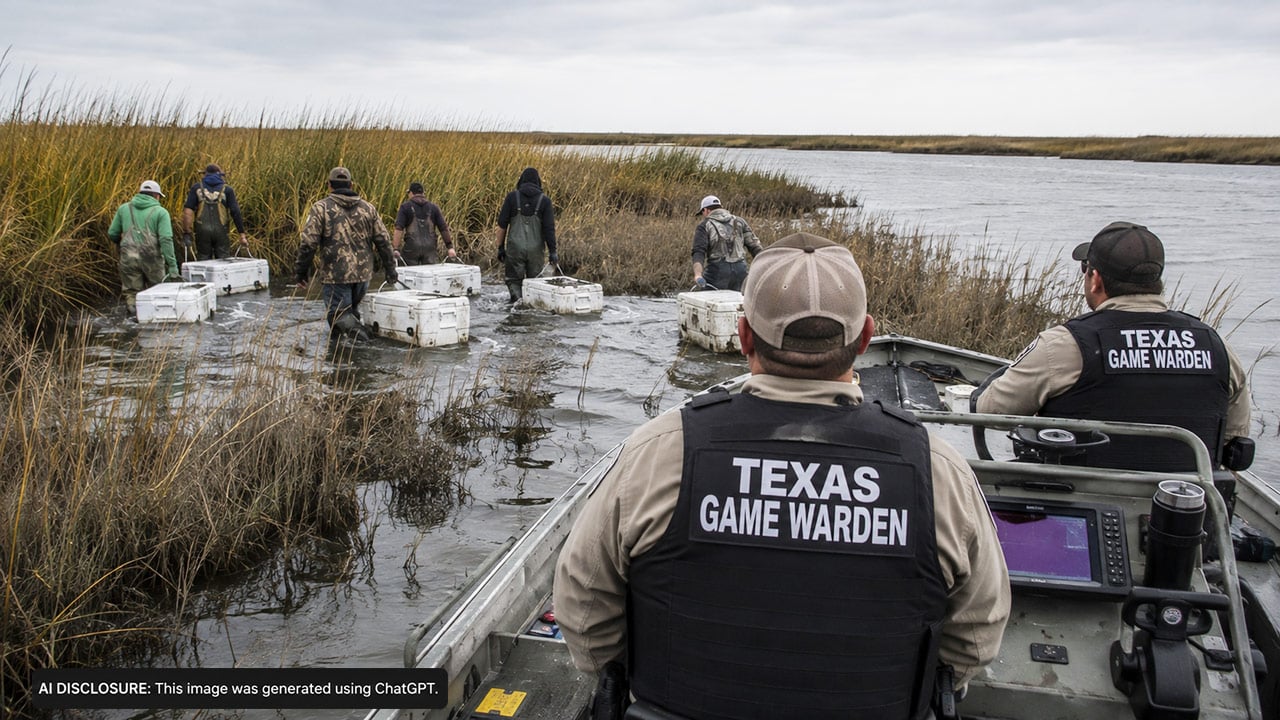
In the Texas marsh, it doesn’t take much to tell when something’s out of place. A line of folks hauling heavy loads across soft ground, heading for a waiting vehicle, tends to draw attention—especially when the bay they’re working in is supposed to be off-limits.
That’s the scene Texas Game Wardens describe out of Christmas Bay in Brazoria County, where an oyster harvesting investigation ended with six people facing charges and nine big ice chests—plus buckets—of oysters being recovered and put back in the water. Details were shared in the original post from Fox 4 Beaumont.
Wardens watched the whole shuttle from water to vehicle
According to Texas Game Wardens, the case started May 30 when wardens observed six people harvesting oysters and then transporting them through the marsh to a vehicle. That “through the marsh” part matters. It suggests the group wasn’t just gathering a small mess for dinner—they were moving volume, the kind that needs a cooler run.
By the time the investigation played out, wardens recovered nine large ice chests and buckets of oysters. Those oysters were returned to Christmas Bay, which is a protected coastal bay along the Texas Gulf Coast, roughly 125 miles west-southwest of Beaumont.
It wasn’t just “too many oysters”—it was where and when
Most anglers and hunters understand that game laws aren’t only about the limit. Location and season are just as big, sometimes bigger. In this case, wardens said the charges included harvesting oysters during a closed season and harvesting oysters from a Texas Parks and Wildlife Department closed area.
That’s the kind of double-whammy that turns a “maybe they didn’t know” situation into something that looks a lot more deliberate. Wardens also listed possession of undersized oysters and fishing without a valid license among the charges tied to the investigation.
Nine ice chests tells you how big this was
If you’ve ever carried a loaded ice chest any distance, you know what nine of them means: coordination, time, and a plan. That’s not a случайная bucket of shellfish picked up while wading. It’s a harvest operation.
Texas Game Wardens didn’t release the names of the six people charged, but they were clear about the scale of what was recovered—“nine large ice chests and buckets”—and that it was all allegedly taken illegally.
Closed areas aren’t just conservation rules—they’re a health line
A lot of folks hear “closed season” and think it’s only about protecting the resource, like letting a deer herd rebound or giving fish a spawn window. Oysters add another layer: public health. Wardens said oyster harvest closures are implemented for important conservation and public health reasons.
They specifically pointed to allowing reefs time to recover and reducing the risk of harvesting shellfish from waters that may contain elevated levels of naturally occurring bacteria, including Vibrio. That’s not some paperwork technicality. Eating shellfish from the wrong water at the wrong time can put people in the hospital.
Oyster reefs do more than feed people—they hold the coast together
There’s a reason Texas Parks and Wildlife guards certain bays and reefs closely. Healthy oyster reefs don’t just produce oysters. The agency noted they filter and improve water quality, help protect shorelines from erosion, and provide habitat for fish and other marine life.
When large quantities get pulled off a protected reef, it’s not only a hit to the next guy who wants to legally harvest. It undermines the whole system that keeps those bays productive—cleaner water, better nursery habitat, more resilience when weather and tides get rough.
Tips from the public helped put wardens on it
This case wasn’t framed as a random traffic stop or a lucky encounter. The agency said tips from the public helped wardens investigate the suspected violations, and they credited callers who suspected dangerous illegal activity.
That’s worth paying attention to if you spend time on the water. Most people don’t want to “get involved,” but when something looks wrong—especially in a closed area—calling it in can keep a mess of illegally taken shellfish from ending up on someone’s table, and it can keep a reef from getting hammered.
What outdoorsmen should take from this one
The main lesson here is simple: know the season, know the area, and keep your license straight—because wardens absolutely do watch patterns and movement, especially when someone’s hauling product out of a marsh like they’re running a shuttle. The second lesson is that closures exist for more than bureaucracy. With oysters, the health side is real.
If you see something that doesn’t add up, Texas Parks and Wildlife points people to Operation Game Thief to report suspected wildlife or fishing violations. Out in places like Christmas Bay, that kind of heads-up is often the difference between a protected reef staying intact and getting stripped one ice chest at a time.
Like The Avid Outdoorsman’s content? Subscribe to our newsletter so you never miss an article.
Here’s more from us: