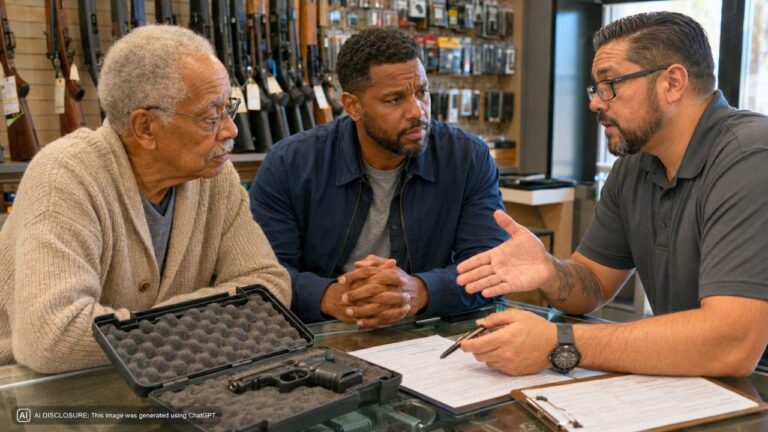
Photo credit: AI-generated image created using ChatGPT. Illustrative only
A routine traffic stop can turn into a full-blown legal mess in a hurry, especially when you’re crossing state lines with a handgun you didn’t buy yourself. That’s exactly what happened to a Tennessee man driving his girlfriend’s car through North Carolina, a situation he laid out in the original post—and it’s the kind of scenario every gun owner should think through before tossing a pistol in a console and hitting the road.
He said he was pulled for speeding, got the standard “anything I need to worry about in the car?” question, and chose the path most of us would recommend: be upfront. He told the officer there was a handgun in the center console. The officer had him step out, retrieved the gun, and then came back with news nobody expects—he was being arrested for possessing a stolen firearm.
A “good faith” traffic stop turned serious fast
The driver said he tried to do everything right in the moment. He was cooperative, respectful, and immediately disclosed the gun because he wanted the officer to be comfortable. That’s a common instinct among responsible gun owners, and most of the time it prevents confusion and keeps the stop calm.
But after the officer ran the firearm, the tone changed. The man said he was booked, then released, and he had an initial appearance a couple hours later. In other words, the stop didn’t just cost him a ticket—it put him in the criminal system.
Different states, different carry rules—and the console was the problem
Part of what set this up was a bad mix of assumptions and state-line reality. The man said he’s from Tennessee, where he believed carrying a handgun concealed in a vehicle is allowed under “castle doctrine” style rules, and that neighboring states he’s familiar with are similar. He also said North Carolina is an open-carry state and that he understood the gun must be in plain view, or stored elsewhere like the trunk.
In his case, the handgun was in the center console while he drove alone in his girlfriend’s car. That detail mattered because he said he was hit with a misdemeanor for unlawful concealed carry in addition to the stolen firearm charge. A lot of outdoorsmen learn the hard way that “it’s legal back home” doesn’t help much once you’re on the other side of the state line.
The bigger shock: the handgun came back stolen—nine years later
The real gut punch wasn’t the carry charge. It was the allegation that the gun itself was stolen. The driver said he was clueless and believed it had to be a mistake because his girlfriend was “a normal law abiding citizen.”
After he finally spoke with her, he relayed her side: she bought the handgun from a “friend” more than nine years earlier. She supposedly had a handwritten bill of sale, possibly messages from the transaction, and even bank records showing a cash withdrawal that day. But the person who sold it to her now denies knowing her.
That’s the part that should make anybody who’s ever bought a used gun at a kitchen table sit up straight. A handwritten bill of sale can be a good habit, but it doesn’t magically erase the gun’s history. If it was stolen before that purchase, the paper you signed later doesn’t change what it is in the eyes of a database hit during a traffic stop.
Why “I didn’t know” doesn’t stop the ride to jail
The man understood the uphill battle right away, writing that “ignorance of it isn’t innocence.” He was facing a felony for possession of a stolen firearm and a misdemeanor for unlawful concealed carry. Even if you honestly had no clue, being in possession is still enough to create a very real problem until it’s sorted out.
That’s especially true when the gun isn’t yours and you’re in someone else’s vehicle. From a practical standpoint, the officer on the roadside has to treat the situation as it presents itself: you’ve got a gun in reach, it’s concealed, and it comes back stolen. Nobody gets the benefit of the doubt in that moment.
For outdoorsmen, this is also a reminder that “truck guns” and “console guns” carry extra risk. Cars get borrowed. Cars get serviced. Cars get broken into. And guns left in vehicles are the ones most likely to wind up in the wrong hands—and later, in the middle of a stop like this.
The practical consequences for a working guy were front and center
This wasn’t just about pride or inconvenience. The man said he works full time in healthcare and carries a CDL. A felony charge isn’t an abstract worry with that background—it can flip your whole life upside down, from employment to licensing to future firearm ownership.
He also noted he had no serious past trouble beyond tickets and a prior driving-under-suspended situation tied to unpaid tickets, which he said had been resolved. That kind of background is exactly why this scenario is so painful: it’s not a career criminal story, it’s a “borrowed car, bad assumptions, old gun” story that can still land with life-changing consequences.
What people tend to focus on in situations like this
Even without a full comment section included, the pressure points are obvious—because they’re the same ones that come up every time a used firearm with a cloudy past enters the picture. The first is representation. The man’s biggest question was whether he should “lawyer up” or rely on a public defender, because he didn’t want to carry a felony that would change his life.
The second is documentation versus reality. A bill of sale, messages, and a cash withdrawal record may help show a good-faith purchase, but they don’t automatically prevent charges when a gun is flagged as stolen. The third is the simple habit of verifying the rules before you travel. Carry laws change at the border, and how you store a handgun inside a vehicle can be the difference between a normal stop and a criminal charge.
And finally, there’s a hard lesson about “buying from a friend.” When the seller later denies the sale—or denies knowing you at all—you’re stuck holding the bag. Whether it’s a gun, a boat, or a four-wheeler, a handshake deal can feel normal in rural life right up until it’s time to prove what happened years ago.
If you carry, hunt, or travel with firearms, the takeaway isn’t to panic—it’s to be intentional. Know the carry and transport rules for the state you’re entering, don’t assume a console is “good enough,” and be extra careful with private-party guns that never went through any formal process. A traffic stop is the last place you want to discover a firearm’s past has been waiting on you for nine years.
Like The Avid Outdoorsman’s content? Subscribe to our newsletter so you never miss an article.
Here’s more from us: