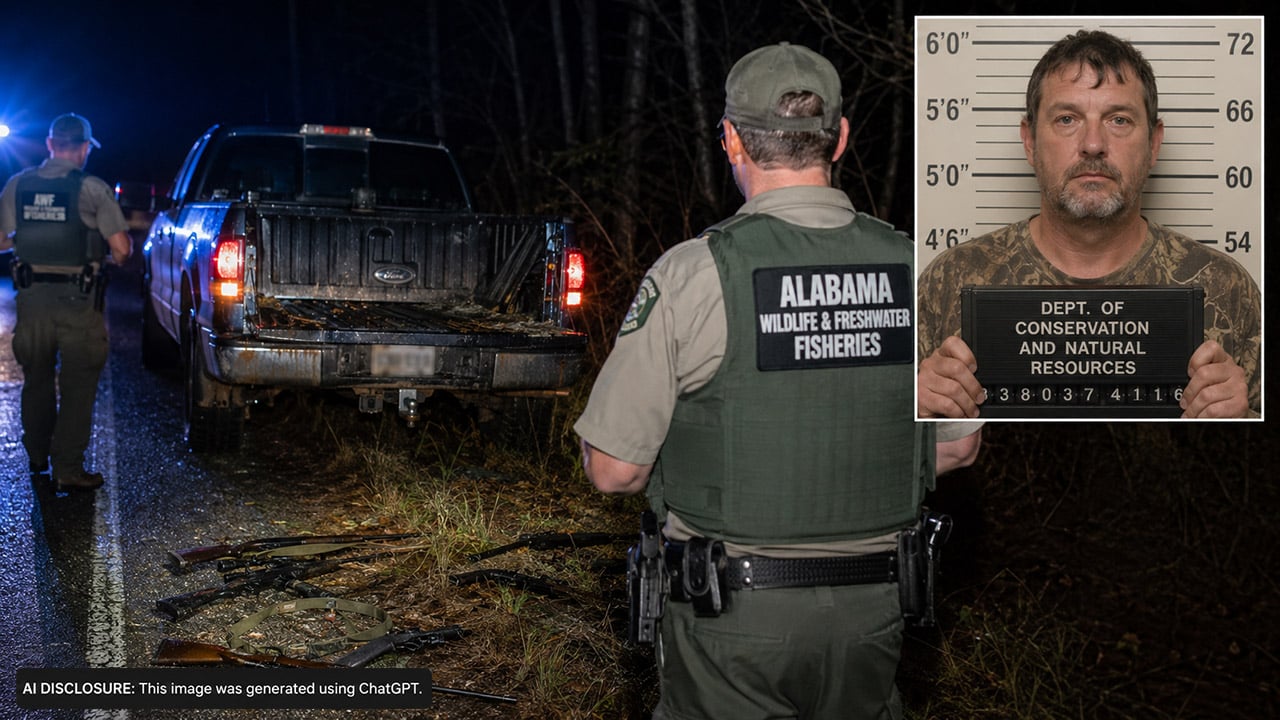
Photo credit: AI-generated image created using ChatGPT. Illustrative only
Night hunting complaints are the kind of calls conservation officers hear all the time—one shot out in the dark, a spotlight sweeping a pasture, then nothing when a truck finally gets there. In Jackson County and neighboring DeKalb County, those calls kept stacking up until investigators started seeing a pattern, and it eventually led to a long sentence for a Sand Mountain man.
Details of the case were laid out in the source post, which describes a multi-agency investigation that ended with guilty pleas from Jacob Clinton Galloway of Section, Alabama, and a pile of seized firearms, ammunition, and deer racks.
A familiar problem: shots at night and a truck that’s gone before anyone arrives
Lt. Greg Elrod with Alabama Conservation Enforcement described how the initial reports sounded: people in Jackson and DeKalb counties calling in gunshots at night. Officers would work the complaints, but they weren’t catching anyone in the act. That’s the frustrating part for landowners and for wardens—by the time you hear the shot, the vehicle can already be miles away.
What changed was information shared with the Alabama officers by the U.S. Fish and Wildlife Service. Elrod said it “pieced together” the complaints and the areas they were coming from, enough to start building a clearer picture of who they were dealing with and how he was operating.
The M.O. was built to avoid getting caught in the moment
Elrod said Galloway’s approach was straightforward and cold-blooded: shoot a deer and leave immediately, then come back six, eight, even 10 hours later to retrieve it—sometimes in a different vehicle. The idea is obvious: if a landowner or officer shows up fast, there’s no deer in the bed and no “fresh” evidence right there at the stop.
He also wasn’t doing it occasionally. Elrod said, “This guy was night hunting and road hunting every day,” and killing deer “everywhere without permission.” Investigators believed he’d been at it for a couple of years and was tied to many of the complaints they’d been receiving.
The stop turned into a chase, and rifles went out the window
Eventually, officers working a night-hunting detail spotted the suspect driving and shining fields. That’s the kind of thing that will get any warden’s attention fast, because it’s not just a wildlife violation—it’s a public safety problem. A bullet launched across a field at night doesn’t care where the property line is, and it doesn’t stop for a house, a barn, or a parked truck.
Once officers tried to stop him, a pursuit followed, and the case escalated. Investigators recovered two rifles that were thrown from the vehicle during the incident. Elrod also found a .450 cartridge in the roadway, which helped lead officers to the firearms used by the night hunter, with help from a citizen.
Search warrants cracked the case open: drugs, ammo, and a lot of racks
After the stop and the recovered weapons, investigators moved into search-warrant territory. Elrod said a search warrant executed at the residence turned up narcotics and ammunition, and a task force arrested Galloway on narcotics and firearms-related charges. A judge revoked his bond.
The investigation didn’t stop there. The task force later learned Galloway’s Toyota Tundra was parked at another residence. Officers impounded the truck, obtained a warrant, and searched it. Elrod said they recovered seven additional firearms, ammunition, and 15 deer racks, with several deer described as freshly harvested.
For folks who manage deer herds—whether that’s a landowner trying to keep a place healthy, or a hunter who leases and plants and runs cameras—that number hits hard. Fifteen racks isn’t “one mistake.” It’s volume, and it’s a sign the person wasn’t just slipping into one corner of one farm. Elrod said the deer were being killed “everywhere without permission.”
The punishment wasn’t just about deer laws—it was about felon-in-possession and trying to run
Galloway was convicted on numerous wildlife violations, but the bigger hammer came down because he was already a convicted felon. According to Jackson County Assistant District Attorney Krystina Jackson, he received two concurrent 15-year sentences—one for possession of a firearm as a convicted felon and one for felony “attempting to elude.”
On top of that prison time, he was fined about $5,000 for the hunting violations and forfeited all recovered firearms. That forfeiture detail matters. A lot of people hear “poaching case” and assume it’s just tickets and fines. Here, the combination of fleeing, firearms, and prior status turned it into a serious prison case with permanent losses stacked onto it.
Elrod credited multiple agencies and the work involved in repeated warrants, and he specifically highlighted the effort from the Jackson County Sheriff’s Department. He also nominated Assistant DA Jackson for the Alabama Wildlife Federation Governor’s Conservation Achievement Award for judicial work, which she won—an indication this case took a sustained push from the enforcement side and the courtroom side to finish.
There were 12 comments on the source post, and while they weren’t included in the material provided, cases like this typically pull focus toward a few practical points: folks wanting tougher penalties for night hunting, appreciation for the officers who stick with long investigations, and the reminder that spotlighting roads and fields isn’t just “cheating,” it’s dangerous in a way that puts neighbors at risk.
For landowners and hunters, the most useful takeaway is the simple one: report the suspicious stuff early, keep notes on dates and times, and don’t try to handle it yourself. In this case, patient documentation, coordinated enforcement, and good warrant work did what a confrontation in a dark field never could—stop a repeat offender and put real consequences behind it.
Like The Avid Outdoorsman’s content? Subscribe to our newsletter so you never miss an article.
Here’s more from us: