Photo credit: Savage Arms
We may earn revenue from products featured on this page through affiliate links.
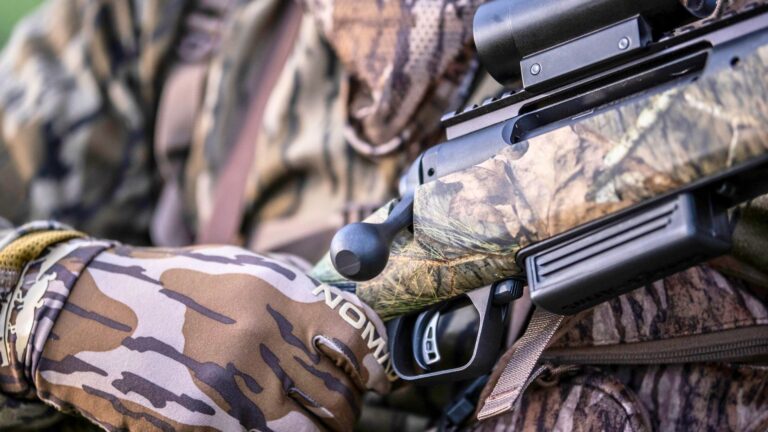
The Savage 110 has always been a “work rifle” in the best sense of the phrase. It wasn’t designed to win beauty contests, and it wasn’t built to be a boutique safe queen. It was designed to give regular hunters a bolt gun that could shoot straight, headspace consistently, and stay practical when conditions weren’t perfect. That’s why you still see them everywhere—because the core design does a few important things very well, and those things happen to be what most hunters actually need.
It was built to be inherently accurate without custom gunsmithing
The 110’s design has always leaned into accuracy through consistent lockup and consistent headspacing, and that’s where the Savage “floating bolt head + barrel nut” story comes from. Savage explains the floating bolt head concept as a way for the bolt head to align with the barrel axis each time a round is chambered, improving consistency without the owner needing custom action work. The barrel nut system ties into the same goal: precise headspacing in a way that’s repeatable at the factory level, which is one reason the 110 developed a reputation for shooting better than people expected for the price category. Savage’s own history write-up points to button rifling and the “famous barrel nut design” as part of why early 110s built an accuracy reputation. The key thing to understand is this: the 110 wasn’t designed to be “cheap.” It was designed to be consistent, and the manufacturing choices supported that—consistent headspace and consistent lug contact are two of the biggest ingredients in a rifle that shoots well without being a hand-built custom.
It was designed to be a dependable hunting rifle, not a delicate one
The 110’s success isn’t just about tight groups on paper. It’s about being a hunting rifle that holds up to real use and still prints where it should. That’s why the platform has evolved into a wide family of 110 variants built around practical needs—weather resistance, suppressor-ready barrels, and stocks that actually give control when your hands are cold or wet. Bass Pro’s Savage 110 listings show that direction clearly: the 110 High Country is marketed with a spiral-fluted bolt and barrel and a barrel threaded for suppressors (with a muzzle brake on some magnum offerings), which is exactly the kind of “built for field reality” setup hunters are buying now. And the 110 Trail Hunter Lite is described as a field-ready hunting option with a fluted threaded barrel, Tungsten Cerakote for corrosion resistance, and a Hogue overmold stock for grip in wet conditions—again, not fancy talk, just practical choices that keep the rifle working in bad weather. That’s what the 110 has always done well: deliver a rifle you can actually hunt with hard, not just shoot off a bench once a year.
It was designed to be adjustable enough for real shooters, not just “average height guys”
One of the sneaky reasons people shoot some rifles better than others has nothing to do with caliber—it’s fit. Length of pull, comb height, and how your eye lines up behind the scope determines whether you get a repeatable cheek weld or you’re “searching for the picture” every time you shoulder the gun. Savage leaned into this with systems like AccuFit on certain 110 models, and even Bass Pro’s own gear review on the 110 High Country calls out how the included combs and spacers let the rifle “adapt to the shooter” instead of the shooter adapting to the rifle. Fit matters most in cold weather, in awkward positions, and under stress—exactly when hunters miss. A rifle that fits you makes you faster to settle, steadier on target, and more consistent from sitting, kneeling, and off a pack. The 110’s “designed to do well” list includes this modern reality: make a factory hunting rifle that more people can actually shoot well without paying a gunsmith to reshape a stock or forcing themselves into an awkward head position behind the optic.
It was designed for practical maintenance and long-term ownership
The 110 platform has also always catered to the idea that a hunter will own the rifle for a long time, not swap it every season. That shows up in how the system is serviced and supported, and it’s part of why the design has remained relevant as shooters change their setups. Savage has continued to publish “how-to” resources for common owner needs like adjusting AccuTrigger on model 110 variants, which reflects a rifle platform built around owner interaction rather than “don’t touch anything” mystery parts. A rifle that can be maintained and understood tends to stay in families and stay in use. And when you look at why the 110 became an “iconic rifle” over time, Savage’s own history write-up highlights features like a tang safety, floating bolt head, and internal box magazine—simple, durable, functional. That’s the long-game advantage: the 110 is a system that’s been around long enough to be understood, supported, and trusted, which is exactly why hunters keep coming back to it when they want a rifle that won’t become a problem.
What it was never meant to be
The Savage 110 was not designed to impress people who judge rifles purely by cosmetics or by brand status. It also wasn’t designed to be the lightest possible rifle on the mountain. The 110’s strength is that it gives you a foundation that tends to shoot well, can be configured for real hunting needs, and keeps working when conditions aren’t comfortable. The reason the 110 still matters is because the original design goals are the same goals hunters still have today: predictable accuracy without custom work, practical field durability, and a rifle that fits and functions in the real world. Savage’s own technical explanations around the floating bolt head and 110’s inherent accuracy point straight at that intention. If you want a rifle designed to do a few important things very well—rather than a rifle designed to look cool—this is exactly why the 110 keeps showing up season after season.
Like The Avid Outdoorsman’s content? Subscribe to our newsletter so you never miss an article.
Here’s more from us: