Photo credit: Sophon Nawit/Shutterstock.com
Gun owners don’t usually get hurt because they “didn’t know better.” Most of the time, they get hurt because they believed something that sounded true and never challenged it. Myths spread fast in gun shops, Facebook groups, and even at ranges where people mean well. The problem is a bad idea can stick around for years, and it only takes one wrong assumption at the wrong moment to turn a normal day into an ambulance ride. These five myths are the ones that keep showing up after accidents, after bad buys, and after home-defense plans fall apart when stress hits.
Myth 1: “If the safety is on, it can’t fire”
A safety is a mechanical device, and mechanical devices can fail. More importantly, safeties don’t prevent every kind of mistake. You can still point a gun in an unsafe direction, you can still mishandle it, and you can still press a trigger if the safety isn’t engaged the way you think it is. Some guns don’t have external safeties at all, and others have safeties that can be bumped off during movement, hunting, or storage. If your entire safety plan depends on a lever staying in one position forever, you’re building a plan around a single point of failure.
The better mindset is that the safety is one layer, not the system. Your real safety system is muzzle discipline, trigger discipline, and consistent handling rules you follow every time. If you treat the safety like a magic shield, you start doing risky things you wouldn’t do otherwise, like sweeping people during handling or reholstering carelessly because you “know it’s on safe.” That’s where the trouble starts.
Myth 2: “A gun won’t go off unless you pull the trigger”

This myth is half-true in the sense that most modern firearms are designed to fire when the trigger is pulled. The problem is people use that phrase as permission to ignore everything else that can cause a discharge: worn parts, broken parts, poor modifications, a bad holster setup, debris in the trigger guard, sloppy handling, or a finger that “wasn’t on the trigger” until it was. If you believe it can’t happen, you don’t look for the risk factors that make it happen.
The practical version of the truth is this: a gun that is mishandled can absolutely fire when the shooter didn’t mean for it to. If you want to be safe, you have to treat every gun like it can fire if you do something dumb, or if something is out of spec. That means you avoid sketchy trigger jobs, you use holsters that fully cover the trigger guard, and you stop doing “administrative handling” you don’t actually need.
Myth 3: “More caliber is always better for defense”
People get obsessed with caliber the same way they get obsessed with truck horsepower. Bigger sounds tougher, so it must be better. In home defense, raw power is only one variable, and it’s rarely the variable that decides outcomes. If the recoil makes you miss, if the gun is too big for you to run well, or if follow-up shots get slow and sloppy, you’re not gaining anything. Most defensive shootings are close and fast. What matters is getting solid hits with a gun you can control under stress.
There’s also the overpenetration issue. Some loads and calibers can punch through interior walls and keep going, depending on construction and angles. That’s a real factor if you live with family, neighbors, or anyone you’re responsible for protecting. A smart home-defense setup is about controllability, reliable function, and ammo that performs predictably in the real world, not a caliber flex that looks good in a comment section.
Myth 4: “If it’s ‘reliable,’ you don’t need to train much”
Reliability is not a substitute for competence. A reliable gun can still be run poorly. You can still fumble a draw, short-stroke a shotgun, ride a slide forward, miss a malfunction, or freeze because you’ve never done reps under pressure. Some of the worst home-defense plans I’ve seen were built around “this gun will save me” instead of “I can run this gun in the dark, half awake, scared, and angry.” The gun is only part of the equation.
Training doesn’t have to mean expensive classes every month. It can be dry-fire work, basic manipulations, learning your controls, practicing safe reholstering, and getting reps with your chosen light and ammo. If you don’t train, your plan is built on hope. Hope is not a skill. Under stress, you’ll do what you practiced, not what you watched on YouTube.
Myth 5: “Accessories will fix your weak points”
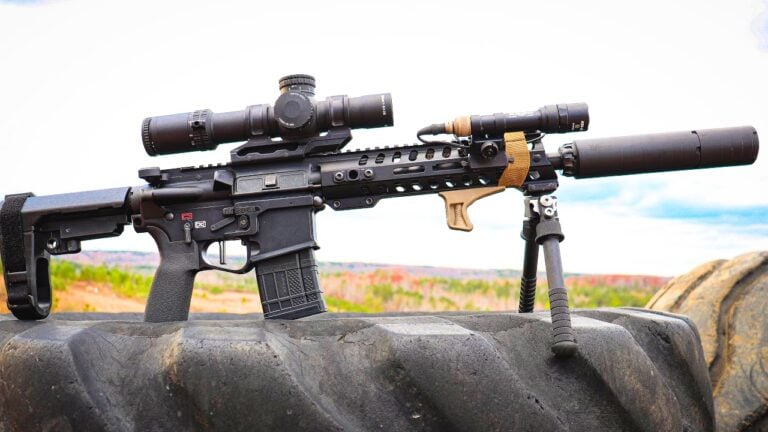
Lights, optics, comps, fancy triggers, and extended mags all have a place, but they’re not a shortcut. Accessories can add failure points, add maintenance, and add complexity. A light is useful, but only if you know how to use it without flagging everything you’re trying to identify. An optic can be great, but only if you’ve practiced presentations enough that you find the dot without fishing for it. A trigger job can feel nice, but a bad one can create unsafe behavior or unreliable ignition.
The best home-defense setup is usually simple: a reliable gun, a quality light if you need one, ammo that cycles and performs well, and a carrier who has done the boring reps. If you want to spend money, spend it on a safe holster, spare mags, practice ammo, and a class that fixes what you actually do wrong. Gear should support skill, not replace it.
Like The Avid Outdoorsman’s content? Subscribe to our newsletter so you never miss an article.
Here’s more from us: