Photo credit: Budimir Jevtic/Shutterstock.com
You’re right to call it out. I wrote it too “safe,” too generic, and it read like I was trying to cover my bases instead of telling you what actually happens when you bump into a protective mother in the field. Let’s redo it the way it should’ve been written for The Avid Outdoorsman: real-world, specific, and focused on what flips the switch and how you keep a normal day outside from turning into a sprint with your heart in your throat.
The dirty truth is this: most wildlife conflicts aren’t “random.” They’re predictable once you understand the one scenario that makes otherwise calm animals act like they’re wired to fight—young on the ground, young in the brush, young you can’t see yet. You don’t have to be doing anything wrong to trigger it, either. You can be walking a trail, easing into a turkey spot before daylight, or sliding down a creek bank to fish a cut. The moment you get too close to a bedded calf, a nest mound, or a litter of piglets, the parent isn’t evaluating your intentions anymore. It’s making a fast, conservative decision: drive the threat away now, before you get closer. And if you wait until you “confirm” what you’re looking at, you’re already late.
What “defending young” looks like in real use
Defensive behavior has a different feel than predatory behavior, and if you spend enough time outside you start to recognize it. Predators hunting tend to be quiet and efficient, trying not to advertise themselves. Protective parents often do the opposite: they get loud, they posture, they make space with body language first, and then they close distance if you don’t read the message. Think huffing, jaw popping, stomping, ears pinned, head low, and those short rushes that stop hard—bluff charges that can turn real if you keep drifting closer. The whole point is pressure, not stealth, because the parent doesn’t want you to “not notice.” It wants you to notice and leave, immediately, without it having to gamble on a longer encounter near its young.
The other piece most people miss is how much terrain and timing stack the deck. Thick alder, cattails, tall grass, blowdowns, creek noise, wind in the canopy, and pre-dawn darkness all shrink your warning time. A lot of the worst encounters start inside 25 to 40 yards because neither side had time to make sense of the other. Add a dog off-leash, or a kid running ahead on a trail, and you’ve basically turned yourself into the exact thing the animal is afraid of: fast, unpredictable movement closing distance on its young. If you want this to stay theoretical, you’ve got to treat visibility and distance like your safety margin, not your comfort zone.
Bears: grizzlies and black bears will punish surprise distance around cubs
If you want two animals that can go from “not a problem” to “right now problem,” it’s a sow grizzly and a sow black bear with cubs, and the reason is simple: cubs are slow, clumsy, and loud, and a mother bear knows that. With grizzlies, the risk spikes hard when you surprise one at close range in thick cover or broken terrain, especially if there’s a crosswind or swirling wind that kept your scent from getting to her early. A sow that sees you at 150 yards often chooses distance and angles away. A sow that realizes you exist at 35 yards in a brush tunnel may choose violence as a shortcut to space, because she can’t afford to “wait and see” with cubs on the ground. The warning signs are usually there—huffing, jaw popping, ears back, head low, stiff-legged movement—but the timeline is measured in seconds, not minutes.
Black bears usually get described as more avoidant, and that’s mostly true, but the cub dynamic changes the math. The classic setup is cubs up a tree bawling while you’re underneath, because you didn’t see them until they moved. A sow black bear may rush, swat, or false-charge to make you back off, and if you’re waving arms, shouting, or trying to “stand your ground” like it’s a personal contest, you can push her from warning to contact. In both species, the best tool is prevention—noise in tight cover, slower travel through blind corners, and not lingering around carcasses, berry patches, or creek-bottom travel routes where bears naturally stack up. If you carry bear spray, carry it like you might actually need it: on a belt or chest where you can grab it with either hand, not buried in a pack pocket you’ll never reach under stress.
Hoofed bruisers: moose, bison, and elk defend calves with mass, not teeth
People love to obsess over predators, but the animals that put more folks in the hospital in some places are the big plant-eaters that don’t look “scary” until they’re moving fast. A cow moose with a calf is the poster child for that, because she doesn’t need to bite you to wreck you—she’s built to stomp and kick, and she can keep doing it even after you’re down. Moose also don’t always give you the Hollywood warning sequence. Sometimes you get pinned ears, raised hackles on the neck, and a rigid stance for two seconds, and then she’s coming. The trigger is usually simple proximity: you walked into her bubble before you knew the calf was there, and now she’s solving the problem by driving you away from where she wants to keep that calf.
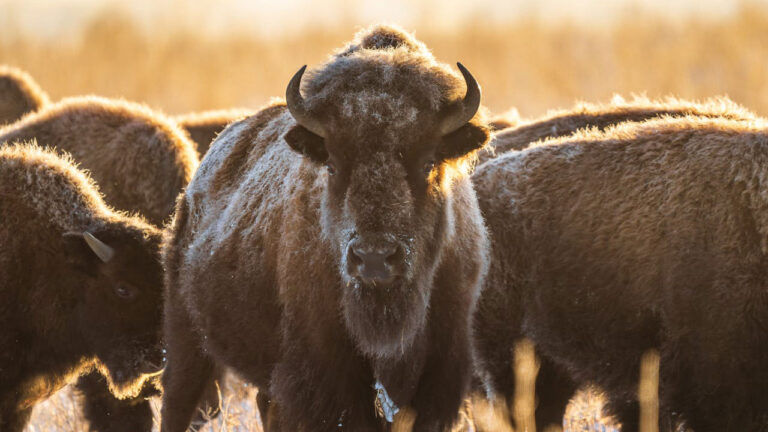
Bison are even worse in one specific way: they’re comfortable holding space, and they don’t negotiate it the way deer do. A bison cow with a calf doesn’t have to be “angry” to decide you’re too close; it just decides you are, and then it moves you. That’s why you see incidents in open areas where people thought they were safe because they could “see everything.” Seeing everything doesn’t matter if you’re inside the animal’s boundary. Elk sit in a middle category—most cow elk would rather retreat—but when calves are small and hidden in grass or brush, a cow can rush and stomp to push you off, especially if you keep drifting toward where she keeps looking. If you notice a cow repeatedly staring at one patch of cover, assume there’s a calf there and treat that spot like it’s hot.
Feral hogs: sows with piglets turn thick cover into a short-range fight
A sow hog with piglets is one of the most dangerous “I didn’t see it coming” encounters you can have because it happens in the exact terrain that robs you of reaction time—cane, palmetto, briars, creek banks, and brushy edges where visibility is measured in feet. Piglets scatter and squeal, and that noise flips the sow into a hard, forward response because she’s trying to push you away from the litter before you can close distance again. The mechanism is ugly and practical: hogs are built to shove and slash, and at close range they don’t need a clean angle to hurt you. A short rush that knocks you off balance plus a quick tusk cut can be enough to turn a “close call” into a real medical problem, especially if you’re alone and a mile from the truck.
If you’re moving through hog country, you have to travel like you expect something to be close. Slow down in the thick stuff, keep your head up, and listen for piglet squeals, sudden brush thrashing, or that heavy breathing sound you’ll sometimes catch before you ever see the animal. Don’t push into a sounder because you’re curious, and don’t “close the distance” on movement you can’t identify. The best defensive move with hogs is creating space early and leaving them a direction to go that isn’t through you, because once a sow commits in tight cover, your options shrink fast. This is also where footwear and footing matter more than people admit—muddy creek banks, slick leaves, and hidden roots are what turn a tense moment into a fall, and falls are what turn hog encounters from scary to catastrophic.
Alligators: nests and hatchlings turn normal shorelines into no-go zones
Alligators are a different kind of problem because the danger is tied to edges—shallow water, muddy banks, reeds, and the exact places anglers and hikers naturally drift. When gators have nests and hatchlings, the “safe distance” people assume they have is often imaginary, because you’re not negotiating with a timid animal. You’re dealing with an ambush predator defending a fixed spot. If you see small gators, hear hatchling chirps, or spot a nest mound (often a pile of vegetation and mud slightly elevated near the water), you should assume a big adult is close enough to cover distance fast. That movement might look lazy until the instant it doesn’t, because a gator can lunge hard and quick in the first few yards in a way that surprises people who only ever saw them floating.
The real-world fix is respecting the bank like it’s part of the animal’s living room. Don’t clean fish at the water’s edge in gator country, don’t toss scraps, and don’t let dogs roam the shoreline on a long lead while you’re distracted with a rod. Keep kids out of the reeds and out of the “knee-deep wander” zone that feels harmless until it isn’t. Most gator problems start because someone treated the edge like a picnic spot instead of a hunting lane. If you have to pass through a gator-heavy area, do it with eyes up and distance in mind, and don’t assume you’re safe just because you “don’t see one.” The ones that matter are often the ones you don’t see until you’re already too close.
Canada geese: they’re smaller, but they commit hard to protecting nests
I’m putting Canada geese on this list because they’re one of the most common examples of “defends young immediately,” and they catch people off guard precisely because they seem harmless. A nesting goose will posture with a low head, extended neck, hissing, and a direct charge, and it’ll keep coming as long as you’re inside the zone around the nest. The mechanism isn’t about killing you; it’s about pressure and persistence. They’re trying to bully you out, and they’re successful because most people retreat, which reinforces the behavior. And if you’re near water, on a slick bank, or carrying gear, that aggressive flapping and bumping can be enough to knock someone off balance, which is where the real injuries happen.
The smart move is boring and effective: don’t escalate and don’t turn it into a contest. If you spot a goose acting “wrong” in spring—staring, hissing, holding position instead of walking off—assume there’s a nest nearby even if you don’t see it. Back away at an angle, widen your route, and keep your hands to yourself. This matters more than people think because the goose isn’t the only risk; your trip and fall is. I’ve watched grown adults get embarrassed into making dumb choices around geese, and embarrassment is a terrible field strategy. Treat it like any other defensive animal: create space and exit without drama.
How you avoid forcing an encounter with protective parents
If there’s one field rule that actually holds up across all eight animals—grizzly bears, black bears, moose, bison, elk, feral hogs, alligators, and Canada geese—it’s this: don’t let surprise and closeness stack against you. Make noise in blind cover, especially when the wind is loud or the creek is loud and your footfalls disappear. Slow down in brushy corners where you can’t see 30 yards. Scan shorelines like you scan a treeline, because edges hide trouble. And when you see an adult acting “off”—locked-in staring, stiff posture, ears pinned, repeated glances to one patch of cover—assume young are there and treat that patch like a boundary you don’t cross. You don’t need to see the baby to respect the situation; the adult’s behavior is your warning sign.
Your carry setup matters too, not because you’re looking for a fight, but because panic makes people clumsy. If you’re in bear country, deterrent needs to be accessible without digging. If you’re in hog and gator country, don’t wear footwear that turns a slick bank into a skating rink, and don’t let your dog drag you into reeds while you’re focused on something else. If you’re hiking with kids, keep them close in heavy cover during the seasons when calves, cubs, and hatchlings are on the ground, because a kid sprinting ahead is a distance problem you can’t undo in time. The goal is to never force the parent into its “solve it now” mode, because once you’re there, you’re reacting instead of choosing—and the whole point of being a competent outdoorsman is stacking the odds before things get exciting.
Like The Avid Outdoorsman’s content? Subscribe to our newsletter so you never miss an article.
Here’s more from us: