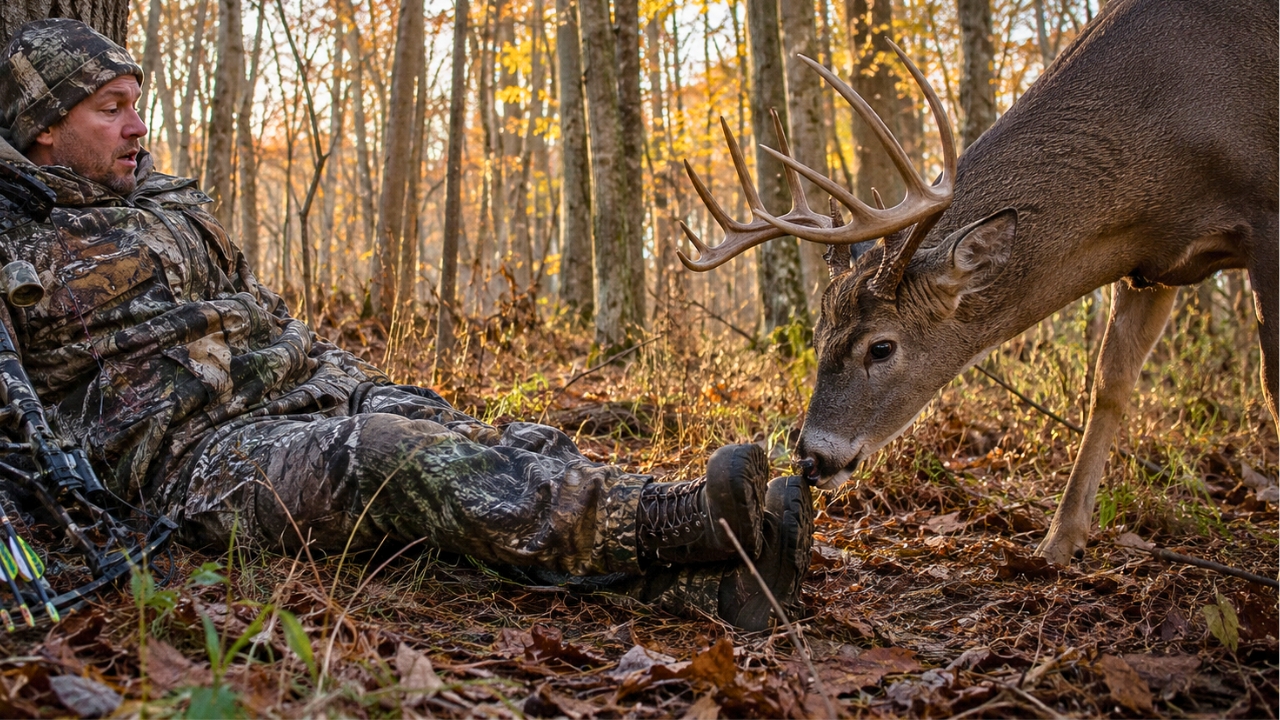
Photo credit: The Avid Outdoorsman
The hunter probably figured the doe scent might help.
That is the idea, anyway. Put a little scent where a buck might catch it, settle in, stay quiet, and hope curiosity does the rest. Sometimes scent does nothing. Sometimes it spooks deer. Sometimes it works in a way that feels almost too ridiculous to believe.
This time, it worked while the hunter was asleep.
In a Reddit thread, hunters were reacting to a story about a hunter who fell asleep with doe scent on his boots, then woke up to a buck close enough to make the whole situation feel more like a setup than a normal hunt. The buck was grunting, trying to find the source of the smell, and the source was apparently the sleeping hunter’s boots.
That is a wild way to wake up.
Not a slow morning. Not a distant deer slipping through brush. Not a quiet rustle that might be a squirrel. A buck was about ten feet away, grunting, worked up, and looking for the doe he thought he had smelled.
Instead, he found a human taking an unplanned nap.
That is the kind of hunting moment that sounds funny because it is funny, but in the moment it probably felt like instant heart failure. Waking up in the woods is already disorienting. Waking up to a deer that close is something else entirely. Your brain has to go from sleep to “giant animal at my feet” in half a second.
And if that deer is a buck in rut mode, grunting and searching, the whole thing gets even stranger.
Doe scent can be one of those tools hunters either swear by or roll their eyes at. Used wrong, it can educate deer or smell unnatural. Used right, in the right timing, with the right wind, it might get a buck curious enough to close distance. But few hunters expect it to work so well that they become the decoy.
That is basically what happened here.
The scent on his boots likely left a trail or pooled around where he settled in. If a buck crossed it and believed there was a receptive doe nearby, he may have followed it right back to the hunter. The buck was not looking for danger. He was looking for the smell. And in that moment, the hunter’s bad decision to nap and his scent setup collided in the weirdest possible way.
The buck was close enough that any normal shooting routine was probably gone.
At ten feet, everything is too close. Movement is obvious. Sound is obvious. A hunter waking from sleep is not exactly in quiet predator mode. He has to process what is happening, control his breathing, find the gun or bow, move without getting busted, and decide if there is even a safe, ethical shot from that angle.
That is asking a lot from someone who was unconscious five seconds earlier.
The buck also may not have reacted the way a calm feeding deer would. A grunting rut buck can be locked onto scent, but he can also snap alert quickly once something does not add up. One blink, one hand movement, one shift of clothing, and the whole thing can go from incredible opportunity to deer leaving the county.
The story sticks because it is the exact opposite of what hunters expect from falling asleep.
Usually, falling asleep costs you. You wake up to deer running away, tracks under your stand, or a buddy texting that deer walked by while you were out. This time, sleep did not keep deer away. If anything, the scent did its job while the hunter was completely checked out.
That does not mean napping is suddenly a strategy.
It just means the woods has a twisted sense of humor.
The practical lesson is still there. If you use scent, understand what you are doing with it. Scent on boots can create a trail, but it can also put attention right on you. If a buck follows that trail, he may come straight to the hunter instead of stopping where a good shot is planned. That can be exciting, but it can also make movement and shot angles much harder.
A scent setup should pull deer into a lane, not directly into your lap.
There is also the safety side of falling asleep. A nap on the ground or in a secure blind is one thing. Falling asleep in a stand without proper safety gear is another. The story is funny because the hunter woke up to a buck instead of falling, dropping gear, or missing the whole sit. But exhaustion in the woods still deserves respect.
The buck probably left confused, disappointed, or very suspicious of whatever “doe” smelled like boots and bad decisions.
The hunter, meanwhile, got a story almost nobody else could top. Falling asleep is usually the embarrassing part. Waking up to a grunting buck at ten feet because your boots smell like a doe turns the embarrassment into legend.
Some hunts are successful because of planning.
Some are successful because the deer does something dumb.
And some apparently happen because a hunter smells interesting and takes a nap.
Commenters treated it like one of those weird rut stories that sounds ridiculous but still makes sense once you think about the scent.
Several hunters joked that the doe scent worked a little too well. Instead of pulling the buck into a clean shooting lane, it apparently brought him right to the hunter’s boots.
Others pointed out that scent placement matters. If you put scent on your own boots, you may be creating a trail that ends at you. That can be useful in some cases, but it can also put a deer too close or at a bad angle.
A lot of people focused on the absurdity of waking up to a buck grunting nearby. Falling asleep usually means missing deer, not becoming the center of their attention.
Some commenters also said rutting bucks can act strange enough that stories like this are believable. When a buck is locked onto scent, he may ignore things that would normally spook him.
The main lesson was simple: deer scent can do weird things, especially during the rut. Just be careful where that scent trail ends.