Photo credit: AI-generated image created using ChatGPT. Illustrative only
Most gun owners expect a little waiting when they order a serialized part, especially in California where everything has to funnel through an FFL. What they don’t expect is to watch the tracking march along like normal, hit a scan point, and then go dead—while the firearm is still in a carrier’s custody.
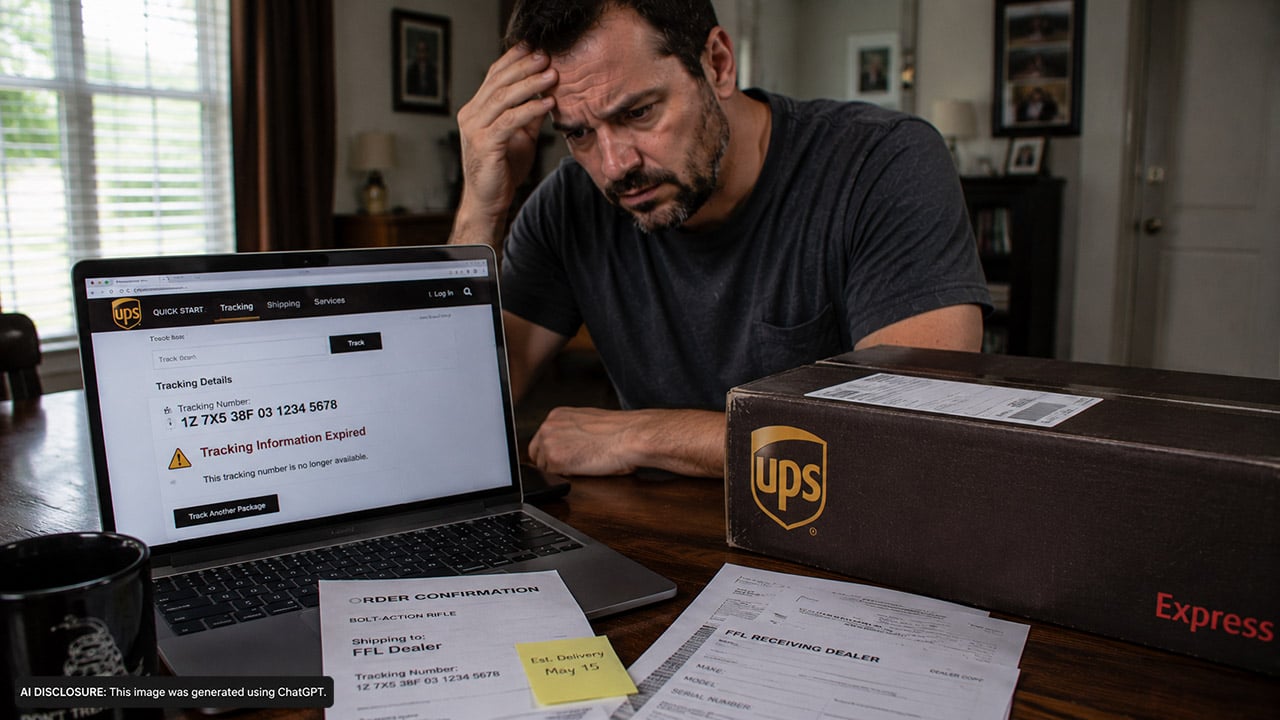
That’s the spot one buyer found himself in after ordering a bolt-action receiver from a manufacturer and having it shipped via UPS to his local FFL. In the original post, he laid out a timeline that’ll make any hunter or rifle builder uneasy: the package moved through the system until an arrival scan in San Pablo on November 5, then nothing—no departure scan, no out-for-delivery, no “held for pickup,” just silence.
A bolt-action receiver entered the system, then the scans went cold
The order itself was straightforward: a bolt-action receiver shipped early November, headed to a local FFL the buyer had already been in contact with. For most folks, that’s the easy part—pick the FFL, pay the transfer, start daydreaming about the finished rifle.
Tracking looked normal at first. Then it showed an arrival scan on the 5th in San Pablo and never updated again. Anyone who’s shipped enough gear recognizes that feeling: you refresh the page, thinking it’s a delay, then the delay turns into a week, and now you’re doing math in your head about where that package could physically be sitting.
UPS marked it “lost,” and the claim process started rolling slowly
By November 10, the buyer called UPS looking for an update. He was told that because the package hadn’t moved in about a week, UPS was marking it as lost in their system. That’s a line nobody wants to hear when the box contains a serialized receiver and not a pair of boots.
A few days after that call, the tracking updated again, but not in the way a customer hopes. Instead, it indicated that a claim would be made to the original sender/manufacturer. UPS reportedly told the shipper it could take another 5–8 days to process the claim and handle everything.
That timeline can feel like a stall, even if it’s just the reality of how big carriers work. But from a gun-owner standpoint, the nagging part is simple: a serialized firearm component didn’t just get delayed—it disappeared while still under the control of the shipper.
The buyer did the right checks: FFL confirmation and manufacturer contact
One thing the buyer did right away was confirm the obvious: he checked with the receiving FFL to make sure it hadn’t arrived and just failed to generate a tracking update. The FFL told him they hadn’t received it, but they’d keep an eye out in case it shows up anyway.
He also contacted the manufacturer. According to the buyer, this was the first time the shipper/manufacturer had a serialized receiver go missing like this. That matters, because it tells you the seller isn’t treating it as routine shrinkage, and it also means they may be figuring out the process in real time instead of running down a well-worn checklist.
To the manufacturer’s credit, they set aside another receiver to ship in case the original doesn’t surface. That’s the practical move on their end: keep the customer from being dead in the water while the claim gears turn.
Why a lost serialized receiver hits different than other “missing packages”
If UPS loses a scope mount or a sling, it’s annoying and expensive, but it’s mostly a customer-service problem. A serialized receiver is different. It’s the controlled part, the part that’s treated like a firearm for transfer purposes, and the part you don’t want floating around in the wrong hands.
This is also where the California angle makes it extra frustrating. The buyer wasn’t trying to cut corners. He wasn’t shipping to his front porch. It was headed to an FFL—exactly the path that’s supposed to keep everything documented and above-board. When it vanishes mid-route, the buyer can’t simply “cancel the order” and pretend it never happened, because there’s a real-world paper trail attached to that serial number.
The other hard truth is that the recipient can’t personally go down to a hub and demand it be pulled off a shelf. Carriers typically deal with the shipper on claims, and in this case UPS indicated the claim would be handled with the manufacturer. That may be standard procedure, but it leaves the buyer stuck in the passenger seat while a firearm-related shipment is unaccounted for.
The practical options looked limited: wait, document, and push through the shipper
The buyer’s main question was simple: is there anything he needs to do, or can do, to speed up the process? From the details provided, he’d already taken the steps most experienced gun owners would recommend first—contact the carrier, verify with the FFL, and communicate with the manufacturer.
Beyond that, the leverage tends to sit with the original shipper because the shipping contract is in their name. That’s why the manufacturer being engaged matters. They’re the ones who can press UPS through the claims channel, provide shipping documentation, and keep the paperwork straight on their inventory side.
And while the buyer said he was okay with how the manufacturer handled it, what irked him was understandable: a serialized gun part went missing in the carrier’s possession, and he felt UPS was dragging its feet on actually searching for it—especially after he had trouble even getting in contact with UPS in the first place.
In the meantime, the buyer’s best move was the boring move: keep records of every contact, save screenshots of tracking changes, and stay in close touch with the FFL and manufacturer in case the receiver suddenly reappears and shows up at the shop’s door with a beat-up label.
What other gun owners tend to focus on in situations like this
Even without a long thread of responses included here, this kind of story usually brings out the same concerns from experienced hunters and shooters. First is the safety angle: nobody likes the idea of a firearm or serialized receiver becoming an unknown in the system.
Second is the logistics reality: carriers sometimes “lose” things temporarily—stuck on a trailer, mis-sorted to the wrong facility, or sitting in an overgoods area—until a scan finally happens days or weeks later. That’s why the FFL saying they’ll keep an eye out matters. Sometimes the box does show up long after the tracking gives up.
Third is the paperwork angle: most folks want to make sure the manufacturer and receiving FFL stay in the loop so the serial number is handled correctly if a replacement ships and the original later resurfaces. You don’t want two receivers tied up in a mess because one was presumed lost and then arrives unexpectedly.
Shipping guns and gun parts isn’t supposed to feel like rolling the dice, and most of the time it doesn’t. But this is a reminder that “in transit” isn’t a guarantee—it’s a chain of handoffs, scans, and storage points, and when that chain breaks, the person waiting on the other end has fewer tools than you’d think.
In this case, the buyer did what a careful gun owner should do: verify with the FFL, communicate with the manufacturer, and get the carrier to formally acknowledge the problem. Now it’s a waiting game—either the claim process finishes and a replacement goes out, or the original receiver finally gets found and makes its way to the counter where it was supposed to land in the first place.
Like The Avid Outdoorsman’s content? Subscribe to our newsletter so you never miss an article.
Here’s more from us: