Photo credit: AI-generated image created using ChatGPT. Illustrative only
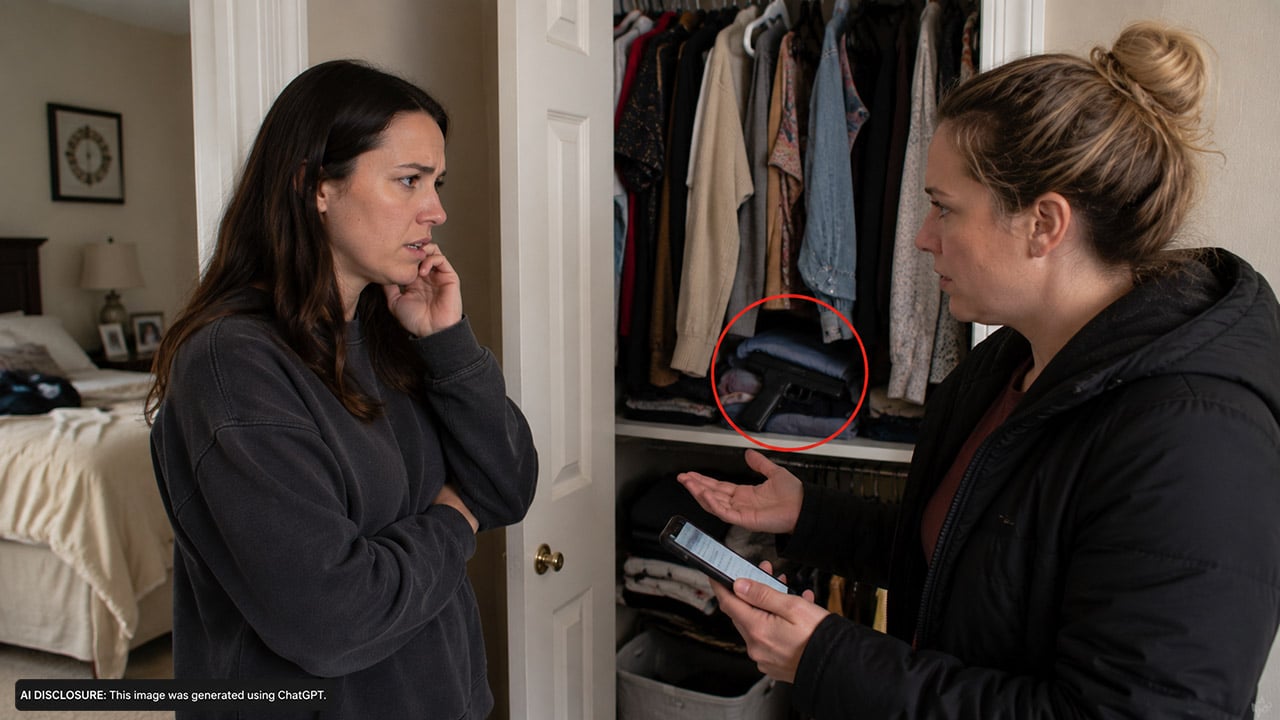
Divorce is messy enough without a surprise firearm showing up where it doesn’t belong. But that’s exactly the spot one Idaho woman found herself in when her soon-to-be ex allegedly placed a brand-new Glock and sealed ammo in her closet while they’re still legally married and in the middle of splitting up.
The situation was laid out in the original post by a worried friend who said the husband is currently living in California and is expected to come back up to Idaho soon. The friend, a medical professional and SART nurse, said they fear for the woman’s safety and asked whether she can call police to take custody of the gun.
A “new Glock in the closet” changes the whole tone of a divorce
Plenty of couples own guns. Plenty of divorces involve arguments over property. But a “new Glock with ammo” showing up in a closet—especially when the person who brought it in is no longer living there full-time—hits different.
It’s not just about who paid for it or whose name might be on a receipt. The big issue is access and intent. If one party is worried, and especially if there’s any history of threats, intimidation, or volatility, the smart move is to treat it like a safety problem first and a property problem second.
Why “unregistered” isn’t the deciding factor in Idaho
The friend described the pistol as “unregistered.” That word makes people think there’s a simple switch police can flip: unregistered equals illegal, so come take it. In Idaho, that’s generally not how it works.
Idaho doesn’t have a firearm registration system like some states, so “unregistered” often just means “not on any list.” That doesn’t automatically make it contraband. And because the husband is living in California, there’s an added layer of confusion: what’s normal paperwork in one state may not exist in the other.
Bottom line: the question isn’t just “is it registered,” but “who legally possesses it, who has access, and is there a safety threat that justifies law enforcement involvement right now?”
Can police “seize it for safekeeping”? Sometimes, but it depends on the call
People often assume an officer can simply swing by, pick up the firearm, and store it like a spare set of keys. In real life, police taking custody of a gun usually happens under a few common circumstances: evidence of a crime, a qualifying protective order, a domestic violence situation with specific legal triggers, or a mental health hold scenario where firearms are addressed by statute or court order.
Without one of those hooks, “come get this gun out of my house” can be a tough ask. Many agencies don’t want to take property without clear authority, because then they own the liability: chain-of-custody, storage, return, and the inevitable dispute between spouses over who gets it back.
That said, if the woman is truly afraid and explains why—especially if there are threats, prior incidents, or a credible reason she believes the ex intends harm—law enforcement may be able to document the situation, advise on next steps, and potentially take action if there’s a legal basis. The key is describing the safety issue clearly, not just the existence of the gun.
A protective order was the first practical step mentioned for a reason
The friend said they recommended a protective order (PO) and reporting the weapon. That advice fits how these cases usually play out, because a court order can create clear legal authority and clear boundaries.
A PO isn’t just a piece of paper—it can set terms about contact, residence access, and in many situations it can restrict firearm possession or require surrender depending on the type of order and the specific findings. If someone’s worried about an ex “coming up next week,” a court order can also spell out what happens if he shows up at the home or tries to enter.
This is one of those times where “do it right, do it early” matters. Waiting until the ex is back in town and emotions are running hot is how small problems turn into big ones.
What responsible gun owners notice right away: access is the real danger
Most of us who grew up around firearms know the basic rule: control access and you control risk. A loaded handgun stored in a shared home during a divorce—especially when one spouse may come and go, and tensions are high—is a recipe for trouble.
The immediate, practical concern isn’t the brand name on the slide. It’s that a handgun is easy to move, easy to conceal, and easy to use in a moment of anger. Add in uncertainty about who placed it there and why, and a worried friend is right to take it seriously.
From a safety standpoint, the woman’s priorities should be simple: don’t handle it if she isn’t comfortable or trained, don’t leave it accessible to kids or visitors, and don’t get drawn into a confrontation over it. A divorce is already a high-risk period in many domestic situations. You want distance, documentation, and clear lines.
What this situation looks like on the ground: documentation and clear communication
When someone says, “He put a gun in my closet,” law enforcement is going to sort out a few basics: Is the home legally hers, his, or both? Is he allowed to enter? Is there any court order already? Are there threats, stalking, harassment, or violence? And is the caller asking for immediate help because they’re in fear?
Even if officers can’t simply haul it off as “safekeeping,” reporting the situation creates a paper trail. That matters in divorce proceedings, protective order hearings, and any later dispute about access to the residence or intimidation. It also gives the woman a chance to ask specific questions about local procedure: what they can do, what they can’t, and what paperwork changes the game.
In a perfect world, you’d also want a calm, lawful resolution to the property side—through attorneys and the court—rather than a face-to-face exchange in a driveway when the ex arrives from out of state.
There’s a time to be tough, and there’s a time to be smart. When a handgun shows up in a closet during a divorce and a trained medical professional is worried about safety, the smart move is to treat it like a real risk, get law enforcement guidance, and push the situation into clear legal lanes with a protective order if warranted.
Like The Avid Outdoorsman’s content? Subscribe to our newsletter so you never miss an article.
Here’s more from us: