Photo credit: AI-generated image created using ChatGPT. Illustrative only
Cleaning out an inherited house is already a grind. Add decades of hoarding, and it turns into a full-on work project—dust, boxes, old furniture, and the kind of “I’ll deal with it later” piles that swallow rooms. That’s where a Colorado family found themselves after a relative passed in 2014, leaving the home to two siblings while the deceased’s adult son stayed behind in the basement.
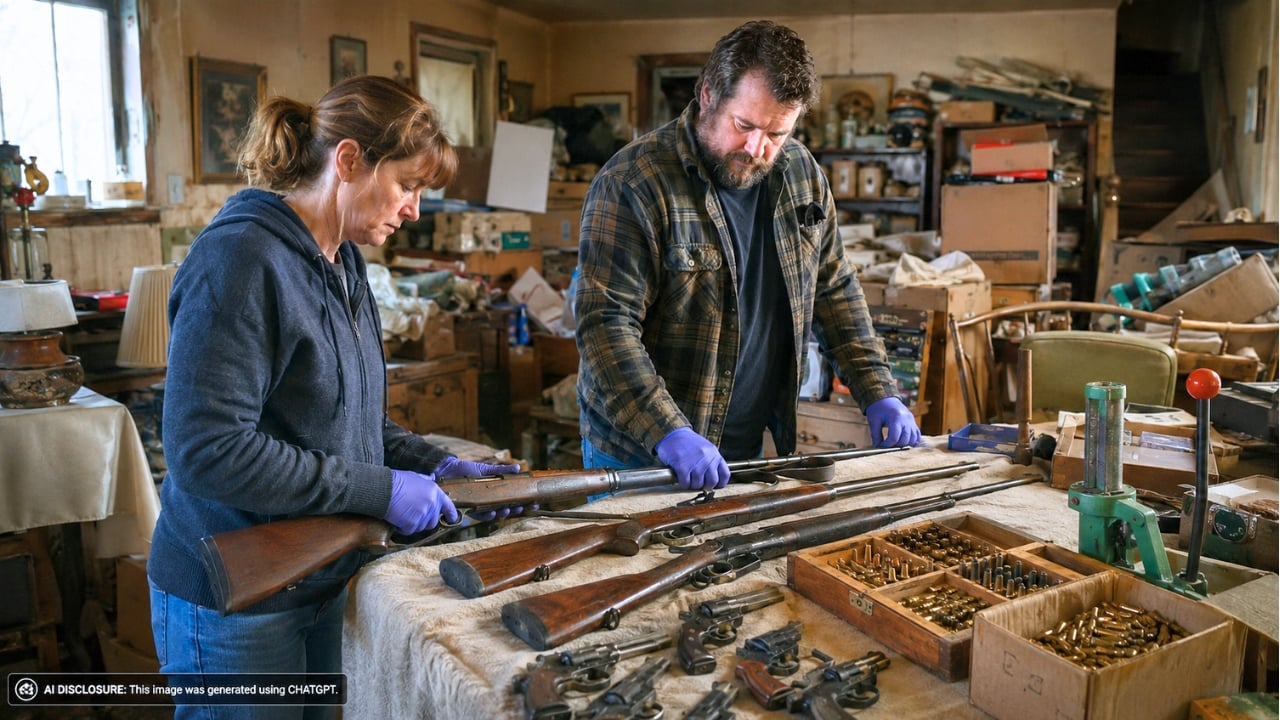
They’d tried to help him dig out and move on, but by January 2015 he basically vanished—dodging calls and avoiding contact even though they knew where he was living and that he was coming and going. Then, while continuing the cleanup to prep the place for sale, they uncovered what a lot of outdoorsmen recognize as a double-edged find: several rifles and handguns, plus ammo and a complete reloading setup, tucked away and forgotten in the mess. The details come from the original post.
A hoarder cleanup turned into a firearms discovery
The guns weren’t scattered around like junk. The family said they were stored well, looked maintained, and then simply abandoned in place when the basement-dwelling relative left. Most of the firearms appeared to be more than 50 years old, but less than 100—so not ancient antiques, but old enough to include discontinued designs, oddball chambers, and collectible pieces.
Alongside the guns, they found ammunition “in many calibers,” including some that dated to the early 1900s and some military issue from around that era. They also ran into ammo that’s no longer in production—exactly the kind of stuff that gets hoarded because you can’t just grab a fresh box off the shelf at the local shop.
Reloading gear and old ammunition raise the stakes
Finding a couple hunting rifles is one thing. Finding a “fully stocked reloading area” is another. The family described a press, primers, smokeless powder, lead bullets, and “a lot of brass,” plus a couple machines they couldn’t identify but believed were tied to reloading.
Any experienced handloader knows why that matters. Components can be valuable, but they also bring safety concerns—especially if you don’t know how old the powder is, how it was stored, or whether containers are properly labeled. Even if everything is perfectly legal, it’s not the kind of stuff you want sitting unsecured in a house that’s being cleaned out, shown to buyers, or accessed by contractors.
When the person who left the guns won’t respond
The hard part wasn’t just the physical discovery. It was the human problem attached to it. The relative who had lived in the basement for decades—who the family believed owned the firearms and reloading gear—couldn’t be contacted and had “actively avoided communication” since early 2015.
They didn’t frame it as a welfare issue. They knew where he lived, they knew he was active, and they weren’t looking to escalate with a wellness check. They were simply stuck holding property they didn’t expect to have, in a house they needed to sell, with no cooperation from the person who left the items behind.
Probate and ownership questions don’t mix well with gun storage
The home was still in probate at the time of the post. The family mentioned no contest had been filed, and their lawyer described wanting to let it “die a slow death,” which they took as waiting out timelines so the estate could be wrapped up.
That probate limbo is where the real-world headache shows up for gun owners. The family wasn’t trying to do anything shady. They’d already started photographing what they found and keeping an inventory. They also believed the guns were likely obtained legally—saying they’d found bills of sale from reputable local dealers and that the relative “doesn’t screw around with the law.” But belief and paperwork aren’t the same thing as clear legal authority to possess, transfer, or sell what’s sitting on the floor of a hoarded basement.
The questions they asked were the same ones any responsible gun-owning family would ask in that situation: Who owns these now that they’ve been left behind? Is any of it illegal to possess now, even if it was bought legally decades ago? Can the siblings become legal owners, and what would that procedure look like in Colorado? And maybe most practically: can they remove everything and store it securely while the house is prepared for sale?
The practical outdoorsman’s problem: safety, documentation, and not making it worse
Strip away the legal terminology and you’re left with a scenario that’s more common than folks admit—especially in rural families: somebody passes away, somebody else disappears, and suddenly there are firearms and components in the middle of an estate cleanup.
The first issue is simple safety. Guns should be treated as loaded until verified otherwise, and a hoarder house is the worst environment to assume you “already checked that corner.” Add unknown ammunition and loose reloading supplies, and it’s smart to slow down. Secure storage matters here, not because anyone’s panicking, but because accidental access is a real risk when a property has multiple people coming through.
The second issue is documentation. They were already doing the right kind of work—photos and inventory. That’s the sort of step that helps later when an attorney asks, “How many firearms, what types, any serial numbers, and where were they located?” It also helps avoid arguments inside the family about what was found and when.
The third issue is not making the situation worse by guessing. A lot of old guns are perfectly ordinary hunting rifles and revolvers. But “generally more than 50 years old” also lives in the zone where certain items and configurations can trigger extra rules, and where local and federal laws don’t always line up with what people assume from gun-counter talk.
What the family did next: bring in a firearms-savvy attorney
To their credit, they weren’t asking strangers for a magic workaround. They already planned to speak with an attorney who specializes in firearm law, and they were looking for “input on what to expect” and “good questions to ask the lawyer.” That’s a solid move, especially with probate involved and a non-responsive relative tied to the property left behind.
From a practical standpoint, the attorney conversation is where this gets sorted into a real plan: how to handle the firearms as part of the estate or as abandoned property, how to keep everything secure while the house is marketed, and how to avoid accidental illegal transfer if the guns legally belong to someone who isn’t cooperating. It’s also where the reloading supplies should be discussed, because powder and primers aren’t something you want to casually transport or store without thinking through fire safety and local rules.
There’s a reason this kind of situation makes responsible gun owners uneasy. You don’t want guns floating around unaccounted for. You don’t want to create a record problem by moving things the wrong way. And you definitely don’t want a house sale derailed because a basement cleanup turned up firearms, ammo, and a reloading bench nobody wants to touch.
In the end, this Colorado family’s problem wasn’t “finding guns.” It was finding guns attached to an absent owner, inside an estate that wasn’t fully closed, in a house that needed to be sold. That’s where patience, secure handling, good documentation, and the right legal advice matter more than bravado.
Like The Avid Outdoorsman’s content? Be sure to follow us.
Here’s more from us: