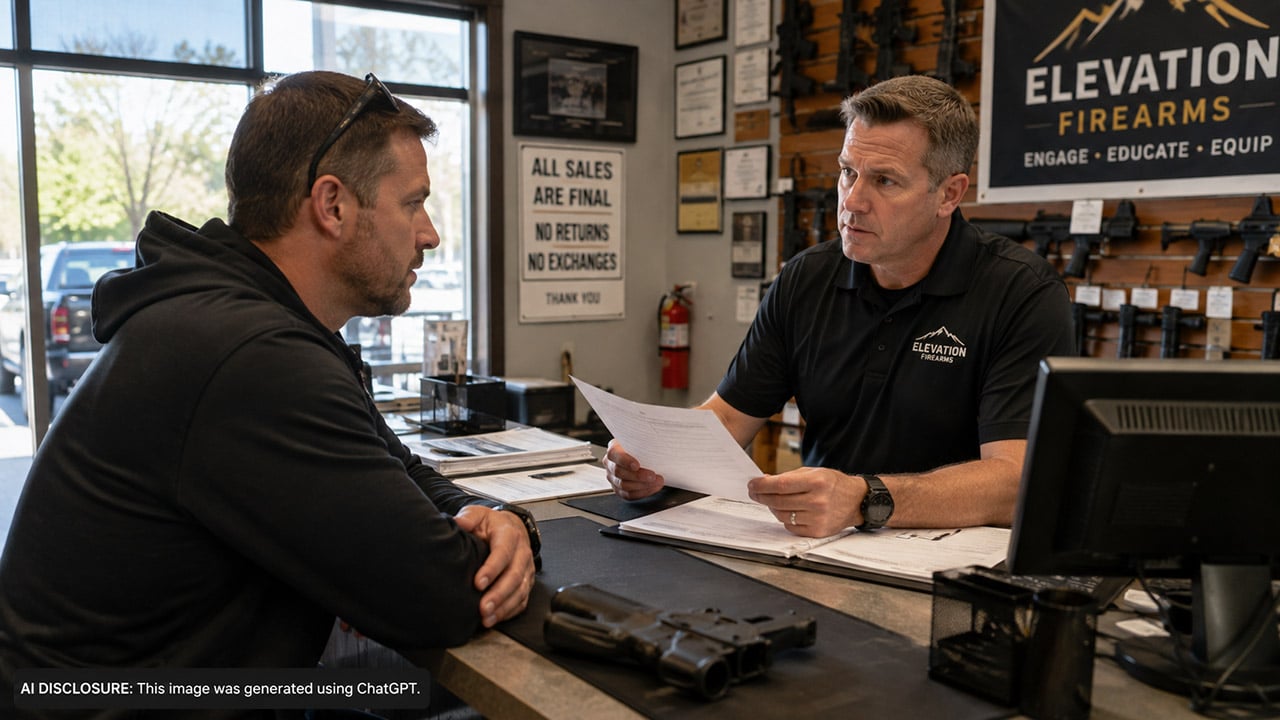
Photo credit: AI-generated image created using ChatGPT. Illustrative only
Buying a stripped lower should be about as routine as it gets: ship it to your FFL, fill out the 4473, pass the background check, and head home. But one Colorado buyer says a simple paperwork mistake turned into a mess involving a missing-gun report and a manufacturer that wouldn’t back down even after the receiver was located.
The account, shared in the original post, lays out a chain of events that every gun owner should pay attention to—because when serial numbers, invoices, and bound books don’t match, the stakes are higher than a delayed Amazon order.
A lower receiver arrives… but not under the buyer’s name
According to the buyer, they ordered a lower receiver from KAK Industry and had it shipped via UPS to their receiving FFL, Skyline Firearms Distribution in Aurora, Colorado. When they stopped in to pick up another firearm, they asked about the lower and were told it wasn’t showing up in the shop’s system under their name.
Skyline’s staff reportedly did more than a quick glance behind the counter. The buyer says employees searched the back room and checked items in storage, but still couldn’t locate the package tied to the buyer’s information.
Skyline and the buyer did what most folks would do
Anyone who’s spent time around a busy gun counter knows deliveries can stack up fast, especially for stores doing a lot of transfers. Skyline’s staff reportedly explained that mislaid or mislabeled packages can happen with big delivery volume, and advised the buyer to contact the shipper so the shipping details could be cross-referenced.
The buyer says they started an email thread that included both KAK Industry and Skyline so the two businesses could compare notes. KAK provided a serial number and maintained that UPS had delivered the package, and the buyer says KAK indicated there wasn’t much else to do other than report it.
The serial-number search found the receiver—sitting in the shop the whole time
Once Skyline had the serial number KAK provided, the shop reportedly checked inventory again using that exact number. That’s when the lower turned up: it had been in Skyline’s storage room the entire time.
The reason it wasn’t found under the buyer’s name is where this story turns from “shipping hiccup” to “paperwork nightmare.” The buyer says KAK included another customer’s invoice inside the box. Skyline, using the paperwork that arrived with the serialized part, logged the receiver under the other customer’s name.
Fixing the paperwork should’ve been the easy part
Once the mix-up was identified, Skyline reportedly contacted KAK and asked for a corrected invoice showing the proper buyer name so the transfer could be completed cleanly. In other words: correct the documentation, match the serial number to the right customer, and move forward.
Instead, the buyer says KAK sent a revised invoice that omitted the serial number. That’s a big deal with serialized items, because the whole point is to keep the paper trail tied to that specific receiver, not just a generic line item.
The situation escalated when a missing firearm report was filed
Before Skyline could verify everything against the physical receiver, the buyer says KAK “jumped the gun” and filed a Lost/Stolen Firearm report with the ATF. That kind of report isn’t just an internal note—it can follow a serial number, and it’s the last thing a buyer wants attached to a lower they’re trying to lawfully transfer through their local shop.
Here’s the part that would make most experienced gun owners stop and reread: once the receiver was confirmed to be safe and accounted for at Skyline, the buyer says KAK refused to withdraw the report. Instead, KAK demanded the receiver be shipped back to Missouri, refunded the order, and canceled it—while the receiver itself was still physically sitting at the buyer’s FFL.
The buyer also says KAK claimed they didn’t have stock to send a replacement, and that after forcing the return they stopped responding to emails in the thread. The buyer noted that KAK’s owner, identified as Kurt in the post, did not offer an apology for the invoice mix-up on a regulated item.
Skyline’s staff chose the “take care of the customer” route
Skyline Firearms Distribution is the hero of this particular story, at least as the buyer tells it. One employee, Max, summed up the frustration with a blunt line included in the post: “This is the most ludicrous thing I’ve ever seen. You guys put the wrong invoice in the box… How about this: withdraw your lost and stolen report with the ATF, the customer comes in to start paperwork on the receiver that is here for them, and this entire situation goes away?”
When KAK still insisted on getting the receiver shipped back, Skyline reportedly offered the buyer a free lower receiver out of their own inventory to make up for the headache. The buyer says Skyline had them come in that same day, complete the 4473 background check paperwork, and they left with the free lower after the check cleared.
Why this kind of mix-up matters to everyday gun owners
A stripped lower is the serialized firearm in an AR build, and it’s the part that has to be transferred through an FFL. When a manufacturer slips another customer’s paperwork into the box, it can trigger a chain reaction: wrong name in the bound book, delays, extra emails, and a customer stuck in the middle while two businesses sort out who is responsible for fixing the paper trail.
Adding an ATF lost/stolen report on top of that is where things get serious fast. Even if you’ve done everything right as a buyer—using an FFL, providing your info, showing up in person to do the transfer—the wrong report tied to the wrong serial number can become a problem you didn’t create and can’t directly fix.
The practical lesson here is simple: keep your receipts, ask for the serial number early if something seems off, and lean on a competent local FFL that’s willing to do real inventory checks instead of just saying “it’s not here.” The buyer also linked an image album described as “receipts,” suggesting they documented the timeline and communication.
In the end, the buyer walked away with a lower—thanks to Skyline’s decision to eat the cost and protect their customer. But the story is a good reminder that with serialized parts, paperwork isn’t a formality. It’s the whole game, and one sloppy invoice can turn a normal transfer into a long, stressful week at the gun counter.
Like The Avid Outdoorsman’s content? Subscribe to our newsletter so you never miss an article.
Here’s more from us: