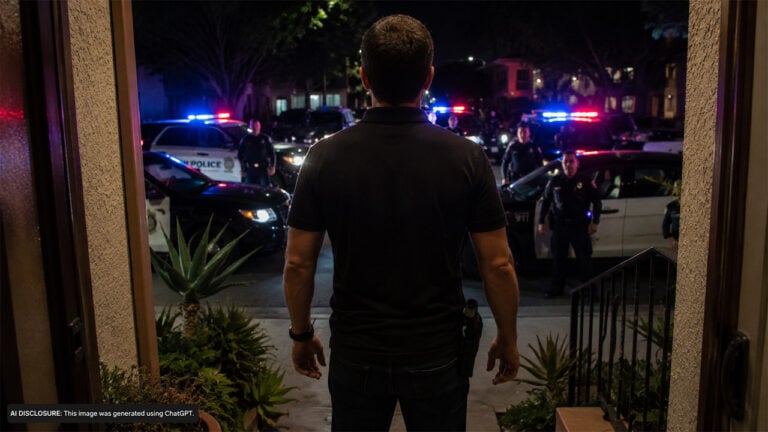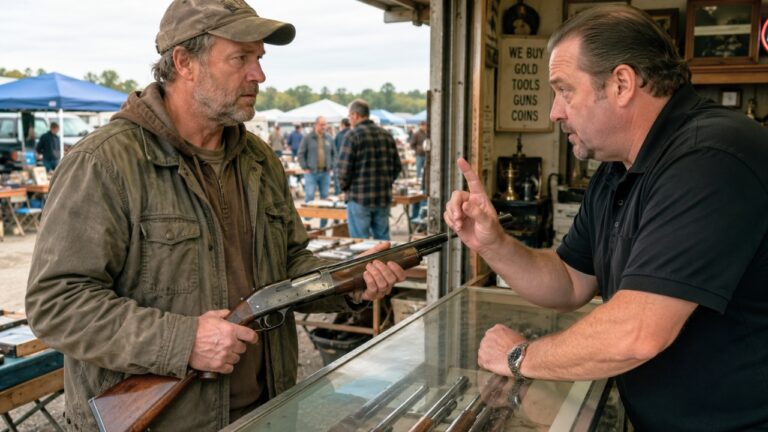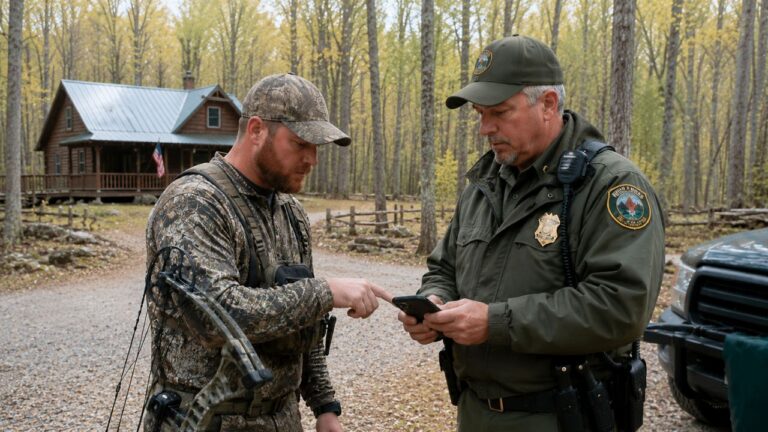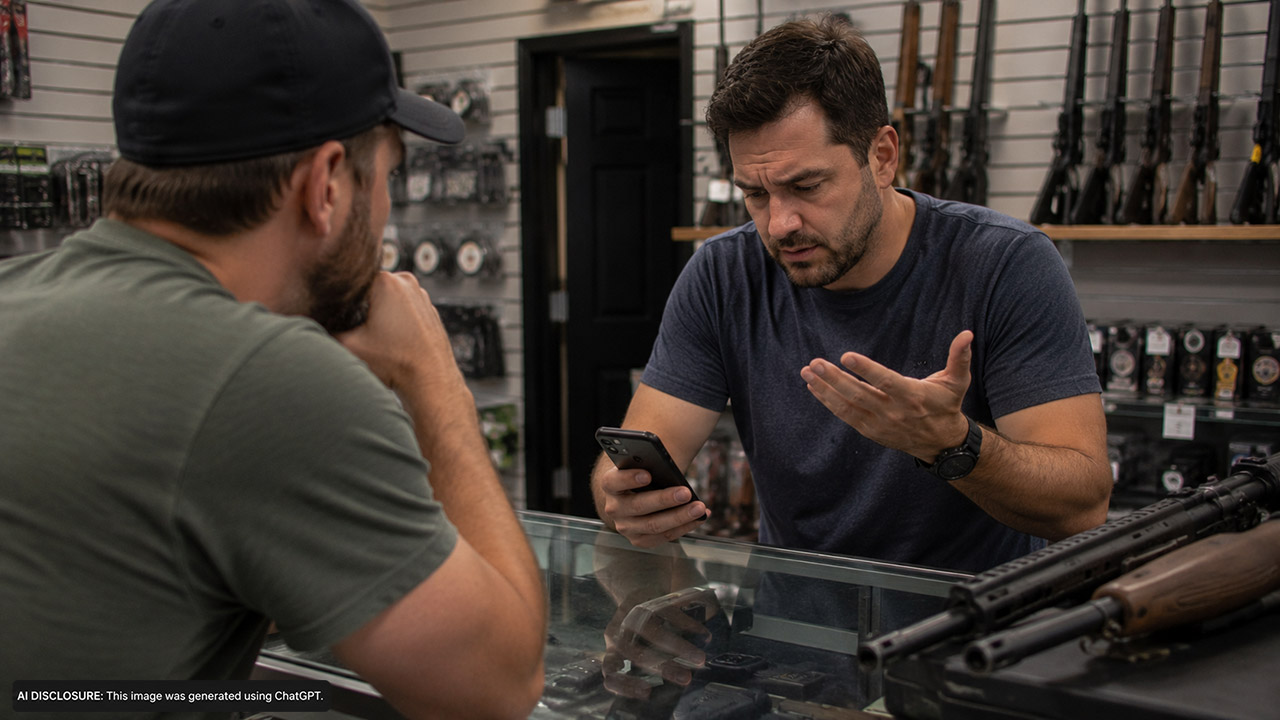
Photo credit: AI-generated image created using ChatGPT. Illustrative only
Anybody who’s bought a firearm through a dealer knows that little pause while the background check runs can feel longer than it really is. Most of the time it’s quick: proceed, pay, walk out. But one buyer laid out a very different experience—getting delayed, waiting a few days, and then landing on a denial even though he believed he didn’t have anything on his record that should block him.
In his case, the backstory matters, and it’s messy. A family fight in California, a short stint in detention, charges that shifted, and then a move to Texas the next day. After that, two attempted gun purchases during a restraining-order/probation period both ended the same way: delayed at first, denied a couple days later. Now he’s asking the practical question a lot of outdoorsmen would ask: once the court-ordered time is over, does buying a gun finally go back to normal?
The incident that followed him out of California
The buyer said the whole thing started in California with a heated argument involving his former stepfather. It escalated into violence when he “fought back” and tried to defend himself, and police were called. He was apprehended without resistance and spent a total of 11 days in detention.
He listed the first two charges as PC 368(B)(1) (elderly abuse) and PC 243(D) (battery causing serious bodily injury). But he also said those were dropped down to a misdemeanor and, in conversations with his public defender, he specifically raised that he wanted to re-enlist in the military. According to him, his defender bargained for a misdemeanor he believed would not affect gun rights.
a misdemeanor and a restraining order
He said he was ultimately “convicted and released under PC 415(2) unreasonable noise misdemeanor,” along with one year of non-reporting probation and a one-year restraining order. In plain English, he’s describing a resolution where the serious-sounding charges weren’t the final conviction, but there were still court conditions attached.
That’s a big detail for gun owners. The conviction code might look like a low-level misdemeanor on its face, but the restraining order and probation timeline can matter just as much—or more—when you’re trying to pass a firearms eligibility check.
Two attempts to buy in Texas, both ending in “delayed” then “denied”
After court, he said he moved to Texas the next day. During the period when the probation and restraining order were still active, he tried to purchase a firearm twice. Both times, he didn’t get an instant yes or no—he got delayed, and then denied a couple of days later.
That delayed-then-denied pattern is the part that makes a lot of folks uneasy. A delay can be something as simple as a records mismatch or an old file that needs to be pulled. But a denial means the system is seeing something that it thinks is disqualifying, even if the buyer believes it shouldn’t be.
The buyer pegged the start of his probation and restraining order to June 2022 and said both expired in June 2023. His question now is straightforward: if those conditions are over, will a third attempt finally come back proceed?
Why “no convictions” and “no disqualifiers” can still turn into a denial
From the outside, it’s easy to hear “misdemeanor noise charge” and assume it should be a non-issue. But background checks don’t just look for felony convictions. They can also flag court orders and certain misdemeanor convictions, and—especially—active restraining orders.
Even without getting into a legal weeds fight, there are a few practical realities gun buyers run into:
First, timing matters. If he tried to buy while a restraining order was active, that alone can be enough to stop a purchase, depending on the exact type and terms of the order. Second, database records aren’t always clean. Court updates can lag. A case can be “reduced” in one place but still show up under an older label in another system. Third, the disqualifier isn’t always the conviction code the buyer is focused on—it can be the existence of a protective order, a probation condition, or how an incident was categorized.
That’s why “I don’t have a disqualifying conviction” and “I got denied” can both be true from two different points of view. The buyer is looking at what he believes he was convicted of. The system may be seeing a different entry, an active order at the time, or a record that wasn’t updated the way he thinks it was.
In the the original post, the buyer emphasized that he thought his public defender bargained down to something that wouldn’t affect gun rights. That’s a common assumption, and it’s where a lot of outdoorsmen get tripped up: “doesn’t affect gun rights” can mean different things depending on the exact statute, the presence of a restraining order, and whether the case involved factors that trigger federal restrictions.
The practical advice that usually follows situations like this is less about trying again and hoping for a different answer, and more about getting documentation in hand. That means obtaining the actual court disposition, the terms and end date of the restraining order, and anything showing probation completion. If the denial is based on incorrect or stale data, the fix isn’t at the gun counter—it’s in correcting the record and using the proper appeals/challenge process for the denial.
Hunters and shooters tend to think in simple pass/fail terms: either you’re legal or you’re not. But the systems that feed these checks are built on entries, dates, and categories. If one of those is wrong, you can be living with the consequences long after you think the matter is settled.
The real-world problem for gun owners: you can’t plan around a “maybe”
For an outdoorsman, a denial isn’t just embarrassing—it can throw off the whole plan. Maybe you’re trying to pick up a deer rifle before season, a shotgun for a home place out in the county, or a simple .22 for pests around the barn. You budget for it, you make the drive, you do everything the lawful way, and you still walk out empty-handed.
And once you’ve been denied, it’s hard not to get stuck in your own head about it. Do you try again? Do you switch dealers? Do you wait longer? The smart move is usually to stop burning time and money on repeat attempts and instead figure out exactly what the denial is tied to. If the restraining order/probation window is what caused the earlier denials, the expiration could change the outcome—but if the record still reflects an active order, or if something else is being interpreted as prohibiting, the result may not change until the paperwork is cleaned up.
Bottom line: this is one of those cases where “I’m good now” doesn’t always translate into “the system shows I’m good now.” If you’ve had a court case, a protective order, or even a misdemeanor that came out of a violent incident, don’t guess. Get the disposition, confirm the order is terminated in the record, and use the proper path to challenge a denial. That’s the difference between another wasted trip and getting your rights—and your hunting plans—back on solid ground.
Like The Avid Outdoorsman’s content? Subscribe to our newsletter so you never miss an article.
Here’s more from us: