Photo credit: AI-generated image created using ChatGPT. Illustrative only
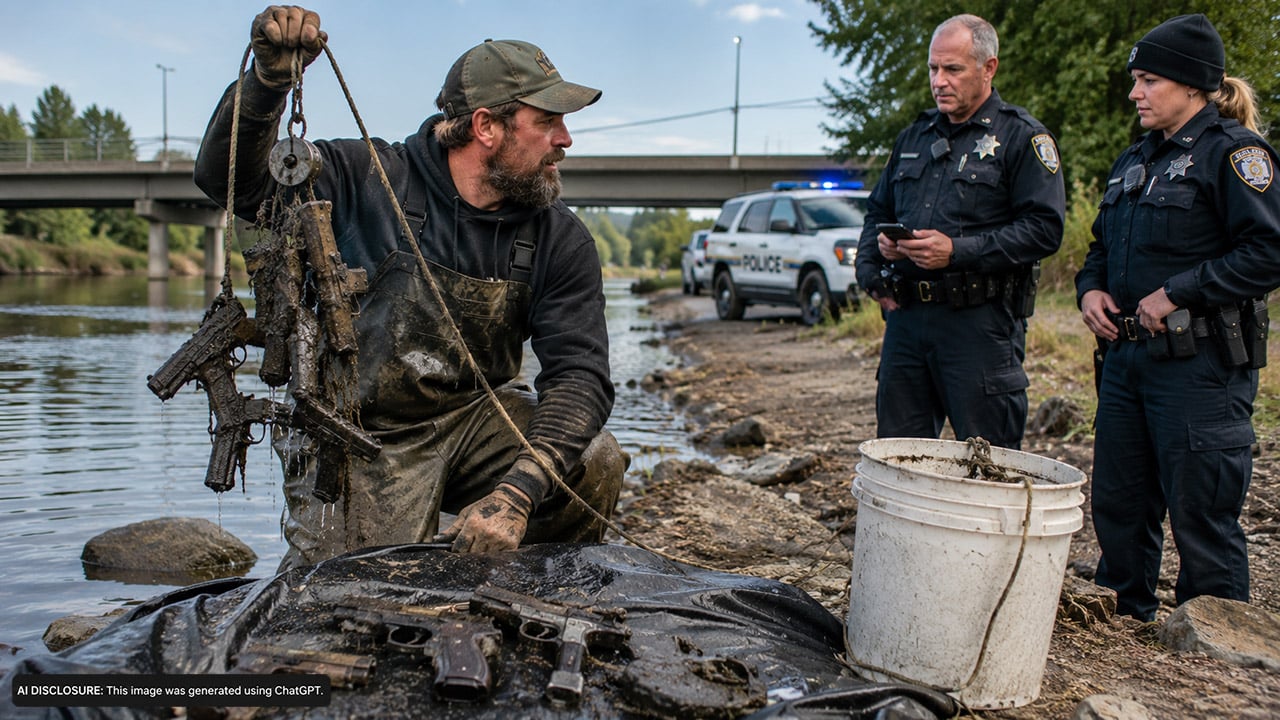
Most magnet-fishing days are a pile of scrap, a couple lures, and maybe a pocketknife if you’re lucky. But one magnet fisherman hit something different—four rifles and a revolver in roughly 20 minutes—while working a spot he’d never tried before. The details were shared in the original post, and the pace of the finds is what makes it hard to ignore.
He ended the day with 10 guns total (not counting four BB guns), and said law enforcement got involved for a separate reason entirely: earlier, they’d found a large piece of artillery and called it in. When officers were around, the magnet fisherman wanted serial numbers checked—but was told they couldn’t run them until the next morning.
A new spot turned into a hot stretch fast
According to the post, the first two rifles came on back-to-back casts. He believed both were 30-30 lever actions, and at first he thought they might be BB guns—until he knocked rust off and realized the barrels were far too substantial for airguns.
That little moment matters, because it’s exactly how magnet fishing can fool you. A rusted receiver and a mud-packed barrel can make a real firearm look like a toy, and that’s when folks get casual and start swinging things around for the camera. This guy’s surprise is a good reminder: treat every “junk gun” like it’s loaded until you’ve proven otherwise.
Four rifles, then a revolver
Shortly after the first pair of lever guns, he pulled two more rifles on back-to-back throws again. He described one as a .22 pump action, and said the fourth rifle might be an Indian Martini .22, though he wasn’t sure on the exact model.
Then came the revolver—a .357 Magnum that he strongly believed was a Smith & Wesson. He said he found numbers under the wooden grips and even posted on an S&W forum to get more information. Anyone who’s ever tried to identify an old wheelgun from partial markings knows that’s often the only way to get a confident answer without factory letters or a knowledgeable local smith.
Why “run the serials” isn’t always instant
The part that got outdoorsmen talking is the timing: five guns out of the water quickly, officers present because of the artillery call, and still no immediate serial-number check. The magnet fisherman said police told him they couldn’t run the serials until the next morning.
That can sound crazy if you’re used to TV where a number gets typed in and a full history prints out. In the real world, it can depend on staffing, access to the right systems, and whether a supervisor wants to treat submerged, corroded firearms as evidence right now or log them later. If it’s late, if the right person isn’t on shift, or if the guns need to be processed differently due to condition, you may get a “tomorrow” answer even when an officer is standing right there.
He didn’t call police because of the guns
A key detail in the post is that the firearms weren’t what brought police to the scene. He said officers were called over a large piece of artillery found earlier that day, and the gun discussion happened after that.
That’s a big distinction for anyone who magnet fishes, hunts public land, or just spends time around water access points. Different departments (and different officers) react differently to recovered firearms. Some want to take possession immediately. Some will tell you what the local process is. And some will treat it like property unless they have an obvious reason to seize it—especially if it’s been underwater long enough to look like river scrap.
The practical outdoorsman angle: safety, legality, and what you do next
Even if a river gun looks like it’s been down there since your granddad was in short pants, it deserves careful handling. Don’t put your finger in the trigger guard to “see if it moves.” Don’t try to cycle an action that’s locked with rust and grit. And don’t start disassembling it on the tailgate like it’s a garage-sale .22—because you can still get surprises from springs under tension, live rounds in a chamber, or a stuck cartridge that moves once mud washes out.
Legally, you’re in patchwork country. In some places, you may be allowed to keep certain finds; in others, firearms fall under specific rules for found property or require surrender. This poster said he was able to keep all the guns from that day, but that won’t be universal. If you’re going to magnet fish regularly—especially around bridges, parks, or old dumping spots—it’s worth asking your local department ahead of time how they want these handled and whether they’ll accept them for disposal or documentation.
It wasn’t his first big day, but it was his fastest
The magnet fisherman said he’s been at it for over seven years, and days with five or more guns have only happened twice for him. One was in Saginaw, Michigan across two different spots. Another was in South Bend, where he found five guns at the same spot, took a break, and came back an hour later to pull out five more.
What makes this particular stretch stand out is the speed: five firearms in under 20 minutes at a brand-new location. If you’ve spent time around old river crossings, backroad bridges, and urban edges where people dump evidence, you know there are places that just “feel” like they’ve got a story under them. Sometimes that story is shopping carts and rebar. Sometimes it’s a pile of guns.
However you feel about magnet fishing, this is a good reminder that waterways collect more than fishing tackle. If you work these areas—whether you’re casting for smallmouth or checking a trap line—keep your head on a swivel, treat found firearms with respect, and know who you’ll call if you pull up something more serious than scrap.
Like The Avid Outdoorsman’s content? Subscribe to our newsletter so you never miss an article.
Here’s more from us: