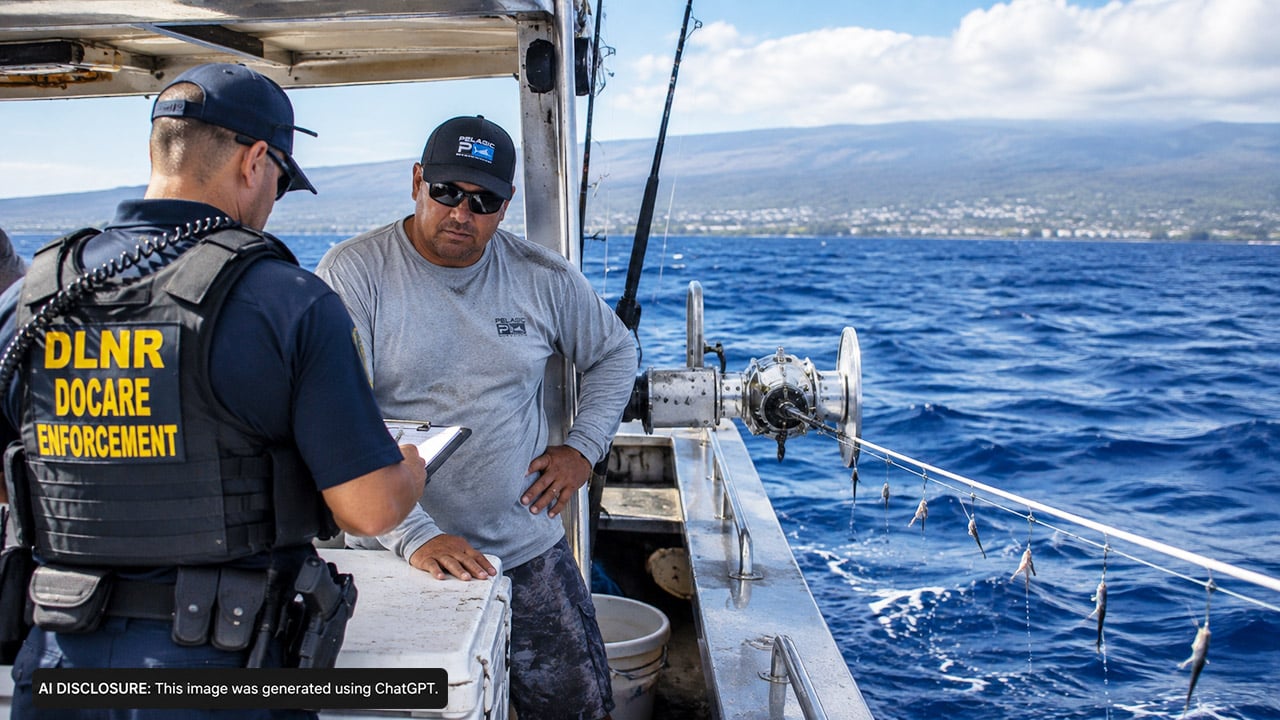
Photo credit: AI-generated image created using ChatGPT. Illustrative only
On the Kona coast, the line between legal commercial fishing and a hard lesson can be measured in nautical miles. In this case, state officers say a longline set that ran far past the limit ended with a maximum state penalty, a license revocation, and a referral that could keep the spotlight on the captain for a while.
In a Jan. 9, 2026 release from Hawaiʻi’s Department of Land and Natural Resources, officials laid out what happened and what it cost: $10,051.90 in administrative fines and costs, plus a one-year revocation of the captain’s Commercial Marine License. Details are in the original post.
What officers say they saw off Kona
The state says the case goes back to May 7, 2025, when Division of Conservation and Resources Enforcement (DOCARE) officers were patrolling off Hawaiʻi Island’s Kona coast. According to the release, officers documented longline fishing gear being deployed in Hawaiʻi state waters—an area where longline fishing is prohibited under state law.
Not only was the gear in the wrong place, the state says it was far longer than allowed. DOCARE documented the longline stretched 3.69 nautical miles, which the release describes as more than three times the legal limit. The legal limit referenced in the release is one nautical mile.
The gear length wasn’t a small overage—it was the whole problem
Most outdoorsmen understand how regulations often work: the state gives you a bright line because it’s enforceable. One hook too many, one net in the wrong water, one line too long—it’s measurable, and it’s hard to argue once it’s documented.
Here, the DLNR says the captain, Konane Zager—identified as the owner of the vessel Waiʻaka—deployed a set that ran 3.69 nautical miles. That’s the kind of number that doesn’t read like a mistake made in a rush. It reads like a decision.
The catch turned the violation into a dollars-and-cents case
According to the release, officers observed the gear in the water and, while it was being retrieved, documented the take of three yellowfin tuna (ahi). The state says two of those fish were later sold to a local fish buyer.
The third tuna, the release notes, was found alive and released back to the ocean. That’s a better ending for that fish, but it doesn’t erase the take that DOCARE documented, and it didn’t stop the state from stacking penalties tied to what was caught or injured.
Officials say the captain admitted what he did—and knew the limit
One detail in the release matters because it goes straight to intent: DLNR says Zager admitted deploying the gear and acknowledged knowing it exceeded the one-nautical-mile limit.
In the real world, that kind of admission takes the “I didn’t know” defense off the table. A lot of outdoor violations live in the gray area—boundaries not marked, changing rules, honest confusion about seasons. This one, at least as the state describes it, wasn’t that.
The BLNR went with the maximum fine and a one-year license revocation
After the DOCARE investigation, the DLNR Division of Aquatic Resources (DAR) recommended the Board of Land and Natural Resources (BLNR) impose the maximum allowable administrative penalties. The BLNR unanimously voted to adopt DAR’s recommendations.
The total fine and costs came to $10,051.90, broken down this way in the release: $1,000 for a first-offense violation of longline fishing within state waters; $3,000 for the ahi taken/injured (listed as $1,000 per fish); and $6,051.90 in DLNR administrative costs tied to investigation and enforcement.
On top of the money, the board approved revoking Zager’s Commercial Marine License for one year and barred him from reapplying until that revocation period is over. For a working captain, that’s not a slap on the wrist—that’s a season (and then some) of lost income and lost opportunity.
The state also kicked it to NOAA for possible federal issues
The penalties didn’t stop at the state level. The BLNR also directed DAR to transmit investigative materials to the National Oceanic and Atmospheric Administration’s Office of Law Enforcement (NOAA OLE) for further investigation of potential federal law violations.
That matters because commercial fishing often lives under overlapping layers of rules—state waters, federal waters, permits, gear restrictions, reporting requirements. The state release doesn’t say what, if anything, NOAA will do next. But it does make clear Hawaiʻi is treating this as more than a local paperwork problem.
DLNR Acting Chair Ryan K.P. Kanakaʻole said, “This action sends a clear message that illegal longline fishing in Hawai‘i’s state waters will not be tolerated,” and pointed to the purpose behind the rules: protecting marine resources and making sure fishing is done “responsibly and sustainably.”
DAR Administrator Brian Neilson added that state law prohibits longline fishing in state waters to protect local fisheries and traditional fishing grounds, and said the board’s decision reflects the seriousness of the violation and the commitment to uphold those protections.
Where the money goes—and why that matters to legal operators
DLNR says the total administrative fine and costs will be deposited into the Commercial Fisheries Special Fund. That fund supports programs and activities tied to management and conservation of Hawaiʻi’s aquatic resources used for commercial purposes.
Plenty of folks who make their living on the water roll their eyes at the idea of “fees” and “funds.” But there’s another angle: when enforcement is real and penalties are real, the guys trying to do it by the book aren’t competing against someone willing to bend the rules in closed water with oversized gear.
If the state’s goal is to protect local fisheries and traditional fishing grounds, then consistent enforcement is part of keeping the playing field level—especially in places where nearshore pressure, high demand, and tight margins can push people toward bad decisions.
The Kona case shows how fast it can stack up: documented gear in prohibited state waters, a line more than three times the stated legal limit, fish taken and sold, maximum administrative penalties, a year without a commercial license, and now a federal referral. Out on the ocean, you don’t always get a second chance to make the right call—and neither does your license.
Like The Avid Outdoorsman’s content? Subscribe to our newsletter so you never miss an article.
Here’s more from us: