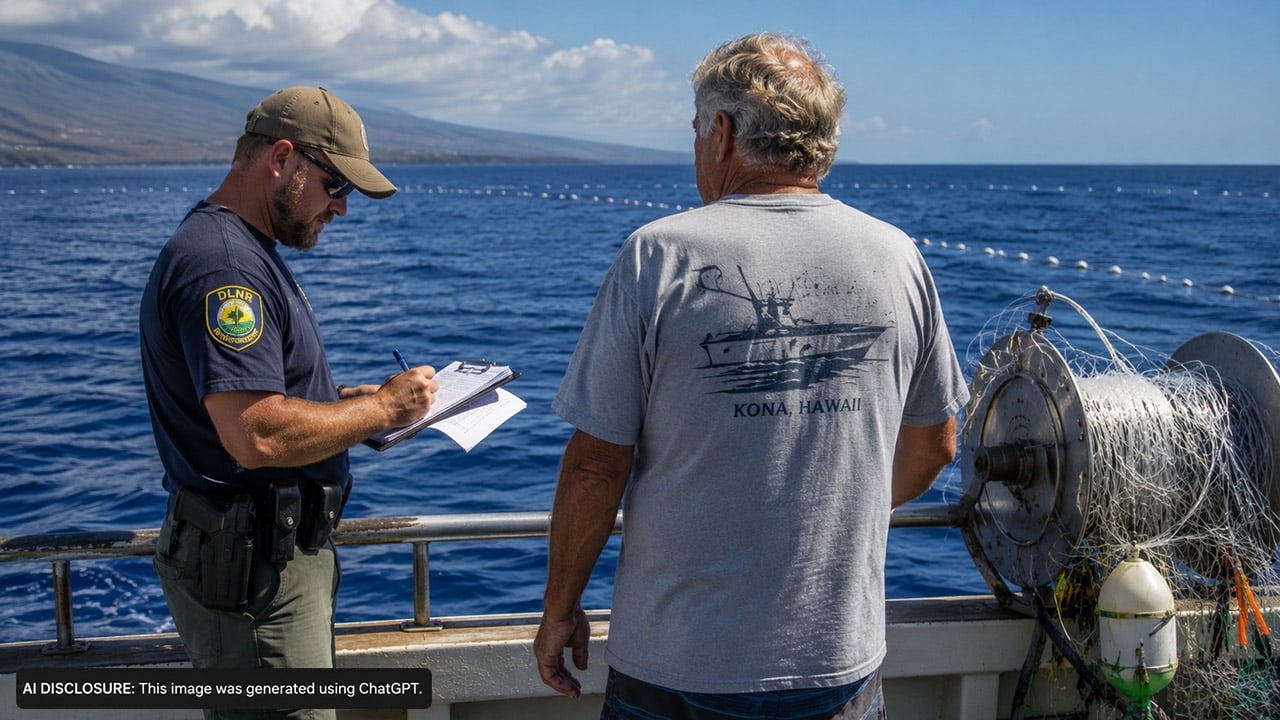
Photo credit: AI-generated image created using ChatGPT. Illustrative only
If you’ve spent any time chasing pelagics, you already know longline gear isn’t a casual setup. It’s serious commercial fishing equipment, it covers water fast, and when it’s run wrong it can tangle up more than just fish. That’s why Hawaii draws a hard line on how much of it can be in the water inside state waters.
That line got crossed off the Kona coast in a big way. In a case laid out in the original post, state officers documented a longline that stretched 3.69 nautical miles—more than three times the one-nautical-mile limit—and the boater ended up taking the maximum penalty the state can hit him with.
What officers say they found off the Kona coast
According to the Department of Land and Natural Resources (DLNR), Division of Conservation and Resource Enforcement (DOCARE) officers documented Konane Zager operating a boat named the Waiaka on May 7, 2025. The issue wasn’t a small paperwork mistake or a borderline measurement.
DOCARE said the longline gear extended 3.69 nautical miles. Hawaii’s legal limit in state waters is one nautical mile, and DLNR said this set ran more than triple what’s allowed. When you’re talking about longline, that isn’t an “oops”—that’s a deliberate amount of gear in the water.
The fish taken, sold, and released
DOCARE officers said Zager hauled in three yellowfin tuna (ahi). Two of those fish were sold to a local fish buyer, and the third was found alive and released back into the ocean.
From an outdoorsman’s perspective, that detail matters. Selling fish makes the whole thing unmistakably commercial in nature, and it tightens the spotlight on the resource side of the equation. It’s one thing to get checked and be short a stamp; it’s another to run illegal gear and then move product.
Admitting the gear was over the limit changed the tone
DLNR said Zager admitted he deployed the gear and knew it exceeded the legal limit. That’s a rough spot to be in, because once you’ve acknowledged you understood the rule and crossed it anyway, there’s not much room left for “I didn’t know” or “I measured wrong.”
In the real world, enforcement cases often swing on intent and knowledge. Here, the state’s position wasn’t built on guesswork—they documented the length, and they say he knew it was too long.
The state stacked the maximum penalty and added the price of enforcement
The DLNR Division of Aquatic Resources (DAR) recommended the Board of Land and Natural Resources (BLNR) impose the maximum allowable administrative fines, totaling $10,051.90. That total wasn’t just one flat number—it was a mix of penalties and costs.
DLNR listed the breakdown like this: $1,000 for a first-offense violation of longline fishing within state waters; $3,000 tied to the ahi taken/injured ($1,000 per fish); and $6,051.90 in administrative costs for investigation and enforcement. BLNR unanimously voted to adopt DAR’s recommendation.
Losing the license for a year is the part that hits working boats hardest
The fine gets the headlines, but the bigger practical hit for anyone who makes a living on the water is what happened to Zager’s commercial marine license. BLNR revoked it for one year, and he’s barred from reapplying until after that revocation period expires.
If you’re a commercial operator, that’s not just a slap on the wrist. That’s a full season of not working under that license—plus the ripple effect: lost contacts, missed runs, and a hole in the business that doesn’t care why you’re tied to the dock.
Why this case didn’t end at the state line
DLNR said all investigative materials were given to the National Oceanic and Atmospheric Administration’s Office of Law Enforcement for further investigation of potential federal violations. That’s a reminder a lot of folks forget: on the ocean, you can stack trouble quickly because you’re dealing with overlapping lines of authority.
State waters rules are one piece. Federal rules are another. When a case is strong enough that it gets handed over for possible federal follow-up, that’s usually a sign the agencies view it as more than a minor infraction.
DLNR also noted the funds will be deposited into the Commercial Fisheries Special Fund, which supports programs and activities tied to management and conservation of Hawaii’s aquatic resources used for commercial purposes.
For regular anglers and honest commercial guys, this is the kind of enforcement you want to see: clear rule, clear violation, and a consequence big enough that it’s not just a cost of doing business. Because when someone runs a longline that far over the limit, it’s not just about their boat—it’s about the pressure that extra gear puts on the fishery and the headache it creates for everyone trying to do it the right way.
Like The Avid Outdoorsman’s content? Subscribe to our newsletter so you never miss an article.
Here’s more from us: