Photo credit: AI-generated image created using ChatGPT. Illustrative only
Most folks who toss a magnet in the river are hoping for old tools, maybe a knife, maybe a fishing lure collection. This guy has been pulling up firearms for a while—enough that the next one should’ve felt routine. But on gun number 82, he finally checked something off his bucket list: a 1911 that didn’t even look like a 1911 at first.
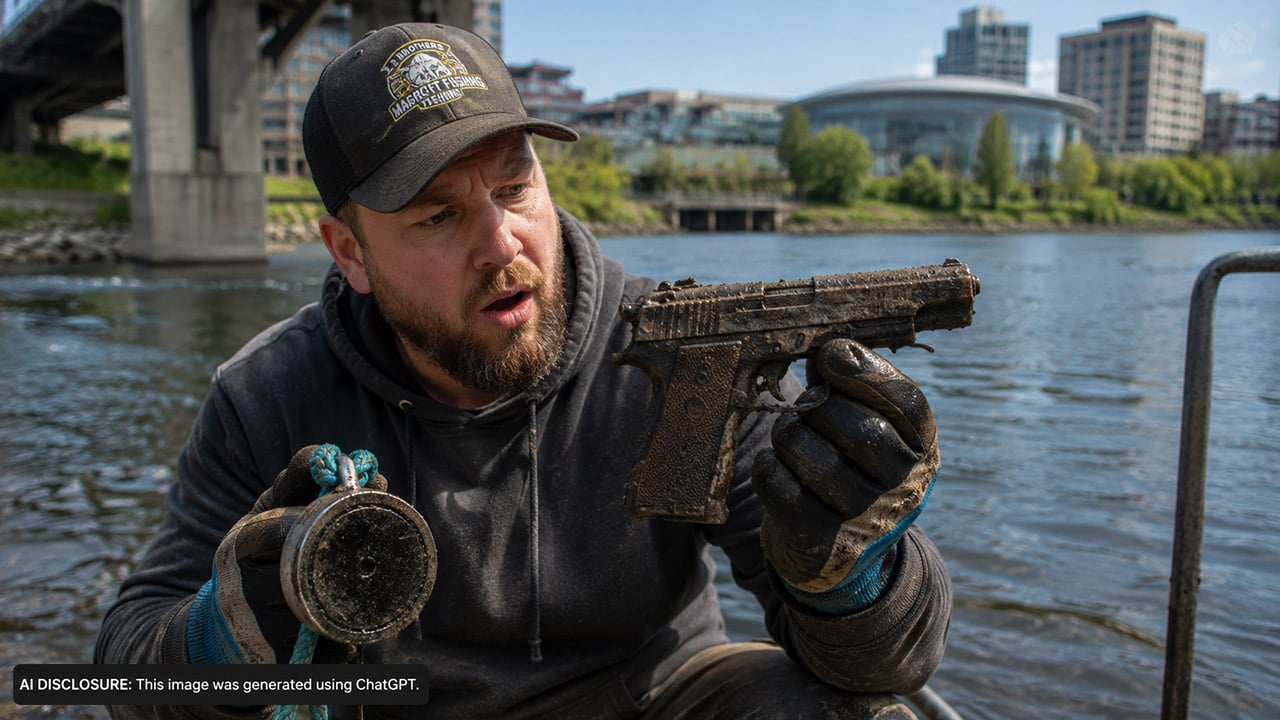
In the original post, he explains that when the pistol first came up, he “couldn’t even tell what it was.” The photos show why—heavy corrosion and river grime can round off the details that normally give a handgun away at a glance. After some research, he identified it as a WWII-era M1911A1 made by Union Switch & Signal, a model that can bring serious money when it’s in firing condition.
A bucket-list find that didn’t look like much at first
The best magnet-fishing finds usually don’t announce themselves. This one came up looking like a misshapen chunk of metal—more “boat anchor” than “collectible sidearm.” The poster says photo 5 shows how rough it looked when it first surfaced, and that tracks with what river guns tend to look like: pitted, crusted, and hard to identify without slowing down and studying the shape.
But the outline was there. Enough frame, enough slide, enough of that familiar 1911 profile once the mud and rust quit fooling your eyes. After three years of hoping to snag an M1911 as a “reasonable” magnet-fishing goal, he finally had one stuck to the magnet.
Not a Colt—something arguably more interesting
He admits it “too bad it isn’t a Colt 1911,” which is what a lot of shooters picture when they think of a classic military 1911. Colts have the name recognition, and for many collectors that’s the first stamp they want to see. But once he dug into what he actually had, the story got better.
His pistol is marked as a Union Switch & Signal M1911A1. That’s not a company most folks associate with handguns, because it wasn’t a traditional firearms maker. Union Switch & Signal was a railroad signaling manufacturer that produced wartime pistols when the government needed production capacity—exactly the kind of oddball WWII manufacturing story gun guys love.
The WWII production numbers that make it stand out
Union Switch & Signal pistols have a built-in scarcity compared to the big-name makers. The poster says US&S made 55,000 M1911A1 pistols in a two-year span, mainly in 1943, and that they were manufactured from 1942 to 1944 based on what he found online. In the world of U.S. military sidearms, that’s a short run.
That limited production is the hook. Plenty of old guns are “old,” but not all of them are uncommon. A wartime pistol made by a railroad signaling company, in comparatively small numbers, is the kind of thing collectors remember—and the kind of thing that can separate a neat find from a truly special one.
Why the value talk gets complicated fast
The poster notes that these guns range from $3,500 to $4,600 at auction “in firing condition.” That last part matters. A river gun can be historically interesting and still be a mechanical wreck, and the gap between “found artifact” and “safe shooter” is where a lot of optimism goes to die.
Even if a pistol is rare, a collector usually cares about originality, markings, and overall condition. A gun that’s been soaking, rusting, and grinding against sand and rocks can lose value quickly, especially if key markings are obscured or if the metal has deep pitting. On the other hand, rarity is rarity, and a legitimate US&S 1911 still turns heads even when it’s rough.
The real-world outdoorsman side of pulling guns from water
Finding a firearm in a river isn’t the same as finding a wrench. It changes how you handle the day. Even when it’s corroded and looks dead, you treat it like it could still be loaded, and you keep it pointed in a safe direction while you’re sorting out what it is.
There’s also the common-sense legal side. Laws vary, but a gun pulled from public water can still be evidence, stolen property, or tied to an old case. Anyone doing this hobby a lot needs a plan before the next one comes up: who you call, what you document, and how you store it safely until you know what you’re dealing with. This poster didn’t lay out those steps in the source material, but with “82 guns” behind him, you can bet he knows this isn’t something you toss in the truck bed and forget about.
And on a practical note for anyone who’s tempted to “see if it’ll run”: river guns and “firing condition” don’t belong in the same sentence until a qualified professional has eyes and hands on it. Corrosion doesn’t just make a gun ugly; it can weaken parts you’re trusting to contain pressure inches from your face.
A unique kind of firearm story—history with mud still on it
What makes this find fun is that it’s not just another “look what I found” gun post. It’s a reminder that wartime manufacturing produced some strange, limited-run pieces, and they’re still out there—sometimes in places you’d never expect, like the bottom of a river.
The magnet fisherman called it “definitely one of the more unique firearms” he’s found and said he’d love to learn more about it. That’s the right attitude. Whether it ends up as a collectible project, a display piece, or simply a documented artifact, a US&S M1911A1 is the kind of find that puts a little weight behind the phrase “they don’t make them like they used to.”
Like The Avid Outdoorsman’s content? Subscribe to our newsletter so you never miss an article.
Here’s more from us: