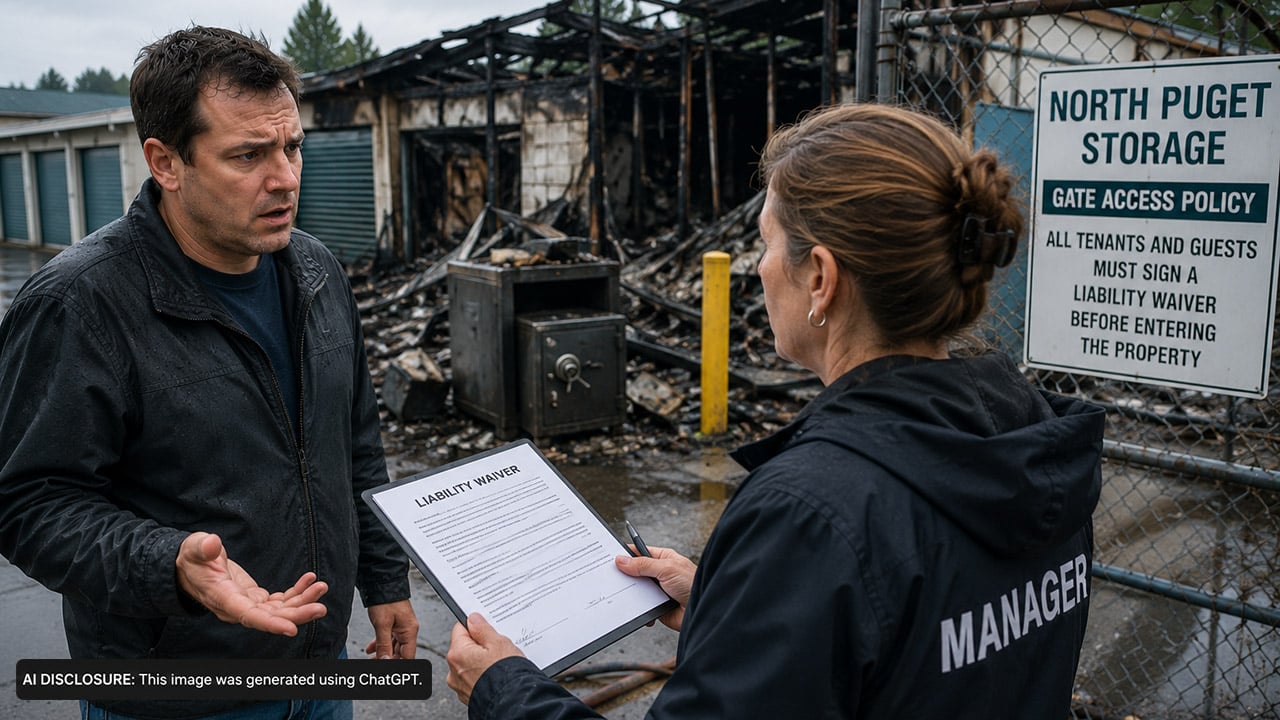
Photo credit: AI-generated image created using ChatGPT. Illustrative only
A storage unit is supposed to be the place you put the stuff you can’t lose—tools, family keepsakes, hunting gear, important paperwork—so you can sleep at night. In Pierce County, Washington, one customer says that kind of trust turned into a drawn-out nightmare after a suspicious fire wiped out a facility, a large gun safe disappeared, and the company later insisted on a sweeping liability waiver before letting them anywhere near what’s left.
The account comes from the original post, where the renter describes a commercial/personal unit that functioned as their workshop and held “every worldly possession” they own. They say the building burned in early January, there’s evidence of forced entry and theft, and they’ve been denied access for more than two months—unless they sign away their rights to pursue legal action.
The fire wasn’t the first warning sign
One detail that stands out is the timeline. The renter says there were “red flags” in the month leading up to the fire: a tool inside their unit that didn’t belong to them and was “large enough” and set up to cut sheet metal, plus an alarm setting that neither renter had ever used.
Anyone who’s kept a shop in a storage unit knows the feeling—if something’s off, it’s usually off for a reason. A random tool and a changed alarm mode aren’t proof by themselves, but they’re the kind of thing that makes you start taking photos, checking your lock, and asking management hard questions.
Forced entry, a stolen safe, and a fire that destroyed the building
After the blaze, the renter says there were clear signs their unit was broken into. They describe the front door as “completely bashed in,” and say their roughly 5-foot-tall “fire proof gun safe” was stolen.
How would a safe that size leave? The renter believes the thieves cut open the metal garage door and wheeled the safe out. They say a furniture dolly was left behind after the fire. They also describe a cut-through into a neighboring unit where they believe the fire started, and they question how the situation got so far out of hand despite alarms in each unit and a security camera pointed down the row.
There’s also a public-safety angle here that hits home for gun owners: the renter says there’s a police investigation regarding the stolen safe and firearms, and they’ve supplied serial numbers. Stolen guns don’t just disappear into thin air. They tend to show up later in the worst ways, and reporting serials is one of the few concrete steps a victim can take that may actually matter down the line.
Insurance confusion turned into an ugly surprise
A lot of folks rent storage thinking, “If the worst happens, insurance is there.” In this case, the renter says they were told—verbally and in emails they kept—that the facility would sign them up for insurance through the company and that it would be included in monthly rent.
They also say the paperwork or process made it sound like insurance was required at signing, and if the renter didn’t bring their own, the facility would enroll them. After the fire, the renter says they discovered they had no coverage at all. If true, that’s the kind of gap that doesn’t just hurt—it changes everything about how a family recovers, especially when the unit was being used as a workshop tied to income.
Access denied, jobs lost, and the “sign this or stay out” waiver
The most aggravating part of the story is what happened after the smoke cleared. The renter says it has been more than two months and they’ve been blocked from even getting near the site to assess damage or salvage anything. They say the tools needed for their trade are in that unit, and losing access led to lost employment and a major hit to financial stability.
Then comes the part that would make most outdoorsmen set their jaw: the facility sent a waiver saying access would be allowed only if the renters release the company from “any and all liability” for known and unknown losses and claims. The renters didn’t sign. After that, they say the facility stopped responding to emails, even after the renters asked for assurance their property wouldn’t be moved or disposed of without explicit consent.
In plain terms, they feel like their stuff is being held hostage behind legal language. And if you’ve ever dealt with a property dispute—land lines, easements, cattle gates, stolen trail cameras—you know how quickly “let’s just handle this reasonably” can turn into “talk to my attorney.”
Why “gross negligence” and documentation became the big questions
The renter specifically asks whether evidence of theft and tampering before the fire could point to “gross negligence” that might bypass the usual “store at your own risk” language that shows up in storage contracts. That’s a fair question, and it’s one reason these situations get complicated fast. Contracts can limit liability, but they don’t necessarily give a company a free pass for everything under the sun—especially if there’s serious misconduct, misrepresentation, or extreme carelessness involved.
The renter also notes the fire investigator told them in an email that the storage company has “not been very forthcoming with information,” and that the report will be incomplete when closed out. That’s another detail that matters because paper trails matter. If you ever wind up in a dispute like this, you want every email saved, every photo backed up, every serial number listed, and every timeline written down while it’s still fresh.
The renter says they’ve also teamed up with a neighboring business owner who is “being treated similarly.” When multiple renters are seeing the same wall go up, it can change the leverage and the level of attention a case gets—at least enough to make it harder to shrug off as a one-off misunderstanding.
What people in the outdoors world should take from this
This story is a gut check for anyone storing guns, optics, reloading gear, or the tools that keep the lights on. If you’re using a unit as a workshop, don’t assume the facility’s policy is the same as “you’re covered.” Ask for the actual insurance declarations page or written proof of enrollment, and keep it where you can grab it even if your unit is gone tomorrow.
Second, inventory matters. Serial numbers for firearms are huge, but so are model numbers on suppressor-ready uppers, high-dollar scopes, binoculars, generators, welders, chainsaws, and specialty tools. Photos help. Receipts help. A simple spreadsheet helps. It’s not fun, but it’s a lot less painful than trying to rebuild a list from memory after everything is ash.
Finally, don’t let frustration push you into signing something you don’t understand—especially a broad release tied to access. If a company is asking you to waive rights before you can even look at your own property, that’s a sign to slow down, read every word, and get competent advice. When your livelihood is in the balance, “just sign it so you can get in there” can be a costly mistake.
For the Pierce County renters, the immediate problem isn’t just what burned or what was stolen—it’s being stuck in limbo while time and money keep bleeding out. And for the rest of us, it’s a reminder that security isn’t just locks and cameras. It’s paperwork, proof, and making sure the fine print doesn’t become the trap door.
Like The Avid Outdoorsman’s content? Subscribe to our newsletter so you never miss an article.
Here’s more from us: