Photo credit: AI-generated image created using ChatGPT. Illustrative only
Most magnet fishing trips are a mix of railroad spikes, old tools, and enough scrap to make you wonder why you didn’t bring thicker gloves. But one night run turned into something else entirely when a magnet fisherman who says he’s pulled more than 50 firearms from the water felt a bagged-up hunk of metal come off the bottom and realized it wasn’t junk.
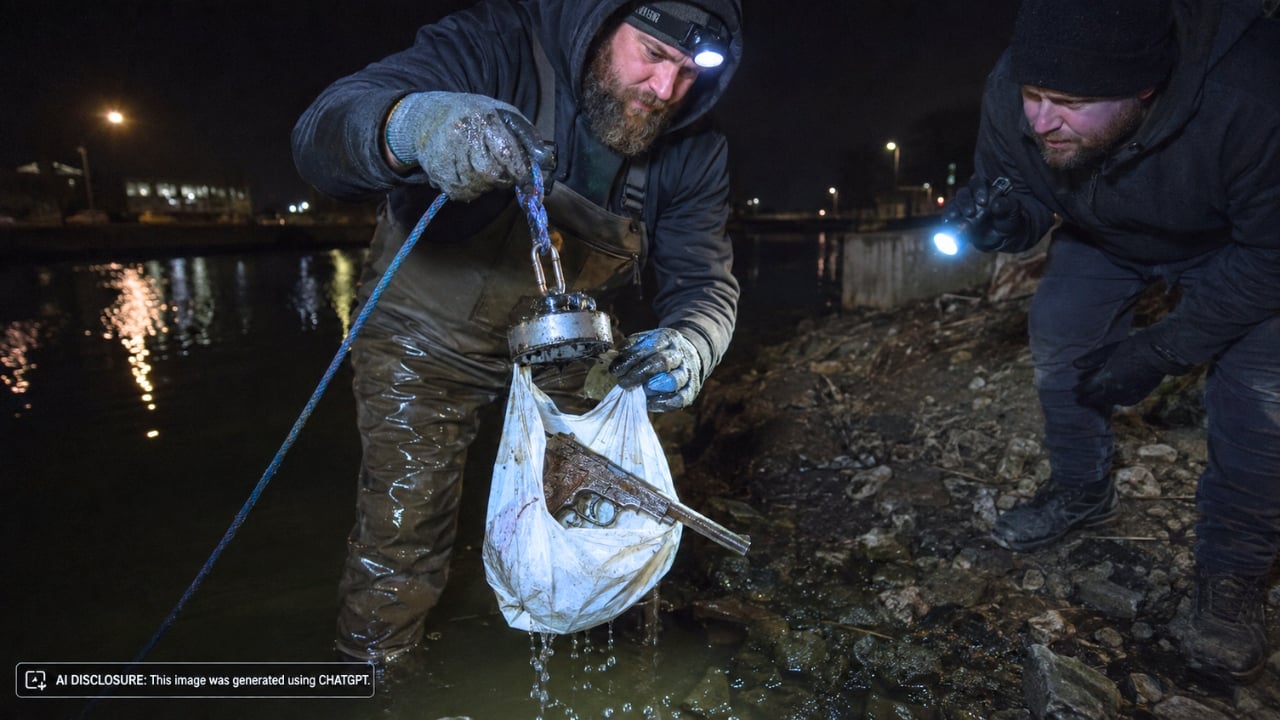
In the original post, the magnet fisher said the find that actually got his attention wasn’t the sheer number of guns he’d recovered—it was a 1942 Colt Woodsman, wrapped inside a Walmart bag like somebody wanted it hidden and forgotten.
Night magnet fishing is when “the guns bite”
The poster’s routine stood out right away: he likes magnet fishing at night, and he swears that’s when firearms show up most often. He joked that nighttime is when “the guns bite the most,” which is funny until you remember what it means in real-world terms—somebody, at some point, decided a gun belonged in the water.
Folks who spend time around rural bridges, bank-fishing pull-offs, and backroad access points already know how different things feel after dark. Less traffic, less attention, and for a certain type of person, less risk. Whether it’s dumping stolen property or getting rid of a problem, water gets used like a trash can.
A Walmart bag on the magnet doesn’t usually mean a collectible pistol
The moment that changed the tone of the night was the bag. The magnet fisherman said he initially thought it was another railroad spike wrapped up in plastic—something that happens when scrap or rebar gets tangled with debris. So he called his buddy over and joked that it was a gun.
Then he felt around through the bag and realized it really might be. That’s when excitement and caution hit at the same time. Anything firearm-shaped coming out of the water needs to be treated like it can still function, and just as importantly, like it can still be evidence.
The standout find was a 1942 Colt Woodsman
The gun that made this trip different was a Colt Woodsman dated to 1942. Even people who aren’t big on older rimfire pistols know the Woodsman has a reputation: classic lines, good triggers, and the kind of fit-and-finish you don’t see on a lot of modern budget handguns.
It’s also not something you expect to see pulled from a river or canal, especially wrapped in a shopping bag. A Woodsman from that era isn’t just “a gun.” It’s a piece of American firearms history, and if it can be safely cleaned up and assessed, it’s the kind of .22 that a lot of shooters would be proud to own and pass down.
The poster said this was the only firearm find that truly excited him—besides any full-auto guns he’s apparently run into before. That line tells you two things: he’s found a whole lot of guns in the water, and most of them weren’t the kind you’d call a keeper.
Then a Hi-Point C-9 came up, and the response got more official
Not long after the Woodsman, the magnet fisherman said he also found a Hi-Point C-9. That’s a very different category of handgun—more “cheap and functional” than “classic and collectible”—and it changes the vibe because it’s the kind of pistol that commonly shows up in crime reporting and property dumps.
He said both firearms were turned over to police. The Woodsman was released back to him “on the spot,” but the Hi-Point was taken. No extra details were given about why one was kept and the other wasn’t, but anyone who’s dealt with found firearms can take a guess: agencies may treat different guns differently depending on condition, whether they’re reported stolen, whether they’re tied to an investigation, or whether they can be immediately cleared.
The practical lesson for outdoorsmen is simple: if you pull a firearm out of the water, your best move is to stop treating it like a novelty find. Don’t try to “test it,” don’t start messing with it on the tailgate, and don’t assume it’s yours because you found it. Make the call, follow local direction, and let the process play out.
Why this keeps happening around public access points
The post didn’t name a location, but the pattern is familiar to anybody who spends time on public water: bridges, parks, ramps, and walk-in banks collect junk because they’re easy to reach and easy to leave. A magnet doesn’t care if the metal is an old pipe wrench or a pistol—if it’s ferrous and within reach, it’s coming up.
The bigger question is why there were more than 50 guns down there in the first place. Some of it is probably careless loss—boating accidents, dropped tackle bags, a gun in a glovebox that ends up in the drink. But the Walmart bag detail and the volume the poster described point to deliberate dumping being part of the story, too.
For hunters and anglers, this is also a reminder that waterways can hide hazards that have nothing to do with hooks and sinkers. Mud and current can conceal sharp metal and loaded firearms alike. If you’re wading, working a snag, or letting kids play near an access, it pays to keep your head on a swivel.
What to do if you ever pull a gun from the water
The magnet fisherman mentioned dark footage and an overreaction, but there’s nothing wrong with reacting when your “railroad spike” turns into a handgun. If anything, it’s a good check on complacency. After you’ve found enough junk, it’s easy to get casual, and firearms are the last thing you want to handle casually.
If this happens to you, think in terms of safety and accountability. Keep it pointed in a safe direction as best you can, minimize handling, and don’t start trying to “clear” it unless you genuinely know what you’re doing and it can be done safely. Waterlogged guns can be unpredictable, and a compromised firearm is still a firearm.
Then do what the poster did—get law enforcement involved and let them decide the next steps. Depending on where you live, there may be rules about transport, surrender, and property claims. Even if the gun seems worthless, it may still matter to somebody’s case file, or it may come back stolen.
Pulling a 1942 Colt Woodsman out of a Walmart bag is the kind of thing that makes for a wild story. But it also shows why magnet fishing isn’t just treasure hunting. Sometimes it’s cleanup. Sometimes it’s evidence recovery. And sometimes it’s both, happening at the same time in the dark.
Like The Avid Outdoorsman’s content? Be sure to follow us.
Here’s more from us: