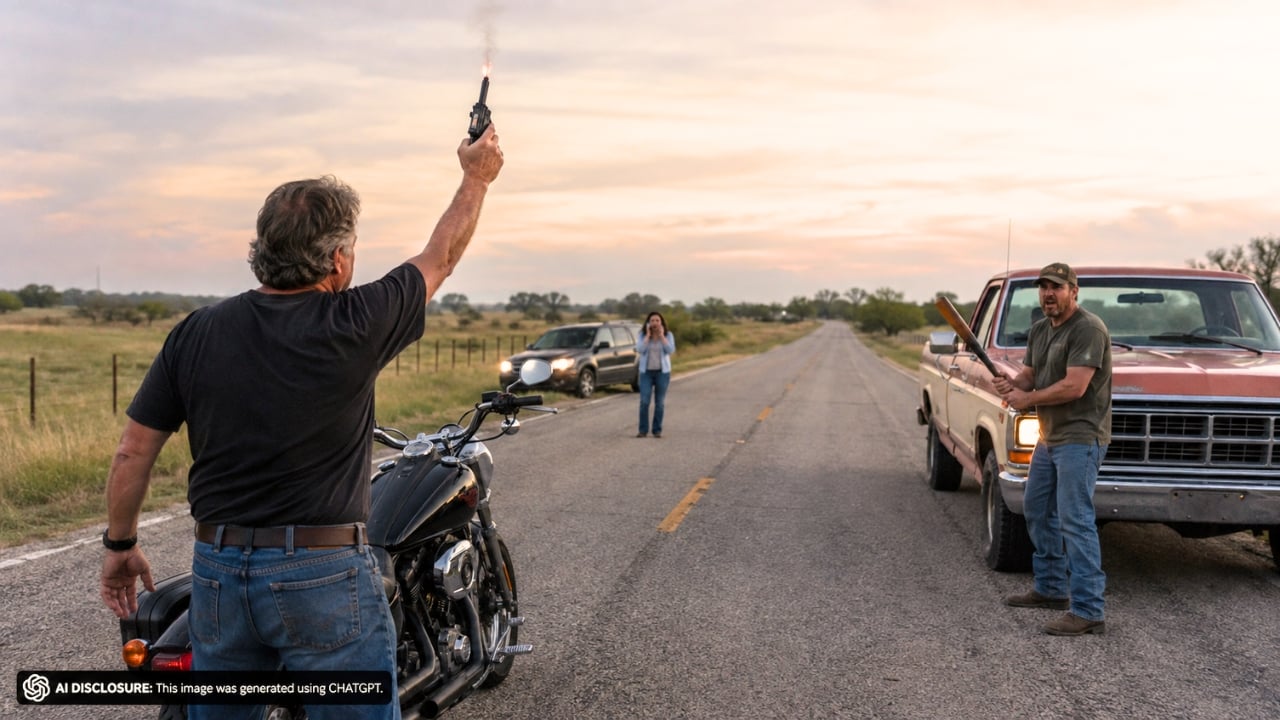
Photo credit: AI-generated image created using ChatGPT. Illustrative only
Out on a quiet country road, it doesn’t take much for a minor traffic mistake to turn into something uglier. In one recent account shared in the original post, a motorcyclist found himself in a roadside argument after he was nearly hit by an oncoming pickup that was allegedly riding the center of the lane.
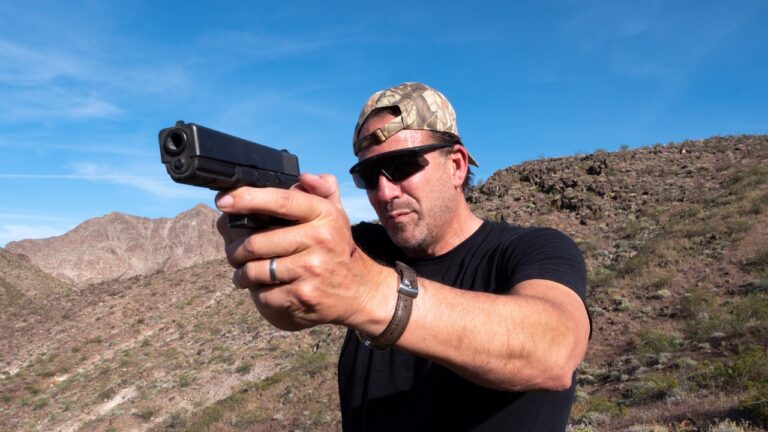
Both drivers stopped. Words were exchanged. Then, according to the story, the pickup driver went back to his vehicle, came out holding a baseball bat, and threatened to hit the motorcyclist and damage his bike. The rider—identified only as “Tom”—was carrying a Glock 17 with a legal concealed carry permit. He drew and fired one round straight up into the air. An onlooker saw it and called law enforcement.
A split-second “warning shot” with a long tail
Plenty of outdoorsmen grew up hearing some version of, “Shoot in the air to scare them off.” Folks say it about coyotes around the chicken coop, dogs chasing calves, even about two-legged threats when tempers flare. But the moment that muzzle points skyward and a shot breaks in public, you’ve stepped into a different world.
In Tom’s case, he wasn’t accused of shooting at the other driver. The issue was that he discharged a firearm in public—an act that, according to the post, could carry up to a year in prison. That’s the part people miss: even if the shot isn’t aimed at a person, it’s still a shot, and it’s still a projectile going somewhere.
“I didn’t shoot him” isn’t the same as “I did nothing wrong”
The story frames Tom’s shot as self-defense, or at least an attempt to stop an advancing threat without hurting anyone. But that’s a tough road in many places because self-defense generally isn’t built around warning shots. It’s built around immediate necessity—stopping a threat that you reasonably believe could cause death or serious bodily harm.
The prosecutor’s expected argument, as described in the post, is that firing into the air wasn’t true self-defense and that Tom didn’t actually believe his life was threatened. That’s not just legal hair-splitting. It’s how courts tend to look at it: if the threat justified deadly force, why didn’t you use it to stop the threat? And if it didn’t justify deadly force, why did you fire at all?
Out in hunting camp we talk about “muzzle discipline” like it’s a habit. In a courtroom, it becomes character evidence in the eyes of a jury—fair or not. A single round launched into the air can be painted as reckless, even if the shooter was trying to avoid bloodshed.
The bullet has to come down somewhere
This is the part that should give every shooter a cold feeling: nobody gets to call the bullet back. A 9mm fired upward doesn’t vanish. It goes up, it slows, and it comes back down—sometimes tumbling, sometimes retaining more speed than most people want to believe.
Even if nobody is hit, the “where did it land?” question hangs over everything. That uncertainty is exactly why “celebratory” shots and “warning” shots are treated harshly in a lot of jurisdictions. In the woods, you pick a backstop. On a road, there is no backstop—just farms, houses, cars, and whoever happens to be downrange of gravity.
The account also mentions onlookers. That matters. A bystander hearing a gunshot on a public road doesn’t know your intentions, your training, or whether the next shot will be level instead of vertical. Calls get made, statements get taken, and suddenly you’re not explaining the danger you felt—you’re explaining why you fired at all.
Ammo choice became another problem Tom didn’t need
As if the “shot into the air” part wasn’t enough, the post claims Tom’s pistol was loaded with “military-grade bullets” he’d bought online to “see the difference and try it out,” and he forgot to switch back to “regular bullets.” The way it’s described, that detail is now making his situation worse.
Setting aside the marketing language that gets thrown around in ammo ads, prosecutors and juries often react to anything that sounds exotic, extreme, or out of place. Whether the rounds were actually unusual or just branded that way, it’s one more thread for the state to pull on: why was he carrying that, what was he expecting, and was he looking for a fight?
For folks who carry daily, this is a practical lesson. Your defensive gun setup shouldn’t be a science project. The range is where you test oddball loads. On-body carry is where you keep it boring, reliable, and easy to explain—because you may someday have to explain it.
The road-rage context cuts both ways
Plenty of us have had close calls on back roads—someone drifting over the line, someone coming around a blind curve too fast, someone not expecting a motorcycle at all. Tempers spike quickly when adrenaline is already high.
But the moment both parties stop and engage, the “I had no choice” argument can get harder to sell. The account says the pickup driver retrieved a baseball bat and threatened Tom and his motorcycle. That’s serious. At the same time, choosing to stand there and argue instead of creating distance can be used against you later, depending on local law and the exact facts.
That’s not victim-blaming; it’s reality. In the outdoors we talk about avoiding bad situations before they bloom—walking away from a trespasser instead of squaring up, calling the sheriff instead of making a scene at the gate. Roadside confrontations are the same. You can be in the right and still end up with cuffs on if your decisions look avoidable in hindsight.
What people zeroed in on: get a lawyer and stop trying to “outsmart” the case
The poster said Tom hired a criminal attorney, but didn’t like the “pessimism” and wanted to convince him to find a different lawyer—possibly someone who “specializes” in self-defense firearms cases. That question comes up a lot any time a gun is involved: is there a special type of attorney who can make the problem disappear?
Even without seeing a pile of comments here, the common, practical focus in these discussions is that the attorney’s job isn’t to make you feel better. It’s to evaluate the law, the facts, the witnesses, and the likely charging decisions. A sober, cautious lawyer may be exactly what you need when the state is looking at prison time, not a pep talk.
Outdoorsmen understand this in other contexts. If your truck is making a bad noise, you don’t want the mechanic who says, “It’s probably nothing.” You want the one who tells you the real list of failures that noise could mean—and what it’ll cost if you ignore it.
And one more hard truth: once you fire a gun in public, you’ve given up a lot of control over how the situation is interpreted. Tom may have believed he was preventing violence. The state may see a man escalating a road-rage argument with a pistol. Either way, it’s not a do-it-yourself problem.
For the rest of us, the takeaway is plain. Don’t fire “warning shots” on a public road. If you’re in fear for your life, your goal is to break contact, get to safety, and call for help—not to send a round into the sky and hope the law, the witnesses, and gravity all treat you kindly.
Like The Avid Outdoorsman’s content? Be sure to follow us.
Here’s more from us: