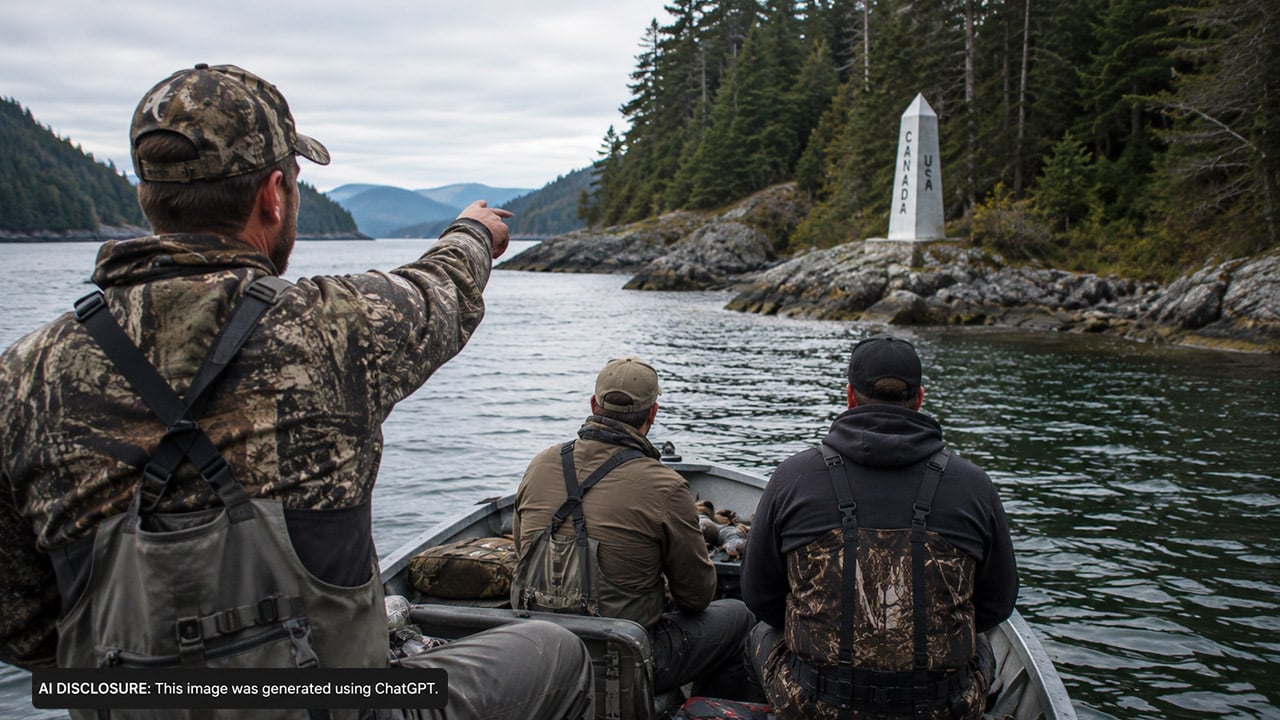
Photo credit: AI-generated image created using ChatGPT. Illustrative only
If you’ve ever booked a guided hunt—especially one that involves crossing a border—you already know the hunt isn’t the hard part. The hard part is keeping every single piece of it legal, clean, and defensible when the birds are on the strap and you’re headed home.
That’s why this case out of Washington is worth paying attention to. In a federal press release, officials laid out how a Washington guide and his company admitted to bird-hunting violations tied to a 2023 trip in western Washington, and he also acknowledged guiding waterfowl hunts in British Columbia in 2022 even though he wasn’t allowed to operate as a hunting guide under Canadian law. Here’s the original post with the government’s summary.
A guiding operation that didn’t stay inside the lines
The Justice Department says Branden Trager, of Brush Prairie, Washington, and his guiding company, Mayhem Services LLC, pleaded guilty in federal court in Tacoma to violating the Lacey Act. In the plea, Trager admitted that he and the company violated the Migratory Bird Treaty Act (MBTA) during a January 2023 hunting trip in western Washington, and then transported the taken birds in violation of the Lacey Act.
They also acknowledged a separate piece that will catch any waterfowl hunter’s attention: in 2022, Trager brought hunters into British Columbia, Canada, where he guided waterfowl hunts targeting harlequin ducks—even though he “could not operate as a hunting guide under Canadian law,” according to the release.
If you’re a paying client, that’s a bad place to be. Clients assume the guide is squared away on licensing, tagging, and the “small stuff” that turns into big stuff once a badge shows up.
Why harlequin ducks are a magnet for trouble
The harlequin duck is one of those birds that doesn’t take long to understand. It’s a small sea duck with a range that runs from Alaska down to California, and hunters prize it both as a trophy and because some folks chase all 41 North American waterfowl species.
That “checklist” appeal is exactly why harlequins can pull people toward the edge of the rulebook. The press release notes that Washington closed harlequin hunting for the 2022–2023 season, while limited hunting remained open in British Columbia. When a bird is closed at home but available nearby, the temptation is obvious—especially if someone is selling a trip built around it.
But “available somewhere else” only helps if you’re legal where you’re standing and legal when you cross back. Borders don’t forgive paperwork mistakes, and migratory birds come with their own set of rules on top of it.
The MBTA problems listed in the case are the same ones that burn hunters every season
The government didn’t just wave at “violations.” It spelled out the kinds of MBTA issues that show up again and again when people get sloppy or start trying to force a hunt to happen.
According to the joint factual statement referenced in the release, the MBTA prohibits (among other things): taking migratory birds using a motor vehicle; using a vehicle to concentrate, drive, or rally birds; taking birds in excess of daily bag limits; taking or crippling a bird and not making reasonable efforts to retrieve it; and transporting migratory birds belonging to another individual without tagging them. The release also notes that “taking” includes pursuing, hunting, shooting, wounding, killing, trapping, capturing, or collecting.
None of that is mysterious to most experienced duck hunters. But guided hunts add pressure: more guns in the spread, more moving parts, more people who are relying on the “pro” to call the shots. When the guide is the one pushing decisions—where to shoot, how to move, what gets carried and how—it can put clients in a bad position fast.
Where the Lacey Act bites: crossing borders with illegally taken wildlife
The Lacey Act is the part of this that should make every traveling hunter sit up straight. The Justice Department called it the nation’s oldest wildlife trafficking law and explained that it prohibits transporting wildlife that was illegally taken under federal, state, tribal, or foreign law.
That matters because once the illegal take happens, the problem doesn’t stay at the marsh. Moving birds across a line—state or international—can turn a “field” violation into something federal. In this case, Trager admitted the MBTA was violated during the January 2023 trip in Washington, and then the birds were transported in violation of the Lacey Act.
For everyday hunters, the practical takeaway is simple: the ride home counts. So does the cooler in the back seat. So does whose birds are whose, whether they’re tagged, and whether the birds were taken legally in the first place.
The money penalties are heavy, and the court-ordered message is unusual
Per the plea agreements filed in court, the recommended fines are $100,000 for Trager and $75,000 for Mayhem Services. Sentencing is scheduled for Oct. 16.
There’s another piece here that’s worth noting because you don’t see it every day in hunting cases: the parties also agreed to recommend that the court order the defendants to make a public statement. Specifically, it would express contrition and emphasize the importance of hunting, guiding, and wildlife regulations.
Whether you like that idea or not, it tells you how seriously the system takes guiding operations that allegedly cut corners. Guides don’t just represent themselves—they represent the paying hunters beside them and, in a lot of ways, the public face of hunting.
The investigation was a team effort, and that’s how these cases usually go
If you think crossing into Canada makes things “less enforceable,” this case points the other direction. The U.S. Fish and Wildlife Service Office of Law Enforcement led the investigation, with help from Homeland Security Investigations, the British Columbia Conservation Officer Service, and the Washington Department of Fish & Wildlife.
That’s a stack of agencies that don’t get involved because somebody forgot a pen. When wildlife issues touch international borders, it’s common to see more coordination, more records requests, and more patience from investigators who can take the long view.
And for hunters who travel, that’s the real-world warning label: the farther you roam, the more likely it is that a mistake follows you across jurisdictions—and gets reviewed by more than one set of eyes.
If you’re booking hunts, especially out-of-state or across the line, this is one of those stories that makes a guy slow down and ask boring questions up front. Is the guide legally allowed to guide there? What are the seasons on the target birds? How are birds tagged and transported? The answers might not make for fun camp talk, but they beat learning the hard way when the hunt is over and the paperwork begins.
Like The Avid Outdoorsman’s content? Subscribe to our newsletter so you never miss an article.
Here’s more from us: