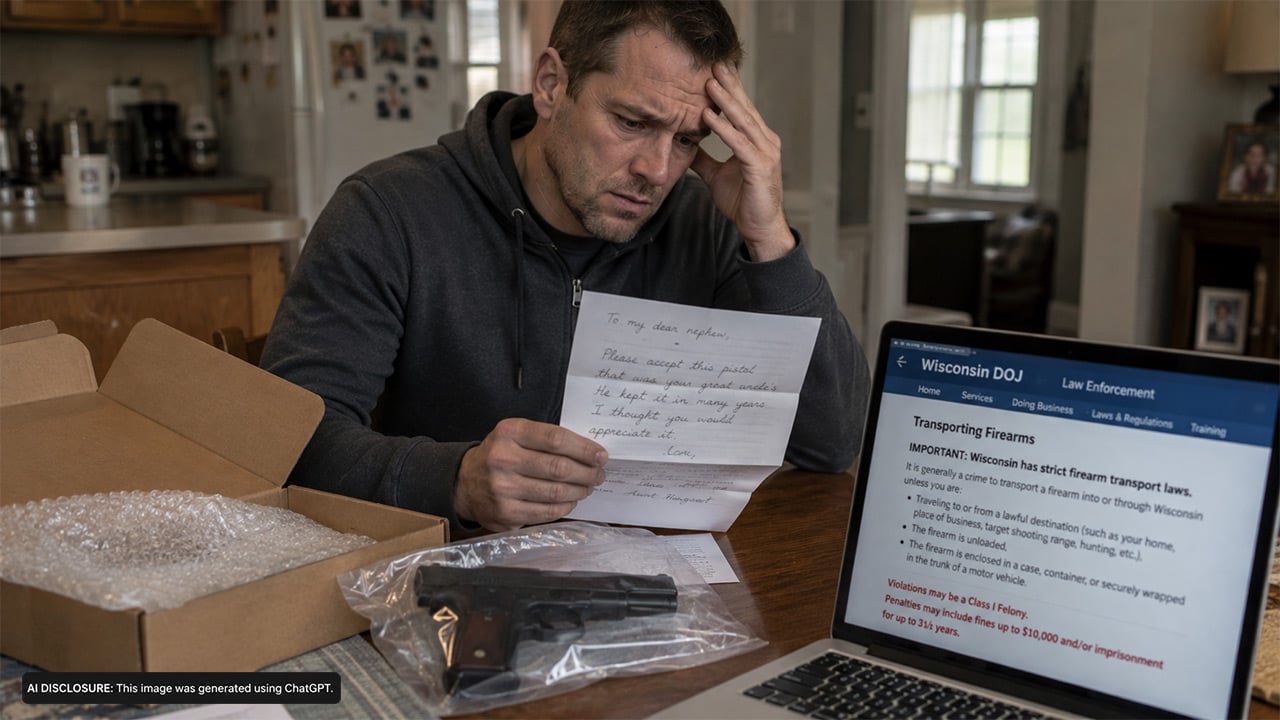
Photo credit: AI-generated image created using ChatGPT. Illustrative only
Most gun owners know the ugly truth about crossing state lines: you can do everything “right” at home and still get jammed up on the road if you don’t know the transport rules where you’re traveling. That’s exactly the rabbit hole one Illinois gun owner found himself in after his great-aunt passed away in Wisconsin and the family handed him her pistol.
In an update shared in the original post, he laid out the steps he took to make sure an inherited handgun sitting in another state didn’t turn into a major legal headache the second he put it in the truck and headed back to Illinois.
A family handoff turned into a cross-border problem
The situation was pretty common, at least on the family side. His aunt died in Wisconsin with no will, and there weren’t enough assets to go through probate. The pistol was part of what was left, and the family decided to give it to him because he was the only other family member “allowed to own a firearm,” and he lived in Illinois.
That’s where it gets real for outdoorsmen. It’s one thing to inherit a rifle that stays in the gun cabinet at deer camp. It’s another to take possession of a handgun and transport it across state lines when you’re already dealing with different rules on ownership, carry, and vehicle transport.
He started at the federal level and worked down
Instead of guessing, he went straight to the Chicago ATF office by email and explained the situation. The response he got was simple: unless the firearm was regulated under the National Firearms Act (NFA), they didn’t have legal concerns with him taking possession of it.
More importantly, the ATF firearms specialist didn’t just stop there. He provided contact info for a Wisconsin state trooper and an Illinois state trooper so the gun owner could verify the state-level rules that actually tend to bite people during traffic stops and routine encounters.
State police focused on transport, not the inheritance itself
When he called state police, he was told they had no issue with him taking possession. He noted he was 21 and had a FOID card, which made him legal to own a pistol in Illinois. From the Wisconsin side, the big point was that he was essentially picking up his own property.
But the part that matters for anyone driving a gun home is what came next: the transport rules were treated the same as if he had driven the gun to Wisconsin himself. In plain terms, he was told to transport it unloaded, locked up, and with ammunition and gun kept separate.
If you’ve spent time traveling to hunts, heading to the range, or bouncing between family properties, you already know how easy it is to get sloppy here. That “just toss it in the console” habit might fly on your own back roads, but it can get expensive fast when you’re crossing jurisdictions that don’t view pistols casually.
A classroom detail and some online noise sent him back to double-check
After that, he took a concealed carry course. During the class, he learned about a “10 year receipts rule for buying firearms,” which added another layer of concern in his mind about documentation and how long you should keep purchase records.
Then came the usual mix of advice and noise you get anytime firearms laws come up. He mentioned that someone chimed in with political name-calling, but also brought up something worth verifying: whether he needed to run the inherited pistol through a Federal Firearms Licensee (FFL) because it involved states.
That’s a fair question, and it’s one a lot of regular gun owners stumble over. People are familiar with using an FFL for buying and selling, but inheritance and gifts can feel like a gray area—especially when the original owner is deceased.
Two FFL calls, two dead ends—and a practical takeaway
To be thorough, he called two FFLs—one in Wisconsin and one in Illinois. The Wisconsin FFL told him they couldn’t “touch it” because he was a FOID card holder and not a Wisconsin resident.
The Illinois FFL told him they couldn’t do anything either, but for a different reason: for the dealer to provide a service, the pistol would need to change hands from one owner to another. Because his aunt was dead, he was told the pistol was technically already his, meaning there wasn’t a transfer for the dealer to process in the way people usually imagine.
What he was told next is the kind of nuts-and-bolts detail outdoorsmen appreciate. The Illinois FFL advised that the handgun was legally considered a gift and that he should keep a note of when it was gifted to him along with whatever original paperwork existed and his aunt’s concealed carry license.
His final summary was straightforward: in his case, the pistol was treated as a gift; both states indicated he could take possession, drive it home across state lines, and keep it in Illinois without extra paperwork, registration, or needing to use an FFL.
The real lesson: transport can be the trap, so make the calls before the drive
The inherited-gun part is what grabs attention, but the near-miss is the transport piece. The moment that handgun goes from “sitting in a house in Wisconsin” to “inside a vehicle headed for Illinois,” you’ve created the kind of scenario where one mistake—loaded gun, easy access, ammo riding alongside it—can turn into a long day on the shoulder of the road.
His best advice was also the most practical: call an FFL and call state police in every state you’ll cross through. In his experience, the people he spoke with were professional and understood he was trying to comply with the law, not skirt it.
If you’re an outdoorsman dealing with a family firearm—especially a handgun—treat that drive like you’d treat a first-time trip into unfamiliar public land. Plan ahead, confirm the rules with the folks who enforce them, and don’t assume that what’s normal at home will be viewed the same way one state line over.
Like The Avid Outdoorsman’s content? Be sure to follow us.
Here’s more from us: