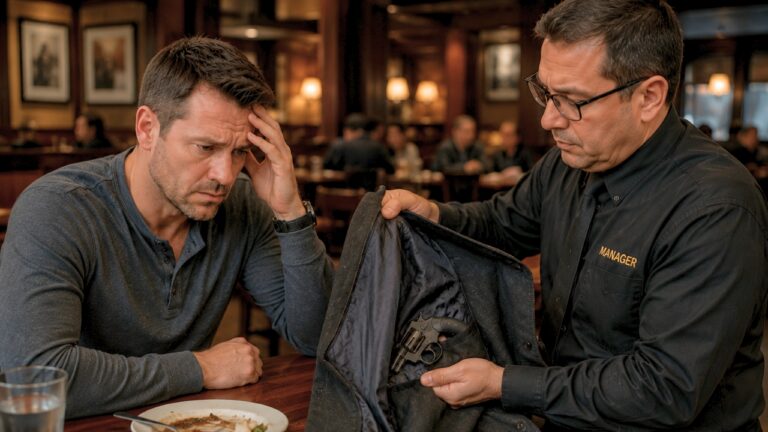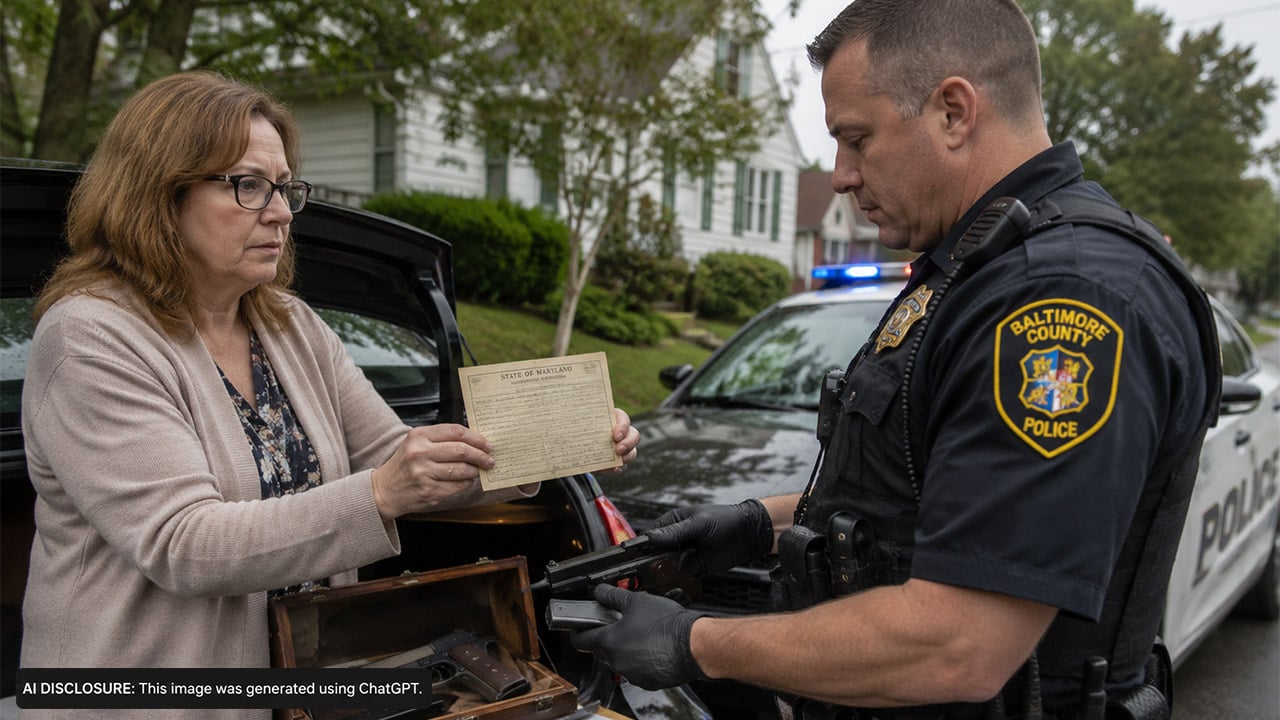
Photo credit: AI-generated image created using ChatGPT. Illustrative only
A lot of outdoors folks have an old family gun tucked away—something granddad carried in the field, something that’s been around longer than the truck in the driveway. In Maryland, one woman says that kind of heirloom turned into a nightmare after a late-night break-in, when a responding officer rejected her paperwork and walked out with the gun anyway.
Her account, shared in the original post, describes a burglary scare that ended with the intruder running off—but also with the homeowner watching an officer take her great-grandfather’s pistol under “suspicion” it was stolen, despite her showing what she believed was valid registration.
A home invasion scare, and a gun left in plain sight
The woman says she woke up around 3 a.m. to the sound of someone pushing her possessions around. Having been burglarized before as a teenager, she recognized the situation fast. With her boyfriend out of town and nobody else in the house, she grabbed her gun and stepped out of her bedroom.
She didn’t fire. She says the burglar either heard her door open or saw the gun and bolted immediately. Once she calmed down enough to think straight, she called the police.
Here’s a detail that matters: she admits she didn’t put the gun away when the officer arrived. She says she set it on her couch, across the room from the front door, and waited until she saw the patrol car pull up before putting it down. In the real world, adrenaline does funny things—but that moment set the tone for everything that followed.
When “registration” wasn’t good enough for the officer on scene
She reports the responding officer was friendly at first and called for additional help to check for fingerprints and document the break-in. Then she mentioned she’d scared the intruder off with her gun, and she says the officer’s demeanor flipped.
According to her, the officer repeatedly demanded a bill of sale. The problem was simple: she didn’t have one because the gun was a family heirloom passed down from her great-grandfather. She says she showed papers she believed proved the gun was legal and registered, but the officer told her that her registration “didn’t prove anything” and insisted a bill of sale was required.
That’s the part that will make most law-abiding gun owners grind their teeth. Plenty of firearms—especially older family guns—don’t come with a neat folder of modern receipts. They still aren’t contraband, and in most families the “paper trail” is a story, not a transaction history.
“Suspicion it was stolen,” and the gun leaves with the officer
The woman says the officer told her that without a bill of sale he would have to confiscate the firearm under suspicion it was stolen. She also describes him questioning why she had “a gun like that,” and insisting it was “way too much” for her to use.
She tried to explain it was a hand-me-down from an outdoorsy family. She says the officer didn’t buy it, told her he’d “look into it,” and took the gun.
Then the key moment: as the officer was leaving, other officers arrived and began talking to her again. In the commotion and stress, she says she got distracted and the first officer walked out with her gun.
Anyone who’s been through a break-in understands that fog. You’re rattled, you’re trying to answer questions, you’re replaying what could’ve happened. That’s also when details—like demanding a property receipt on the spot—can get missed.
No receipt, no mention in the report, and “no record” at the station
She says she waited, assuming the gun would be returned after the report was completed. A month passed. The police didn’t find anything on the burglary, and she got no word about her firearm.
So she went to the station with her copy of the police report. That’s when the situation, in her telling, went from bad to unreal: she says the report did not mention the gun being confiscated at all, and the station told her there was no record of it being taken.
She says an employee told her she would have “definitely gotten a receipt” if anything had been removed from her home, and that she must be confused. When she asked to speak with the other officers who came to her house—who might have seen the first officer leave with the gun—she says she was told no.
Whether this was sloppy paperwork, a breakdown in process, or something worse, you can see why a gun owner would feel trapped. If there’s no chain-of-custody record, it becomes her word against an empty file.
Why an heirloom gun makes this feel even dirtier
The woman says she started to believe the officer took the gun for himself. She describes it as an antique with potential value “to the right person,” and says she suspected the officer recognized that at a glance.
She also notes her particular firearm has distinctive nicks that would make it less attractive to sell, which is why the family still had it. But even a beat-up heirloom can carry value—if not at auction, then as a collectible, a wall-hanger, or something a person simply wants.
For outdoorsmen, the bigger issue isn’t just dollars. It’s the idea that a family firearm—something tied to a great-grandfather and a way of life—can disappear because an official decides your lawful paperwork “doesn’t prove anything.” That hits a nerve.
Practical options she was trying to figure out
She wasn’t asking how to start a fight. She was asking what she could do to pursue return of property she says was taken from her home by an officer. She specifically wanted to know whether she had a right to talk to the other responding officers, or what steps could force the issue.
From a common-sense, boots-on-the-ground perspective, there are a few practical lessons gun owners can take from her story. First: anytime an officer takes property—especially a firearm—ask for documentation right then. A receipt, a property voucher, a case number that specifically lists the item, and the name/badge number of the person taking it.
Second: separate “registration” from “proof you own it” in your own records, even if the officer should know better. Keep photos of serial numbers (where legal and safe), distinctive marks, and any family documentation you do have—old hunting photos, wills, letters, anything tying the item to your family history. It doesn’t replace a receipt, but it helps establish that this wasn’t something you grabbed in a parking lot.
Third: when the station tells you “there’s no record,” don’t let the trail go cold. The difference between a fixable paperwork mess and a permanent loss is often whether you act quickly and keep everything in writing.
In her case, the immediate problem was simple: she says the police report didn’t list the firearm, she didn’t receive a receipt, and the department denied having it. That’s exactly why outdoors folks should treat a property receipt like a tag on a deer—no tag, no proof, and you’re the one left explaining what happened.
If her account is accurate, it’s a hard reminder that owning guns responsibly isn’t just about safe handling and storage. It’s also about documentation and staying calm enough, even on your worst night, to make sure the system leaves a paper trail when your property walks out the door.
Like The Avid Outdoorsman’s content? Subscribe to our newsletter so you never miss an article.
Here’s more from us: