Photo credit: Theavidoutdoorsman.com
Backyard get-togethers are supposed to be simple: a grill going, kids running around, somebody telling the same old deer-camp story for the tenth time. But when gunfire cracks from the property line and rounds land where folks are standing, the whole night turns into something nobody forgets.
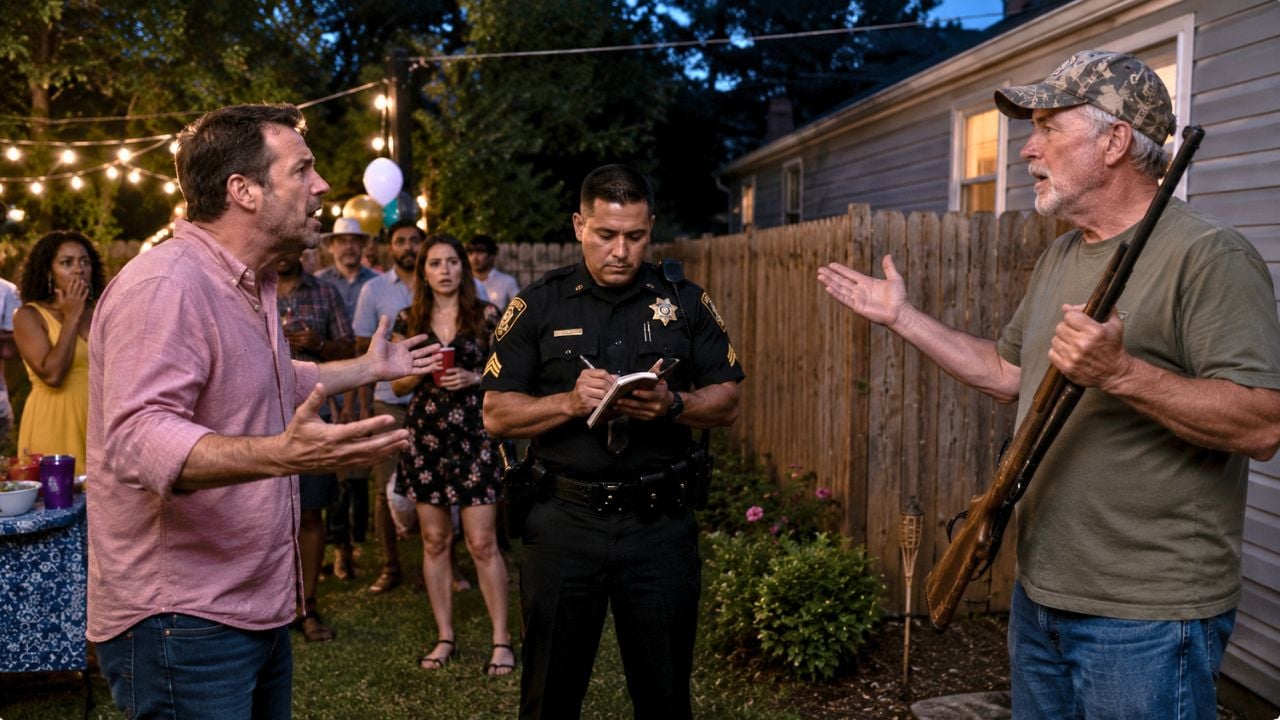
That was the scene at a recent neighborhood party where a homeowner and his guests heard shots and realized they were coming from next door—into his yard. The host did what most reasonable landowners would do: got everyone under cover, made a call, and started trying to figure out how in the world a neighbor decided his fence line was a safe direction to send bullets.
Party noise, a fence line, and a shot that shouldn’t have happened
The party was underway in a typical suburban-to-rural border setup—decent-sized lots, fences, and just enough space that some folks still think of their place as “country.” Music was playing, people were out by a firepit, and several vehicles were parked along the driveway.
Then came the shots. Not off in the distance like someone practicing on their own range, but close enough that multiple people looked toward the same section of fence. When the host realized the rounds were coming from the neighbor’s side and impacting in his yard, the focus shifted from “What was that?” to “Get everybody inside.”
In the outdoors world, we talk about muzzle discipline and knowing your target. But the rule that matters most here is the one you can’t argue with: you own every projectile that leaves your barrel. If you don’t have a safe backstop, you don’t shoot. Period.
The homeowner’s first move was the right move
It’s tempting in moments like this to march to the property line and “handle it” face-to-face. That’s the kind of decision that turns a bad situation into a life-changing one. Instead, the host gathered his guests, accounted for everyone, and contacted authorities.
He also did what more people should do in a world of doorbell cameras and backyard security systems: he started documenting. Not in a dramatic way—just a practical one. Times, the direction of shots, what guests witnessed, and any visible impacts in the yard. If you’ve ever dealt with a trespass dispute, a loose dog incident, or a property line argument, you know memories get fuzzy fast once stories start circulating.
On the gun side, documenting matters for another reason. A bullet hole in a fence, a strike in a tree, or a ding in outdoor furniture is physical evidence that tells a cleaner story than a heated argument ever will.
The neighbor’s counter-report leaned on a familiar excuse
Not long after the initial report was made, the neighbor reportedly filed his own complaint—claiming he was only shooting at a snake. That explanation pops up a lot whenever a shot goes somewhere it shouldn’t, especially in areas where people are used to seeing copperheads, rattlers, or water snakes around patios and landscaping blocks.
Here’s the thing: a snake in the yard is a real issue, and I’m not here to pretend they don’t show up in the worst places. But “snake” doesn’t magically create a safe shooting lane. A handgun round, a rimfire, even birdshot from a shotgun can skip, ricochet, or carry farther than folks think—especially off hard ground, rock borders, or packed clay.
If you’re close enough to identify a snake, you’re close enough to choose a safer tool. A long-handled hoe, a shovel, a rake, even a stout walking stick is a better answer in most neighborhood setups. And if you truly can’t dispatch it safely without sending lead toward a fence line, the best move is to back off, keep kids and pets away, and call someone who handles snakes.
Where the safety line is drawn in plain language
Most gun owners understand the basics: don’t shoot toward homes, don’t shoot over a road, don’t shoot without a backstop. But some folks treat a backyard like it’s a back forty. That’s where trouble starts—especially when a property has a slight slope or a line of trees that “feels” like a berm but isn’t.
Even if the neighbor truly believed he was shooting at something on his side of the fence, the moment rounds crossed into an occupied yard, the conversation changes. It’s no longer about nuisance wildlife. It’s about recklessness and endangerment—terms that carry weight because people get hurt when bullets go places they don’t belong.
There’s also the reality that parties involve alcohol sometimes, and investigators tend to take a hard look at the whole environment: time of day, lighting, sound, and decision-making. It doesn’t take much for “I was dealing with a snake” to start sounding like an after-the-fact explanation.
What people latched onto: cameras, property lines, and “safe direction”
Whenever a neighbor shooting incident comes up, the same practical comments bubble to the top. First: cameras. Folks want to know if the homeowner had a backyard camera catching the muzzle flash, the shot timing, or the neighbor’s movement. Video doesn’t have to show everything to be helpful; even audio can establish when shots occurred and how many.
Second: impacts and angles. Outdoorsmen who’ve patterned shotguns and tracked bullet strikes know that the physical evidence tells you direction. A strike mark in a fence board, a fresh scar in a tree, or a gouge in the dirt can help explain whether shots were level, downward, or skipping.
Third: boundaries and known shooting lanes. Many landowners keep a simple understanding with neighbors—where it’s safe to shoot, where it’s not, and what direction a “range” runs. When that handshake agreement doesn’t exist, or when somebody ignores it, you’re basically waiting on the first close call.
And finally, plenty of folks pointed out a hard truth: if you live close enough to have a privacy fence and you can hear your neighbor’s conversation, you don’t have a safe place to be firing at ground targets. A safe direction has to be more than “away from my house.”
The practical options after the dust settles
Once the initial response is over, the homeowner is left with a few unglamorous steps. Collect photos of impacts. Get written statements from guests while details are fresh. Save any camera footage. Repair damage, but document it first. If there’s a fence line, mark where the strikes occurred before boards get replaced.
From there, it often turns into a neighbor problem more than a gun problem. Some folks can sit down and set firm boundaries—no shooting within X distance of the fence, no firing in certain directions, and a clear agreement that wildlife issues get handled with non-firearm tools when homes are close. Others can’t, and that’s when restraining orders, civil claims for property damage, or a push for formal enforcement comes into play.
The outdoorsman lesson in all of this is simple and not comfortable: you don’t get to “wing it” with gunfire around people. If your property isn’t set up for a safe backstop, you either build a proper range that actually contains rounds—where legal—or you keep the shooting for the range and handle pests with tools that don’t put neighbors at risk.
One bad decision across a fence line can cost you your freedom, your finances, and your ability to own guns at all. It can also cost someone else their life. That’s why the safest shot is the one you don’t take when you can’t guarantee where it’s going to end up.