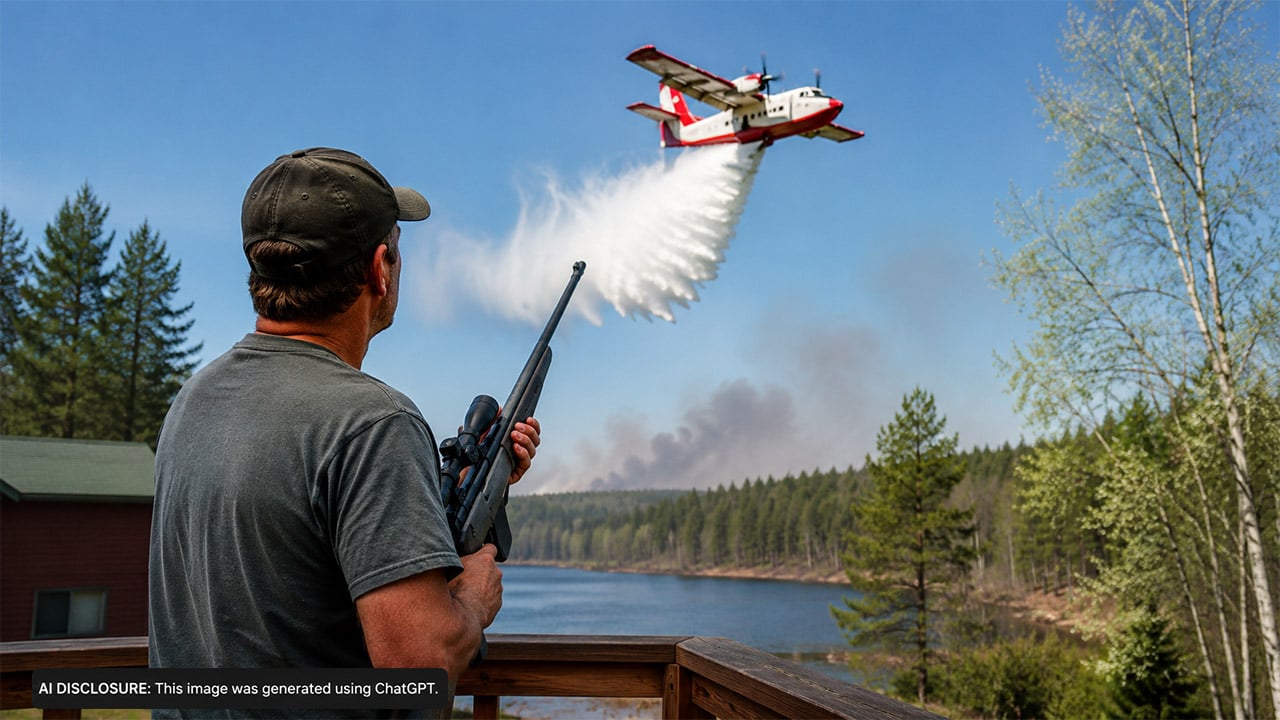
Photo credit: AI-generated image created using ChatGPT. Illustrative only
If you’ve spent any time in the North Country when the smoke is up, you know those aircraft aren’t joyriding. They’re working low, fast, and close to trees and water because that’s what the job demands.
That’s why this one out of St. Louis County hits different: investigators say a man fired multiple times at a wildfire-fighting aircraft as it ran a water-scooping pattern on a lake near Buyck, Minnesota—then later claimed he thought he was shooting crows. The details come from the original post summarizing the criminal complaint and investigation.
What the pilot noticed after the “pop”
According to the complaint, an investigator with the St. Louis County Sheriff’s Office responded to the Range Regional Airport in Hibbing around 7 a.m. after an aircraft used in wildfire suppression was reported damaged. The damage wasn’t subtle: oval-shaped holes on the rudder and trim tab with a “splattered-looking” appearance.
Investigators noted it didn’t look like a bird strike. That matters, because pilots do hit birds—especially when you’re working 500–700 feet above the ground and moving water on repeat. But holes and splatter patterns on a control surface are the kind of thing that gets everyone’s attention in a hurry.
A low, repetitive flight path that made it easy to pinpoint a shooter
The pilot told investigators the aircraft had been dispatched May 15 around 4:48 p.m. to a wildfire near Buyck. The flight path described in the charges is the typical scoop-and-drop routine: enter the east end of Kjostad Lake heading west, scoop water, then return east toward the fire.
He flew that pattern roughly 37 times. On the final run, while traveling about 130 mph and 500 to 700 feet above the ground, he heard a “pop.” At first he suspected a bird strike. After he got back and saw the damage, he believed it was from a bullet.
Because of the remote area—mostly summer cabins—authorities say they were able to narrow down where the shots likely came from along Kjostad Lake. That’s one of those realities rural folks understand: fewer houses can mean fewer witnesses, but it can also mean fewer possible directions a shot could’ve come from.
Neighbors heard shots timed with the plane’s passes
Deputies spoke with a couple at an address on Putrah Road. They told law enforcement they’d heard multiple shots while the plane circled the lake, somewhere between 6 p.m. and 8 p.m.
One man reportedly said he heard “bang” sounds every time the plane came around to gather water and even wondered out loud if someone was shooting at it—or if the sounds were coming from the aircraft itself. That timing is the kind of detail that tends to stick, especially when the same loud noise repeats in the same rhythm as an aircraft’s approach.
The suspect had a prior gripe about planes overhead
Investigators then suspected Daniel Christian Pettit of Orr. The complaint points to prior contact in 2024 where Pettit had expressed annoyance with planes flying over his home.
Anyone who lives under a flight path has had an eye-roll moment, especially during tourist season or when someone’s buzzing around. But wildfire aircraft aren’t sightseeing. When a lake is part of an active suppression route, those pilots are threading the needle to keep a fire from jumping the next line of timber or threatening cabins.
“Crow hunting” and the kind of statement that doesn’t help
Pettit, 48, is charged with second-degree assault and intentional discharge of a firearm for the May 15 incident, according to the source material. After being booked into the Hibbing jail, he allegedly told investigators he knew why law enforcement would be interested in him because he’d seen on the news it was possible he hit an airplane when crow hunting.
He reportedly said he’d been hunting with a 12-gauge and buckshot, and that he also had two pistols and two .308-caliber rifles. He claimed he believed he was following DNR regulations, and he also said “it was against FAA regulation to fly below 500 feet of a residential home.”
Then comes the quote that turns a bad situation worse. Pettit allegedly told investigators, “If I accidentally hit him crow hunting, too bad. He endangered my life,” while also claiming, “Did I aim and try and shoot the plane? Nope, no I didn’t.”
Here’s the plain outdoorsman reality: if you’re “crow hunting” and your shots are lining up with an aircraft run—enough that neighbors are timing bangs to each pass—something is way off. Even before you get into laws and charges, the basic safety rules don’t bend. You’re responsible for every round and every pellet, and “I didn’t mean to” doesn’t put metal back into a rudder.
What folks are zeroing in on: low flying, private property, and common sense
Even without a big stack of public reactions included in the source material, you can already see the fault lines people tend to argue over in situations like this: aircraft flying “too low,” the feeling that nobody asked permission, and the temptation to treat the sky over your place like it’s part of your property line.
But when wildfire operations are underway, the priority is stopping the fire. That means aircraft will be low, repetitive, and sometimes loud enough to rattle a cabin window. If someone truly believes an aircraft is unsafe or violating rules, the move is to document and report it through proper channels—not to step outside with a shotgun.
From a practical standpoint, shooting at any aircraft is playing with consequences you can’t walk back. Control surfaces like rudders and trim tabs aren’t cosmetic. Damage there risks the pilot’s life, the crew on the ground relying on those drops, and everyone living in the footprint of a fire that isn’t getting knocked down as fast as it should.
This is also a reminder for landowners and hunters: when you’re irritated, tired, or feeling boxed in by noise and activity, it’s time to slow down—not speed up. The woods have enough hazards without adding gunfire into an active aerial firefighting lane. If the complaint’s allegations hold, this is the kind of decision that can cost a man his freedom, his firearms rights, and a whole lot more—over something that should’ve been handled with a phone call instead of a trigger pull.
Like The Avid Outdoorsman’s content? Subscribe to our newsletter so you never miss an article.
Here’s more from us: