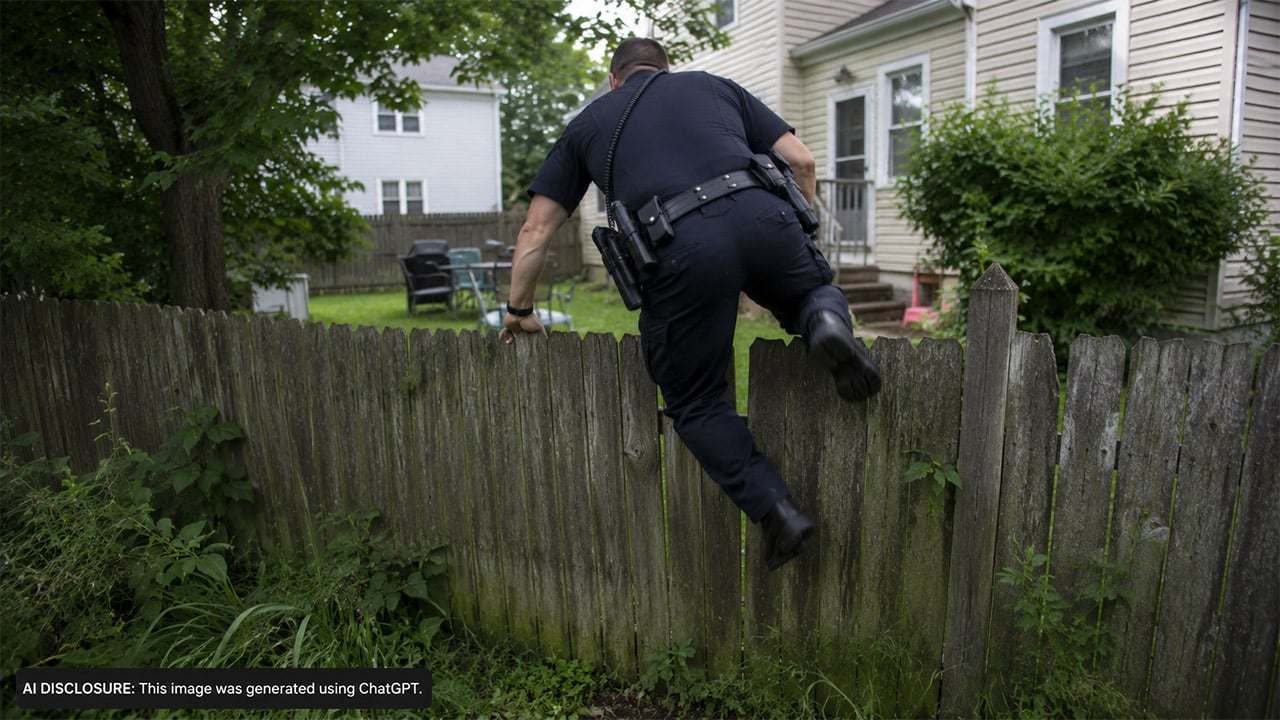
Photo credit: AI-generated image created using ChatGPT. Illustrative only
If you own a piece of ground—whether it’s a tight city lot or a back-40—you know the feeling of somebody being where they don’t belong. Fences go up for a reason. Dogs live on the property for a reason, too.
In Rochester, New York, that line got crossed in a way that ended with a family Labrador dead and a federal jury ordering a payout. The details come from the source post, which lays out the Oct. 19, 2018 incident and what the jury later decided.
A fenced backyard, a foot chase, and a second jump over the fence
According to court filings summarized in the report, Rochester Police officers were running an operation targeting suspected drug dealers in a neighborhood around 5 p.m. Two suspects ran, and one was detained in a backyard next to the home of Charles and Leona Dempsey on Kosciusko Street.
Officer Javier Algarin first entered the Dempseys’ fenced backyard and searched for about a minute, then left. That could’ve been the end of it. But after another officer suggested he “backtrack” through the yards to look for contraband the suspects might have ditched, Algarin jumped the fence and went back into the Dempseys’ yard a second time.
The moment most dog owners can picture
Seconds after Algarin re-entered the yard, Charles Dempsey opened his back door and let Tesla—his family’s black Labrador Retriever—outside. That’s normal life for a lot of folks: dog goes out, does dog things, comes back in.
The problem was Dempsey had no idea an officer was in his backyard. The report states Algarin didn’t knock or announce his presence. Dempsey watched as Algarin shot Tesla twice. After that, Algarin pointed the gun at Dempsey, according to court papers.
What the jury said was unconstitutional
A federal court jury awarded the Dempseys $125,000 after a trial held last week, with the verdict delivered Friday. The jury found the City of Rochester liable and found Algarin personally liable for violating the couple’s Fourth Amendment rights.
The jury determined Algarin conducted an unconstitutional warrantless search when he re-entered the fenced backyard. They also found he violated the Fourth Amendment by shooting and killing Tesla. On top of that, Algarin was found liable for intentional trespass under New York state law.
Why the city got hit too: policies and training failures
This wasn’t framed as a one-off mistake by one officer. The jury found the Rochester Police Department “maintained a policy, custom, or practice” that allowed officers to enter the curtilage of a single-family residence—basically that close-in area around a home—for the purpose of searching for discarded evidence, weapons, or contraband without consent, without a warrant, and without probable cause plus exigent circumstances.
The jury also found the city failed to train officers on lawful entry into residential curtilage, and that the failure amounted to deliberate indifference to constitutional rights.
On the dog-shooting side, the jury found a policy, custom, or practice permitting officers to use lethal force against household dogs during police encounters without first attempting non-lethal alternatives, and without an objectively reasonable basis to conclude the dog posed an imminent threat of serious bodily harm. They also found a failure to train on dog encounters that amounted to deliberate indifference.
The practical landowner takeaway: fences, dogs, and “curtilage” matter
Outdoorsmen deal with lines and boundaries all the time—property corners, posted timber, a gate you keep shut because cattle will find the one weak spot. A fenced backyard in town isn’t that different in principle. It’s still private space, and people expect it to stay private unless somebody has a lawful reason to enter.
This case also shows how fast a “routine” situation turns into something permanent when a dog is involved. Most dog owners know their lab isn’t a “police encounter.” It’s a family dog stepping out the back door like it’s done a thousand times. But if someone is in that space unannounced—especially someone armed—the risk goes through the roof in seconds.
There’s also a hard truth for anyone who keeps a dog for companionship or protection: your dog doesn’t get to choose the scenario it’s thrown into. If a stranger is suddenly in the yard, a dog can run, bark, or close distance, and the human with the gun is going to make a split-second call. The jury’s finding here was that the call—and the lead-up to it—violated the Constitution and state trespass law.
Seven years of litigation, and the bill isn’t finished
The shooting happened in 2018. The verdict came in 2026. That’s a long haul for any family to carry, especially over a dog that never should’ve been put in that position.
And the $125,000 award isn’t the whole financial picture. Under Section 1983, the city will be responsible for costs, expenses, and attorney’s fees tied to the seven-year litigation, with the amount to be determined by U.S. Magistrate Judge Mark W. Pedersen.
The Dempseys were represented by attorney Elliot Shields, who noted in a news release that prevailing on municipal liability claims under Section 1983 is “very unusual” because plaintiffs must prove the municipality itself caused the violation through policies, customs, or deliberate indifference to training needs.
If you’re the kind of person who believes good fences make good neighbors, this one lands heavy. The jury’s message was that jumping a family’s fence to search their yard—then shooting their dog—wasn’t just a bad outcome. It was unlawful, and expensive, and it didn’t have to happen.
Like The Avid Outdoorsman’s content? Subscribe to our newsletter so you never miss an article.
Here’s more from us: